|
Climate change's impact on India's business, tech, finance, & politics. Analysed and explained every Wednesday.
|
|
Good Morning Dear Reader,
I hope you enjoyed last week’s (and our first!) edition of Green Margins, a new weekly newsletter from The Ken. It is only one of seven brand-new newsletters we have launched, so if you haven’t had a chance to check them out, please do give it a go.
As we said in our first issue, Green Margins will bring you solutions-driven insights on everything climate, from climate tech and finance to climate policy. And like The Ken’s stories, it will be nuanced, facts-driven, agenda-free, and more importantly, accessible. Without alarmism or evoking guilt, it’ll keep you updated on how the wheels of carbon move every week.
And it will land in your inbox at 7 am India time every Wednesday.
Well, today is a Wednesday and the time is 7 am, so here we are with our second edition.
|
 |
When the SUV craze goes up, what comes down?
The U in SUV must stand for the ‘unflinching’ love of Indian drivers. Sport utility vehicles are a rage in India, outselling the once-popular category of hatchbacks. In September, SUVs outsold by a wide margin.
That love is not unrequited. Automakers are swiftly adding new models and, in the last week alone, at least four new SUVs were launched in India. Mahindra & Mahindra said it clocked 25,000 bookings in 57 minutes for its XUV upgrade XUV700—a milestone that no four-wheeler in India had achieved before. Toyota Kirloskar, Tata Motors, and MG Astor also each crowed about their new SUV’s impressive features, design, and variants. None had an electric variant, though.
SUVs have taken over our roads; it’s a global trend duly exported by the United States. And if these vehicles continue to ascend the mobility market like they have done so far, they will negate all the decarbonisation gains from electric vehicles.
In general, an average SUV emits 25% more carbon than the average car. In 2020, 29.6 million SUVs were sold globally compared to 1.9 million EV cars and 1.1 million electric SUVs.
In India, the SUV category has contributed to most of the growth in the last decade—30% between 2011 and 2020.
|
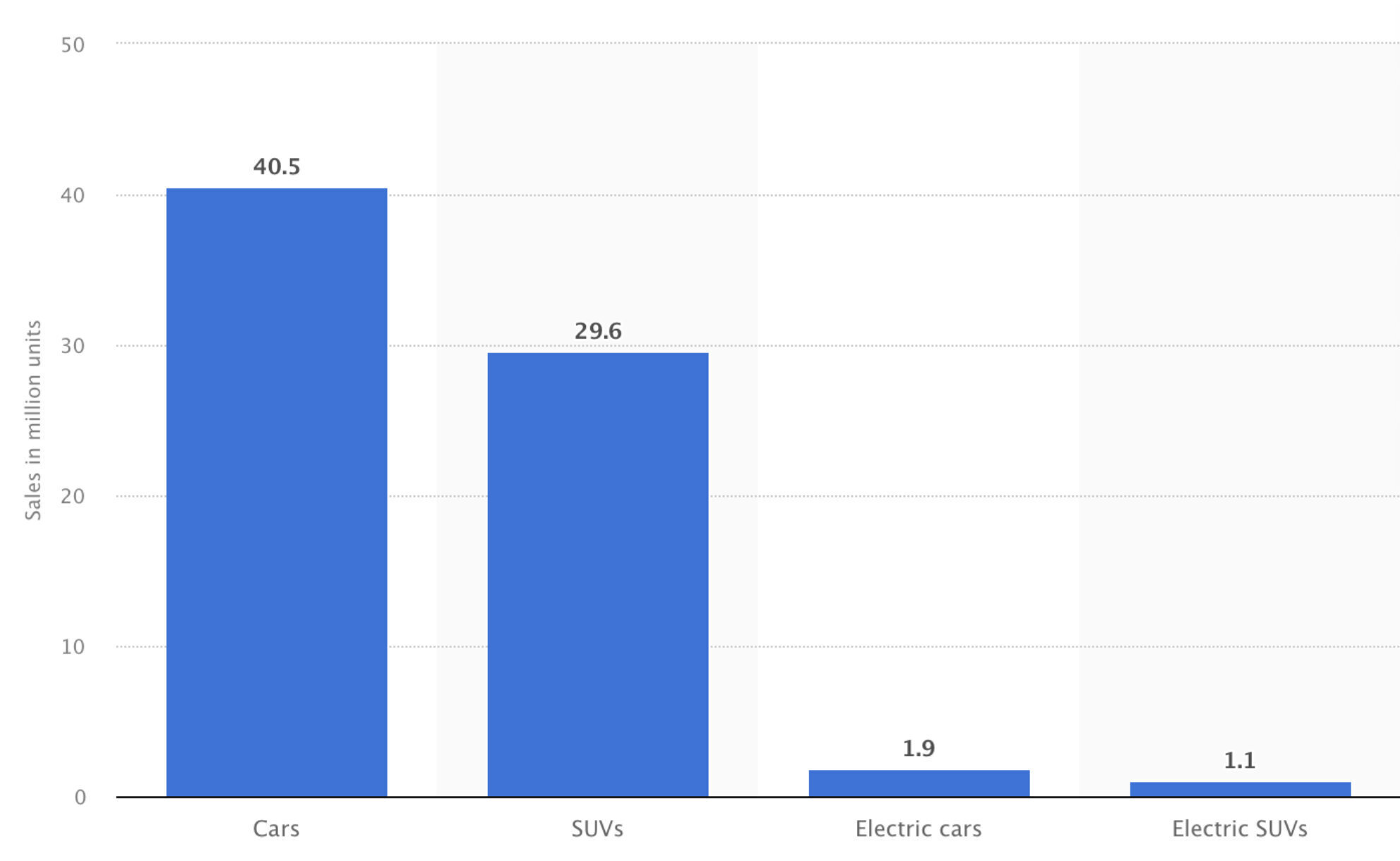 |
Global car and SUV sales in 2020. Source: Statista
While SUVs and Crossovers are getting a little lighter, say from two decades ago, they are still heavier than a sedan. “There are few features that add more to your automotive carbon footprint than the sheer weight you carry around,” says Vaclav Smil, professor emeritus at the University of Manitoba in Canada. Author of more than 40 books, Smil is one of the world’s foremost writers on energy, environment, tech, risk assessment, and public policy. He recently wrote:
|
There were some 250 million SUVs on the road in 2020. That’s several times more than enough to wipe out any decarbonisation gains that came from the 10-million-odd electric cars. In recent years, SUVs have been the second highest cause of rising carbon-dioxide emissions, behind electricity generation and ahead of heavy industry, trucking and aviation. If this trend continues, the additional SUVs on the road by 2040 could offset the carbon savings from more than 100 million electric vehicles.
|
The Age of the Car is gone, that of the SUV has succeeded, September
IEEE-Spectrum
|
|
|
Even Europe and China have fallen for the large-bodied vehicles.
This is not an SUV-bashing edition. Don’t get me wrong. I like to drive and have always aspired to own an SUV. (I guess that’s a relic from my early days in Bengaluru, when as a new reporter in the city, I’d often get lost in its famous one-way streets. I remember that two classes of drivers, in SUVs and BMTC buses, would glower at my clumsy driving. Secure in my little hatchback, I’d attribute their behaviour to their raised driving position, not to my annoying stop-start driving manners.)
There’s a lot to like about SUVs, especially when automakers are launching far more new models in this category than in sedans, the prototypical passenger car. But the fact is, SUVs are generally 15-30% less fuel efficient than sedans.
This rising demand for larger vehicles has led to “slackening, or in some cases even reversal, of national rates of fuel consumption improvements”, says a report from the Global Fuel Economy Initiative, a partnership between the United Nations, the International Energy Agency, and others.
|
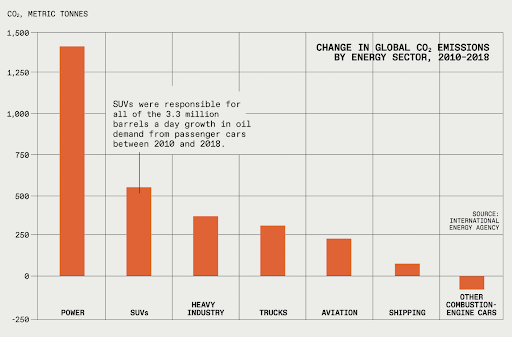 |
Source: International Energy Agency
In the midst of the fast-and-furious SUV launches last week, Naveen Munjal, managing director of Hero Electric, the market leader in electric two-wheelers, said something which most SUV makers wouldn’t like. In an interview to a business daily, Munjal said, “Government must set a target for phasing out IC [internal combustion] engines.”
Munjal is known for his counterintuitive and ‘electrifying’ steps. In 2001, he introduced India to electric bicycles and later carved out Hero Electric from the $8 billion automotive giant Hero MotoCorp (formerly Hero Honda). During the pandemic, he hedged his bets on the “unpredictable EV industry” for the third time and came out somewhat successful. He believes if the government gives a target for phasing out IC engines for each vehicle category, the automakers can work backwards on “the infrastructure, supply base, and vendors”.
Converting IC two-wheelers to electric is very different from converting four-wheelers into electric vehicles. SUVs are even harder to electrify than passenger cars because their larger bodies and powertrains require bigger batteries to crank out more energy. And even if there’s an electric variant in an SUV, it’s awfully expensive.
Consumer choice is colliding with climate concerns.
For governments, mandatory electrification is a policy option, but it requires a huge political will and an industry buy-in. Last year, China imposed a mandate on its automakers asking them to ensure that 40% of their sales come from electric vehicles by 2040. But there’s a high cost to such mandates. Researchers at MIT estimate the “transition cost to China’s society could equal 0.1% of the nation’s growing gross domestic product every year”. They write:
|
This move will expand the production of EVs and EV batteries enough to bring down the worldwide cost of both. Within China, annual sales of all vehicles will drop temporarily and then resume growing. The market share of EVs will expand as mandated, but many models will remain more expensive than their gasoline-powered counterparts.
|
|
|
I asked Smil if India or other countries could resort to similar mandates to phase out ICs. He thinks it really doesn’t matter what governments say because the reality makes it impossible to replace all IC vehicles with EVs for decades to come.
Between 1990 and 2020, the world's dependence on fossil fuels as the share of all primary energy fell from 87 to 83%, he says. “What would make you believe that in the next 30 years it will fall from 83% to ZERO?”
Well, I am optimistic but under no illusion that we’ll get near Zero.
“I myself do not and never will have an SUV, nor would I rush to buy an EV and have never argued that they should be mandated. Given the problems with both, I find an efficient small car, driven only when needed, such as my Honda Civic, the best option,” the Canadian professor told me.
But I’m not sure if consumers, who love the ‘utility’ of an SUV, and the automakers, who love the higher margins they offer, would agree with Smil. It boils down to individual choice. At least for now.
|
|
People don’t understand how much money you can make in things that people hate.
|
Josh Young, managing partner and co-founder of Bison Interests, the hedge fund. The fund is 377% up this year before fees. The exit of big institutional investors from oil and gas companies has left hedge funds as among the only buyers.
Hedge funds cash in as green investors dump energy stocks,
The Financial Times
|
|
|
|
The cost to go green is simply unacceptable even for the rich countries, not to mention middle-income countries like India. So, the path to salvation includes huge innovations like clean hydrogen or scaling up electric cars and trucks to a super high level to take over the way we presently do every one of those activities
|
|
|
|
Large gap still exists on climate action commitment of developed countries to provide $100 billion for developing. This amount is less than what NFL [National Football League, the professional American football tournament] earns on media rights
|
|
TS Tirumurti, India's Permanent Representative to the UN on Climate Action at UNGA76, Italy
|
|
|
|
Fish poop transforms ocean chemistry and can store carbon for centuries...We think this is one of the most effective carbon-sequestration mechanisms in the ocean. It reaches the deep layers, where carbon is sequestered for hundreds or thousands of year
|
Daniele Bianchi, UCLA
Climate scientists should pay more attention to fish poop. Really
Vox
|
|
|
Share this Edition
That’s it for this week.
Do tell me how you found this issue by writing to me at greenmargins@the-ken.com.
|
Here's the link to this edition for you to share. Or you can use the easy share buttons below
https://ift.tt/3v7h3nR
|
Take care.
Regards,
Seema Singh
|
Climate change's impact on India's business, tech, finance, & politics. Analysed and explained every Wednesday
Know someone who would like Trade Tricks?
Want to receive Trade Tricks every week?
|
|
Green Margins is published by The Ken—a digital, subscription-driven publication focussing on technology, business, science and healthcare.
|
Want to unsubscribe from our weekly newsletter, Green Margins? Click here. Or set your email preferences here
© 2021 The Ken
|
|
|
|
|

No comments:
Post a Comment
Note: Only a member of this blog may post a comment.