Wednesday, June 30, 2021

Fusion and Magic

Audio brought to you by Curio, a Lapham’s Quarterly partner

Not so long ago, at the start of 2007, the world’s population lived with a vivid technological divide. Half had a mobile phone: three billion people. Not quite a quarter used the internet. The phones were for talking. The internet required a computer. Wheelers and dealers—lawyers, agents, politicos—had BlackBerrys for emails, which they pecked on Lilliputian keyboards. But otherwise being online was a physically static condition. One surfed sitting still. The internet of the 2000s was an indoor child, happiest on the couch or behind a desk.

That changed the second week of that new year, when Apple CEO Steve Jobs teased the first iPhone from his jeans pocket, on a conference stage in San Francisco. Gaunt from the pancreatic cancer that would eventually kill him, he was nonetheless at the height of his powers as a technologist. The iPod, released in 2001, had been a phenomenon—a worthy follow-up to Jobs’ first great success, the original Macintosh computer, released in 1984. This new thing would be bigger than both, Jobs boasted. “Every once in a while, a revolutionary product comes along that changes everything,” he said from the stage. This was “three revolutionary products”: a phone, “a breakthrough internet communicator,” and a “widescreen iPod.” On a screen behind him, square pictographs of the trio spun into one another like a superhero changing costumes. “Are you getting it?” Jobs shouted while the audience tittered and then roared, wide-eyed at this shared moment of technological alchemy, of transmogrification, of near transubstantiation—all of which might sound purple except for everything that has come since.

It can be hard to recall now, but before Jobs’ black mirror, we were a species of button pressers. Nothing before came close to the iPhone’s fluidity and so seemed as much like the infinite tablet of a prophecy. Little surprise then that Apple has sold around two billion iPhones, making it among the richest companies in history, valued at more than $2 trillion. Forty percent of the world’s population now uses a smartphone. Democracy and truth have themselves been diverted by our phones’ pull on our attention, darkened in the shadow of our doom scrolling, unmoored in the weightlessness of our fiddling.

Occasionally, a singular technological leap changes what we expect from the world and the ability of human ingenuity to shape it. The iron horse of the railroad bent the geopolitics of the nineteenth century, just as the internal combustion engine, and the fossil fuel it requires, did the twentieth. It is a straight line from the Wright brothers’ 1903 biplane made of bicycle parts to the latest carbon-fiber Boeing. All defied what was then thought possible. Each seemed at first like magic, if of two different types. They start out nearly supernatural, a kind of witchcraft, but soon resemble stage magic, a refined trick built on years of practice and iteration. But whereas stage magic relies on sleight of hand, or some other subterfuge, the iterative magic of technology requires its inner workings to be revealed, exposed, and understood—in order to be refined, built upon, and made more marvelous and consequential. In An Enquiry Concerning Human Understanding (1748), David Hume notices that miracles no longer count as miracles when broadly seen. “There is not to be found, in all history,” he writes, “any miracle attested by a sufficient number of men, of such unquestioned good sense, education, and learning, as to secure us against all delusion in themselves.” Explanation ruins miracles. Familiarity deflates them.

Doing research on the web is like using a library assembled piecemeal by pack rats and vandalized nightly.

—Roger Ebert, 1998

Technological magic is persistent. It stands up to scrutiny. It recharges overnight, cruises at highway speeds, and offers cocktails and in-flight movies. But Hume was right about the first impression of a miracle, that initial surprise and delight. There is a threshold between when a technology has to be imagined and when it is real enough to hold in your hand—a moment when the magical becomes real, when dreamed-of things finally happen, when a machine carries you into the sky, or a new medicine polishes a rough edge of human frailty.

Over this past year of human buckling, I have found myself craving that extreme ingenuity, those marvels that arrive infrequently but decisively. For a decade or two, it has become clear how desperately we need new energy technologies to provide the warmth, light, movement, and stuff we demand without catastrophically warming the planet. But this year brought a more specific and more desperate need: a microscopic technology to teach the body to fight the coronavirus, and the industrial and scientific infrastructure to manufacture it and deliver it into human arms. As vaccines have arrived, spectacularly if unevenly, one is tempted to be boastful: science did this. It is easy to worry that the miracle is, again, short-lived. But it has also made me wonder, What further leaps might we see? What else might be possible?


On the evening of March 18, 1987, the American Physical Society, physicists’ century-old professional organization, was midway through its annual meeting when the scientists in attendance crowded the hallways of the New York Hilton, eager to elbow their way into the big second-floor ballroom for a special evening session. The year before, two physicists, J. Georg Bednorz and Karl Alex Müller, had discovered that certain compounds of ceramic materials were remarkable “superconductors” of electricity: electrons flowed through them without any loss. Whereas resistance had been a given for any conductor of electricity—including the aluminum and copper used in power wires—these new ceramics had none, even at temperatures significantly higher than earlier superconductors. Condensed-matter scientists like Bednorz and Müller typically keep a lower profile than the astrophysicists or nuclear physicists accustomed to holding the spotlight with grand pronouncements about the nature of the universe. But in this instance, with these new superconductors raising the prospect of fantastic new applications—levitating trains, electric cars, new imaging tools like MRIs—the field went into a frenzy. Physicists around the world hoping to replicate (if not exceed) Bednorz and Müller’s superconducting success began testing new combinations of materials, looking for an organic mix that could begin superconducting at higher temperatures. Using the Kelvin scale (which starts at the scientific constant of absolute zero, or −273 degrees Celsius), Bednorz and Müller saw superconductivity at the then shocking 35 K (or −238 degrees Celsius). Soon others were leaping ahead, finding new material that worked at 38 K, then 52 K. According to Douglas Scalapino, now a professor emeritus at the University of California, Santa Barbara, it was as if everyone were running a four-minute mile: “You could go to any track meet, and some guy was breaking it.”

In that pre-internet era, with the rate of discovery outpacing the scientific publishing process, physicists were ravenous for news of the latest breakthroughs. Three thousand of them crammed into the Hilton ballroom for the High Temperature Superconductivity Symposium, while hundreds more watched on TVs set up in the hotel corridors. In a marathon session that soon became known as the “Woodstock of physics,” fifty-one separate presentations went on until 3:15 am, with example after example of new superconducting feats. It became a singular event in modern science, its legend fueled by a Nobel Prize that year for Bednorz and Müller and a cover story in Time magazine (“Superconductors!”).

Much of the hype was premature. Since these new superconductors were ceramics, rather than metals, they weren’t bendable like traditional conducting wires but instead were as brittle as dinner plates. To be useful, scientists—or really, engineers—had to manufacture these superconducting materials so that they could be coiled and wrapped. The practical applications would have to wait far longer than expected—not years but decades.

Not until Bob Mumgaard finished his PhD in applied plasma physics at the Massachusetts Institute of Technology, in 2015, did one particularly promising class of high-temperature superconductors made with material known as ReBCO—short for rare-earth barium copper oxide—reach a point of new potential. “The thing that really mattered was you could see this material in an adjacent field get better and better,” Mumgaard says, leaning toward me into his webcam one morning in 2020. Superconductors made from ReBCO operated at higher temperatures (100 K) and could be readily deposited into thin films that could in turn be wound into astonishingly strong and efficient electromagnets. Superconducting magnets had been used in hospital MRI machines and in the grand scientific experiments of particle accelerators, including the Large Hadron Collider outside of Geneva. But Mumgaard, a nuclear physicist, had locked in on their potential to fulfill the grandest promise of his field: fusion.
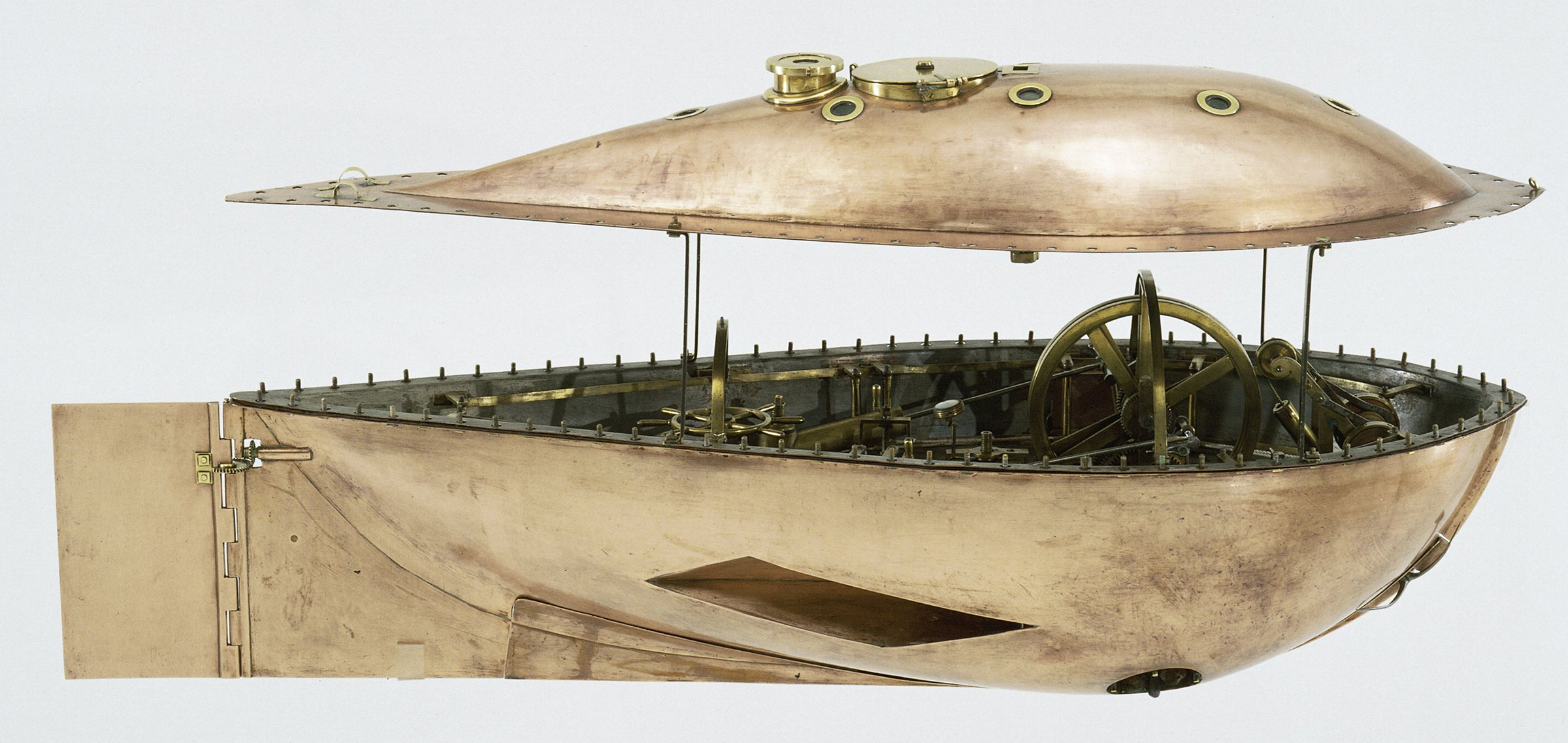
Copper model of a submarine, by Antoine Lipkens and Olke Uhlenbeck, 1836–39. Rijksmuseum.

The first extrasomatic energy source was fire, mastered by prehistoric societies 250,000 years ago. Pack animals provided ancient humans with an order of magnitude more energy. But not until waterwheels came into common use in the medieval era was there any common inanimate source to master. The Canadian historian Vaclav Smil notes that the Domesday Book records 5,624 water mills in southern and eastern England in the late eleventh century, one for every 350 people. Yet it would take another eight hundred years, into the Industrial Revolution, for their performance to be increased by another order of magnitude. Then things sped up. By the 1880s, the electrical system as we know it was recognizable, and crude oil began its rise to dominance for transportation. Ox by ox, water­wheel by waterwheel, engine by engine, the peak capacity of individual generating units rose approximately fifteen million times in ten thousand years, with more than 99 percent of that rise occurring during the twentieth century. Of those leaps, the most dramatic was nuclear fission, the breaking apart of atoms. Fission weapons shaped the century’s geopolitics; fission power plants still supply 10 percent of the world’s electricity.

Except now fission has run its course. In the wake of the Fukushima disaster, society’s appetite for nuclear risk has diminished. The costs of engineering even greater safety make fission power less economically viable compared to the falling costs of renewable sources like wind and solar. Averting further climate catastrophe requires broad policy changes—and some key new technologies. A step-change improvement in energy storage would open up new ways of using renewable energy, like solar energy at night and wind energy on calm days. More efficient ways of removing carbon from the atmosphere, at scale, might help change the climate again.

But the greatest potential for innovation—the closest thing to a technological silver bullet—remains fusion. Fusion is what powers the sun: a self-sustaining reaction in which isotopes of hydrogen at tens of millions of degrees fuse to form helium, releasing vast amounts of energy in the process. Fusion carries none of fission’s catastrophic risks. Its raw materials are abundant and safe, derived primarily from seawater. Its waste is minimally radioactive—more like what’s produced by hospitals than fission power plants. And there is no risk of meltdowns: when a fusion reactor’s power is shut off, its reaction stops.

The challenge is a different kind of control. Fusion reactions take the form of a roiling hot plasma, burning at more than 50 million degrees Celsius. Engineering its containment—putting “the sun in a bottle,” in a classic metaphor—has consumed scientists since the 1950s. The leading strategy is a type of reactor known as a tokamak, a doughnut-shaped chamber that uses electromagnets to hold the plasma in place. Since the tokamak was conceived in 1950, by the Soviet scientist Andrey Sakharov, the stumbling block has been finding magnets powerful enough to hold the plasma but efficient enough to require less energy than the fusion reaction itself creates. (Otherwise what, ultimately, is the point?) That’s where superconductors come in. “If you can figure out how to build a magnet out of this material, the material itself stops being the limit, and instead the engineering becomes the limit,” says Mumgaard. “And if you can do that, you can make small fusion reactors, and you can do that without having to have some big scientific breakthrough in plasma physics.” A working fusion reactor has been perennially out of reach. But a proper magnet made of superconductors offers a new path.

Inventor, n. A person who makes an ingenious arrangement of wheels, levers, and springs and believes it civilization.

—Ambrose Bierce, 1911

Mumgaard cofounded Commonwealth Fusion Systems in 2018, almost as soon as he deemed the technology ready for his uses. Throughout graduate school, he had kept a close eye on the progress of thin-film manufacturing, the process needed to shape superconducting ceramics into useful forms. For other thin-film products like solar panels and silicon computer chips, enormous economies of scale led to constant technological improvements. If the same could be done for ReBCO, then it could be worked and coiled into extremely powerful electromagnets—powerful enough, perhaps, to be fusion’s missing piece.

In 2021 Commonwealth will begin construction on a new headquarters campus, designed to accommodate the fabrication and testing of a two-step project. The first is a massively powerful magnet made with high-temperature superconductors. The second uses the magnet as the transformative component in a fusion reactor capable of producing more energy than it requires to operate. Called SPARC, it is especially remarkable for its relatively small size, with the entire unit taking up about the same space as a volleyball court. This is startlingly intimate in contrast with the grand scale of other fusion projects, most notably ITER, an international collaboration currently under construction in the South of France. Designed over decades, beginning in 1988, ITER’s tokamak doesn’t reap all the benefits of high-temperature superconductors, requiring its magnet to compensate with sheer size in order to generate enough force to contain the plasma. Its budget has stretched into the tens of billions of dollars (the precise number is a matter of considerable dispute). Despite beginning construction in 2013, its first fusion reaction is not expected until 2035.

For Mumgaard (and perhaps all of us), that is too late to be useful. On their current timeline, he and his colleagues hope to press a button that kick-starts a fusion reaction sometime before 2025. When they press it again, the reaction will stop. The net energy created will be the first glimmering light of—quite literally—a human-made sun. “We think it will be a really, really big deal,” he says with quiet understatement. “It’s already a big deal—fusion made all the atoms and all of us, right? It’s the most powerful thing in the universe: 99.999—all the way out—percent of all the energy in the universe starts with fusion.” Once that sun can be turned on and off at will, the challenge will be to extract its excess energy and package it into something resembling a power plant. Then build them, fast.


It is easy to be defeatist about climate change. The political dread of the past several years, the wildfires, the thawing permafrost, the unrelenting virus, make the specter of extreme disruption familiar. But to take just one slice of humanity’s challenge—halting the burning of fossil fuels—it seems possible, with a squint, to see this as a solution. Mumgaard likes to imagine the fuel truck backing up to the plant on the first day and pumping the totality of the hydrogen isotopes, delivered as a gas, required for its entire working life. No coal trains, no tank farms, no underground pipelines of rushing hydrocarbons. In the years following, one imagines, thousands of fossil-fuel power plants that dot the planet, emitting the gases that are cooking us all, can be replaced by thousands of fusion reactors. These would not displace the enormous progress already made with renewables but compensate for their limitations. To create a reliable electric grid exclusively out of variable generation—that is, dependent on the wind or the sun—means building the excess capacity required to cover calm or cloudy days, along with enormous batteries to cover the gaps and the nights. It is prohibitively inefficient. We need “dispatchable” power—easy on, easy off. Fusion could be that, and then some, eliminating (or minimizing) the need for nuclear fission, as well as fossil fuels.

A Cotton Gin, by Franklin G. Weller, c. 1870. The J. Paul Getty Museum, Los Angeles. Digital image courtesy the Getty’s Open Content Program.

If fusion works, the world will change. The hydrocarbons that established society as we know it will be replaced with a clean power source—a magic, at least for a moment, as if out of science fiction. (In the original Star Trek, first aired in 1966, the power source was described as a kind of fusion.) What then unravels? And what newly forms? Freshwater would be more abundant if the energy to desalinate it were, too. Absent the cost of power, more products and materials could be recycled economically, opening up new possibilities for circular material flows. It’s a tantalizing vision, and also totalizing. Fossil fuels have long been the scaffold of the global economy, but what happens when they are plausibly removed from the equation? “The two fundamental markets are human creativity and energy,” Mumgaard says—it’s the second of ten mantras by which Commonwealth guides itself. (Number one: “Energy and a livable environment are both fundamental human rights.”)

But what’s startling to me is that, as implausible as it sounds, transcendent, magical inventions have happened before. Fusion has always emitted the peculiar energy of magical thinking, even stranger as it gets closer to reality. What happens when the magical becomes real? When people fly through the air, when books light up with infinite knowledge, when energy is limitless? At the least there is hope in this space of possibility—this wide gap where reality and fantasy join. It is an abiding thrill of technology that there are moments when it asks us to look away from its externalities—from the conflict minerals, the emissions, the noise, the ad-supported models that suck our attention, destroy the livelihood of culture producers, and warp politics—and toward a miraculous, or just plain livable, future.

We are living on the knife edge of all that now. Will the vaccines beat the virus? Will the technological alternatives to fossil fuels come fast enough to limit the suffering—and perhaps the ultimate apocalypse—of climate change? The promise of technology is the possibility of all its little innovations, those miracles that become commonplace, to amount to the grand magic of ongoing life on earth.


from Hacker News https://ift.tt/3rBnrAx

For the Love of Troff (2020) [pdf]

Comments

from Hacker News https://ift.tt/2UgHsRN

A 1982 chess computer plays itself by mechanically moving the pieces [video]

Comments

from Hacker News https://www.youtube.com/watch?v=UxLd_wiGMA4

Handling errors with grace (and sometimes without it)

Reading Time: 6 minutes
On addressing the dangers that waddle into your way, whether you like it or not.

A year and a half ago I picked up Crafting Interpreters. The project guides programmers through building their own interpreters for the Lox programming language. I started writing a blog series about my progress. You can see all the posts so far right here.

In the last post, we dove into chapter 7 to write an interpreter with the visitor pattern. That’s all well and good when our Lox code is written correctly. But how do we handle the cases where it isn’t?

At the interpretation stage, two things can go sideways:

  1. Lox encounters an operator that it does not know about, like $ or #.
  2. Lox encounters an operator it knows about with operands that don’t associate with that operator, like "two heads" > "one".

In our interpreter code, we have to account for those. We can do that by executing the appropriate checks at the appropriate times and then bubbling up any issues through the Lox run loop.

1. Catching Issues

Remember in the last post, when we looked at this method exemplifying the interpreter’s expression evaluation?

@Override
public Object visitUnaryExpr(Expr.Unary expr) {
        Object right = evaluate(expr.right);

        switch (expr.operator.type) {
            case MINUS:
                checkNumberOperand(expr.operator, right); //we'll get to this later
                return -(double) right;
            case BANG:
                return !isTruthy(right); //we'll also get to this later
        }

        ...
}

I promised to get back to checkNumberOperand() later. As it turns out, that method looks like this:

    private void checkNumberOperand(Token operator, Object operand) {
        if (operand instanceof Double) return;
        throw new RuntimeError(operator, "Operand must be a number.");
    }

We have a similar check embedded inside the interpreter method visitBinaryExpr() to check that both operands are numbers when the operator is something that operates exclusively on numbers, like one of these: > < >= <= * / -

A common lament about error handling is that there isn’t really a good way to completely separate it from the operational code. It sort of has to embed itself in each expression that could receive an input that produces an undesirable output.

At some point, most authors and teachers who talk about software architecture come around to this in one way or another. I’ve heard two solutions that I find myself returning to time and time again:

  1. Avdi Grimm in Confident Ruby: Accept dealing with nonnominal inputs as an expected and necessary part of your workflow, and group it as much as possible at the beginning of a function’s work rather than littering it all over the code (blog post here). That’s what you see exemplified above: we check that the operand is a number as soon as we know that the operator is a minus sign. This is also the idea behind the guard clause pattern.
  2. Michael Feathers, Edge Free Programming: Find ways to turn nonnominal inputs into nominal, expected inputs to keep your code as streamlined as possible (blog post here with examples of how to do this). That might be, to use one of Bob’s examples, taking an operator Lox doesn’t use (such as + as a unary operator a la +123 being the same as 123) and add it to the operators we do parse, surfacing the message “Lox does not support the + operator for just one operand” as the default behavior in the same way the other operators get evaluated as the default behavior.

Though the second of those solutions sounds preferable to the first, I wanted to start with the more familiar example. Also, even if the second one sounds more preferable and clean, from a practical perspective I find that I don’t usually arrive at ‘good’ executions of the second solution until I have noticed patterns in how I’m using the first solution, or come back to a case where I used the first solution after having some time to think.

2. Surfacing Issues

So now we know there’s a problem. What do we do?

In the prior post, I mentioned that I would show where we’re calling the interpreter’s evaluate method in this post, since it includes error handling. Here it is, also on the interpreter:

void interpret(Expr expression) {
     try {
         Object value = evaluate(expression);
     } catch (RuntimeError error) {
         Lox.runtimeError(error);
     }
}

So, when checkNumberOperand() throws that RuntimeError, this will catch it and call our own runtimeError method in the Lox runner:

    static void runtimeError(RuntimeError error) {
        System.err.println(error.getMessage() + "\n[line " + error.token.line + "]");
        hadRuntimeError = true;
    }

We’re calling that interpreter method in the Lox run loop itself. Lox has a static instance of the interpreter, and when some code is run, it scans, parses, and then interprets our code with this static method:

    private static void run(String source) {
        Scanner scanner = new Scanner(source);
        List<Token> tokens = scanner.scanTokens();

        for (Token token: tokens) {
            System.out.println(token);
        }
        Parser parser = new Parser(tokens);
        Expr expression = parser.parse();

        // Stop if there was a syntax error.
        if (hadError) return;

        interpreter.interpret(expression); // <===== HERE!!!
    }

We don’t catch the error that might have been thrown here. Instead, we let RuntimeError surface that message you see above. Worth noting: RuntimeError is a class of our own, which is different from (and inherits from) Java’s RuntimeException. We did this to maintain control over what the message is and to make it clear that this is an error coming from Lox, not the underlying implementing language:

class RuntimeError extends RuntimeException {
    final Token token;

    RuntimeError(Token token, String message) {
        super(message);
        this.token = token;
    }
}

Like many of the Gang of Four patterns or, say, the implementation of a decorator in Python, the process of catching, and throwing error messages as we rise through the call stack just kinda looks gnarly until you get familiar with it. At least, that has been my experience with it.

The next chapter of Crafting Interpreters is called “Statements and State.” I haven’t looked at it yet, but I’m excited about it. Expect more soon.

If you liked this post, you might also like…

The rest of the Crafting Interpreters series

This post about structural verification (I’m just figuring you’re into objectcraft, so)

This post about why use, or not use, an interface (specifically in Python because of the way Python does, or rather doesn’t exactly do, interfaces)

Like this:

Like Loading...


from Hacker News https://ift.tt/3gWG7sT

The City, the Sparrow, and the Tempestuous Sea

Article body copy

This article is part of Birdopolis, a three-part series that explores the lives of birds that are, by accident or design, spending more time in urban environments. The other stories are “The Gull Next Door” and “Honolulu: A Seabird’s Surprising Five Star Destination”.

For insights into the urban lives of another group of coastal birds—gulls—watch the recording of our webinar “Birdopolis: Coastal Birds at Home in the City.”

Today, the name of the park preserve—Idlewild—seems aspirational. Snugged up against the northwest border of John F. Kennedy International Airport in the New York borough of Queens, population 2.2 million, the green space, approximately one-fifth the size of nearby Central Park, is a remaining sliver of the expansive wetlands that once carpeted the Atlantic coastline. It’s also some of the only habitat remaining for one of North America’s endangered birds, the saltmarsh sparrow. And in their little patch of wild, female saltmarsh sparrows are hardly idle. Undeterred as jets fly overhead every five minutes or so, females flit and dip through the grasses, hurriedly building nests so that they can lay their eggs and raise them to fully fledged chicks, all within one lunar cycle.

I’ve joined Alex Cook, a biologist at the State University of New York College of Environmental Science and Forestry (SUNY ESF), and her team of four in Idlewild this July 2019 morning, already steamy at 5 a.m., to learn more about their work and the saltmarsh sparrow. As we load up the gear, I notice the stark contrast between our knee-high rubber boots—mine, shiny black and newly purchased; theirs, mud-caked and sun-bleached—and rightly predict what the day has in store. Within 100 meters of entering the wetlands, I’m breathing loudly and heavily, trying to keep up with the all-female team skirting along a barely discernible path through the sloppy mud.

With each step the mud reaches halfway up my boots. The suction feels powerful enough to pull them off my feet.

“Don’t worry,” Cook says. “It’ll go over your boots by the end of the day. It’s inevitable.”

Eventually, I free myself and carry on into the marsh.

When I looked up the saltmarsh sparrow in preparation for this trip, I knew I wouldn’t be much help in the ID department. To me, the bird looked like an LBB, or “little brown bird,” the informal name birders sometimes use for any small brownish bird that is difficult to identify. Its picture showed lots of grays and browns, streaks and spots, but the white throat and the orange “eyebrow” seemed like good clues. I am in excellent hands with Cook and her team, though. Cook’s program at SUNY ESF has been studying the birds since 2011 as part of the Saltmarsh Habitat and Avian Research Program (SHARP), an umbrella organization that amasses data on tidal marsh birds for various research groups. And I’d certainly be excused for never having seen a bird so rare. Once, a population of 250,000 saltmarsh sparrows bred in a 1,000-kilometer-long strip of coastal wetlands from Maine to the Chesapeake Bay. Now, only an estimated 60,000 birds hang on in a few remaining pockets of breeding habitat.

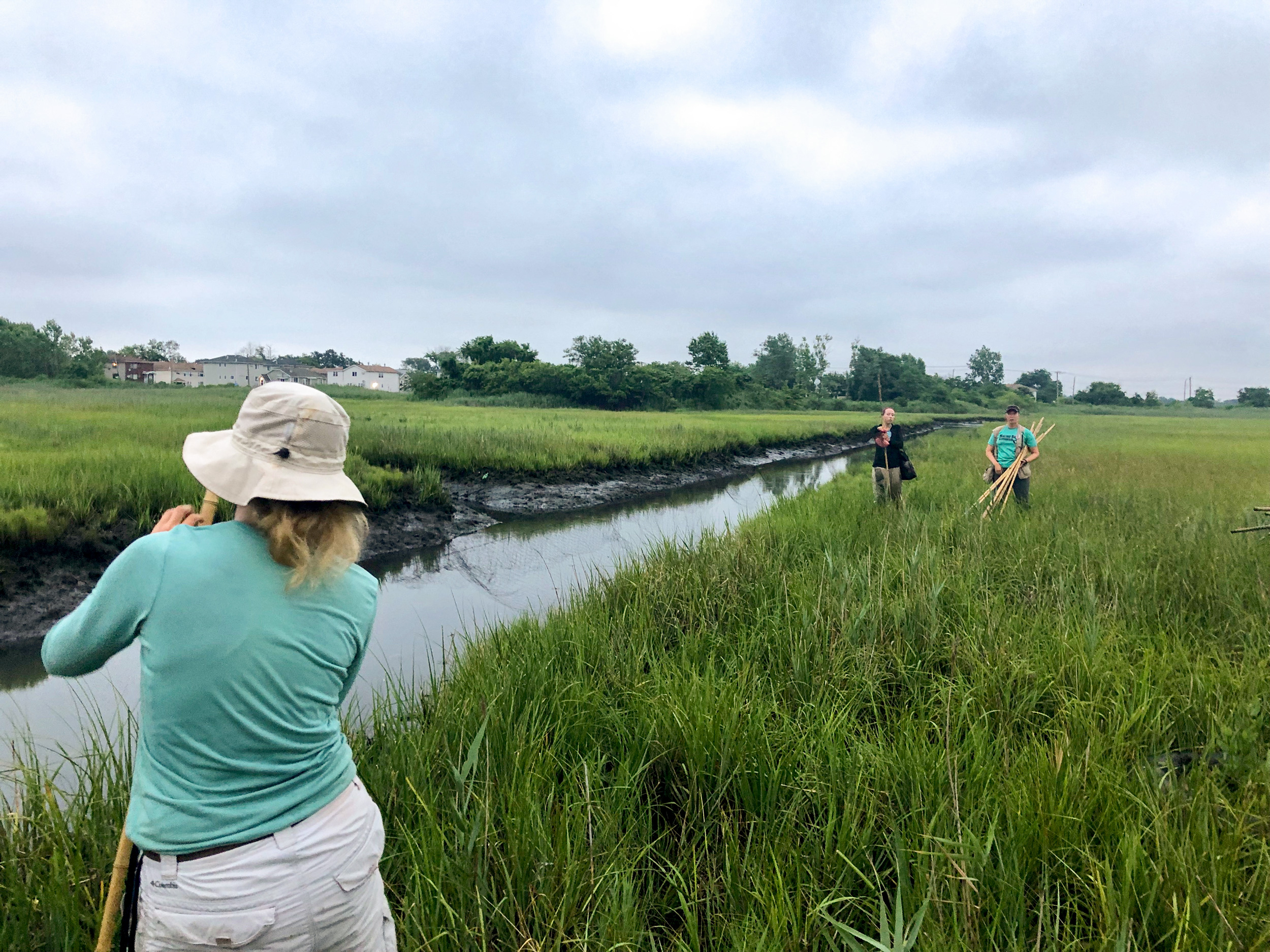
A team of researchers from State University of New York College of Environmental Science and Forestry (SUNY ESF) search for saltmarsh sparrow nests in Idlewild Park Preserve, New York City, New York

A team of researchers from the State University of New York College of Environmental Science and Forestry (SUNY ESF) search for saltmarsh sparrow nests in Idlewild Park Preserve, New York City, New York. Photo courtesy of Alex Cook

In addition to having specific breeding locations, saltmarsh sparrows also have a specific breeding time frame—one that is dictated by the movement of the moon around the Earth, and the tides this celestial dance creates. Because the sparrows build their nests exclusively in coastal wetlands that are susceptible to flooding, their reproductive cycle relies on this predictable sequence—they have carved out a niche to raise their young in these coastal wetlands between the lunar flooding that occurs every 28 days on the highest of high tides.

But global warming—with accelerated sea level rise, more volatile weather conditions, and even a shift in global wind directions that floods or dries out coastal wetlands—has disturbed this delicate balance. Habitat destruction has further whittled this already small strip of suitable breeding ground down to a sliver.

All of this leads to a bird with an uncertain future. In the last two decades, the saltmarsh sparrow population has declined by 75 percent, a shockingly precipitous decrease leading scientists to believe that within 15 years the saltmarsh sparrow could join the passenger pigeon and the Carolina parakeet on the list of birds of the continental United States that have been erased from the face of the Earth forever.


Carrying bags teeming with equipment—transponders, calipers, bamboo poles, folding chairs, umbrellas, water, food, a tarp, and thin netting bundled up in threadbare plastic bags—we push through hip-high mugwort plants and reeds that stretch over our heads into the hazy sky above. The marsh smell is a strange amalgamation of swamp stench—hydrogen sulfide, methane, sulfur—and jet-fuel exhaust. Likewise, there is a peculiar discordance of noise—pulsating airplane engines mixing with the sounds of nature. We set up a field camp on a patch of damp, tamped-down grass just a few feet from a canal. The canal water is interspersed with shimmering, iridescent oil slicks that capture the rising sun in psychedelic explosions of color. Waxy white patches slowly float out to sea like cartwheeling snowflakes. The humidity is thick enough to chew. It is barely daybreak, but already oppressively hot, as if the sun were boiling the marsh. Everything is soggy. If you stand too long in one spot, you begin to sink.

Despite the pollution, the airport, and surrounding development, the Idlewild Park Preserve remains a dynamic and vibrant ecosystem, teeming with vegetation, insects, and birds. The park is part of the greater Jamaica Bay wetlands, which are a renowned haven for over 325 species of birds—nearly a third of all species found in North America. As the researchers set up the field camp, I spot bleach-white great egrets, black skimmers, cedar waxwings, yellow-crowned night-herons, and red-winged blackbirds, to name only a few.

researchers setting up a mist net

The SUNY ESF team sets up a mist net. They will use it to catch saltmarsh sparrows and briefly retain them for measurements and banding. Photo by Joseph Quaderer

Once the roar of the jets momentarily subsides, we can hear the calls and songs of the many birds that live in the preserve. The saltmarsh sparrow call is conspicuously absent. Most birds, especially songbirds, sing to declare a territory or to attract a mate. But saltmarsh sparrows are not like most birds—they are notoriously promiscuous. Typically, avian parents pair up to take care of young birds. Occasionally, birds will have “extra pair copulation,” behavioral ecologists’ term for screwing around, but saltmarsh sparrows bring extra pair copulation to a new level—males mate with multiple females and females mate with multiple males. Because saltmarsh sparrows don’t form pairs, the males don’t need to be territorial. The females never sing, and the males’ only song is a mating call. As a result, they are naturally more muted than other species, but even those muted calls are getting quieter and quieter each year.

Wild birds are subject to a litany of assaults—attacks by domestic cats (estimated to cause between 1.3 and four billion deaths a year in the United States alone), collisions with buildings and windows (up to another billion), pollution, and habitat destruction. But nothing poses an existential threat to birds the way climate change does. In 2014, the National Audubon Society conducted a study on 588 North American species of birds and concluded that over half of that population will lose more than 50 percent of their current climatic range by 2080.

jet flying over researchers in a saltmarsh

Idlewild Park Preserve is adjacent to the John F. Kennedy International Airport, and wildlife in the preserve, and human visitors, are subject to a low-flying jet every five minutes or so. Photo by Anna Peel

One of the major consequences of climate change is an increase in the pace of sea level rise, which is currently increasing three to five millimeters per year on the eastern coast of the United States. Even though the world’s oceans are connected, sea level rise is uneven, with the eastern coast of the United States experiencing rises considerably faster and higher than the global mean.

Historically, in salt marshes such as Idlewild, gradual sea level rise wasn’t an issue because, among other things, the marshes had the capacity to expand inland, where conditions were more accommodating. But today, artificial barriers such as roads, buildings, and dams block this natural creep.

Sea level rise also affects how often salt marshes are flooded. There are multifarious types of grasses growing in the marshes and some are better suited than others to withstand these more frequent inundations. The increased flooding is affecting the specific grass the saltmarsh sparrow prefers to nest in. Ultimately, climate change is not only reducing the available saltmarsh breeding habitat size, but also its quality.


The verdantly green vegetation carpeting the interior of the Idlewild Park Preserve is beautiful—fields of long, swaying grass sigh in the salty offshore winds of the Atlantic. To the untrained eye, the salt marsh looks homogenous, but it’s a finely tuned ecosystem calibrated to even the slightest variances in elevation. Height above sea level affects the likelihood of an area being inundated with salt water, and that in turn affects the vegetation that grows there. Mere centimeters can demarcate which areas are considered “high marsh” or “low marsh.” The vegetation the saltmarsh sparrow nests in is supremely attuned to these nuances.

The saltmeadow cordgrass (Spartina patens), a wispy, hay-like species native to the Atlantic Coast, grows in higher elevations in the marsh that are less likely to flood with storm surges. It’s the favored nesting habitat for saltmarsh sparrows, but with global warming causing more volatile weather conditions and increased flooding, the saltmeadow cordgrass is declining.

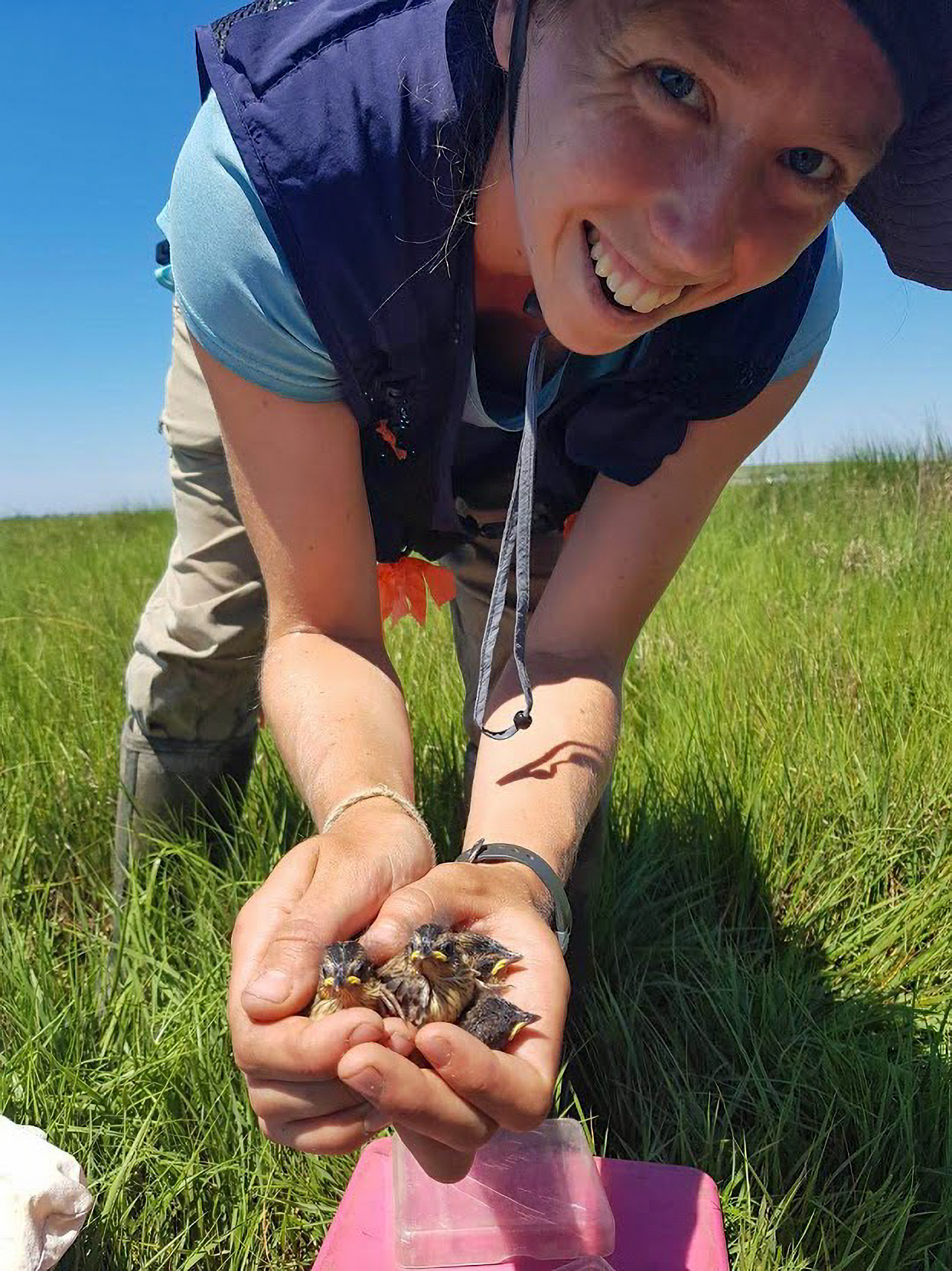
Alex Cook holding saltmarsh sparrow chicks

Biologist Alex Cook, lead of the SUNY ESF team, with several saltmarsh sparrow chicks briefly removed from their nest. Photo courtesy of Alex Cook

Cook and I trudge through the fields of saltmeadow cordgrass, sticking bamboo poles into the muck, and stretching thin black mist nets—finely woven nets that will be used to catch the birds—between them. Even though we’re at a relatively high elevation in the marsh, larger detritus deposited during storm surges peeks through the bursts of bright green grass: car and truck tires, some with metal rims; glass bottles—Johnnie Walker Black Label, Bud Light; and a once-black Valvoline oil container bleached gray by the sun. Throughout the marsh, the intersection of human refuse and natural bounty is omnipresent, yet perpetually jarring.

Closer to the tendrils of water—stretching like crooked fingers into the salt marsh—is the smooth cordgrass (Spartina alterniflora), a thicker, ribbonlike grass that can withstand more frequent flooding.

A few weeks later, I’ll meet with Chris Elphick, an avian specialist in the Department of Ecology and Evolutionary Biology at the University of Connecticut, in the salt marsh at Hammonasset Beach State Park to learn more about these grasses and saltmarsh sparrows, which he’s studied for 20 years. As we walk through the Connecticut salt marsh, our shadows long in the mid-July, late-afternoon sun, he tells me about a study he did in the early 2000s, in which he analyzed vegetation around the saltmarsh sparrow nests in nearly every major marsh system in Connecticut, around 60 study plots in all. When the same vegetation plots were resurveyed in 2013, everything had changed—across the board, the smooth cordgrass was more common, and the saltmeadow cordgrass was less common.

“So, the vegetation is shifting in a way that indicates the marshes are being flooded more often,” Elphick tells me.

Back in the Idlewild Park Preserve, as Cook and I walk through the marsh setting up the final mist nets, I note that the perimeter of the marsh is lined with the European common reed (Phragmites australis), which is invasive in American wetlands and is dramatically altering the sparrow’s already dwindling habitat. The hardier, more robust species, which grows to four meters in height, is not only altogether unsuitable for nesting, but it also hoards the sunlight and further decimates the grasses the saltmarsh sparrow can breed in.

“The vegetation for saltmarsh sparrows keeps getting worse and worse, but they’re still here,” Cook says as we set up the last mist net. “Either they’re adapting or they’re at their limit.”


Available vegetation dictates where saltmarsh sparrows breed, but the tidal cycles dictate when they breed. The highest spring tide, most likely to flood a salt marsh, occurs every 28 days. Saltmarsh sparrows have evolved to breed in between these flooding periods.

In the best-case scenario, it takes 22 days for the saltmarsh sparrow chicks to fully develop into functional birds and 27 days in the worst-case scenario. Because they primarily create their nests higher up in the marsh, in the saltmeadow cordgrass, the nests typically only flood during the month’s highest tide. If the salt marshes flood every 28 days, the mothers still have enough time to lay the eggs and the chicks have enough time to develop and fledge the nests.

But if the nests flood more frequently, it can be calamitous.

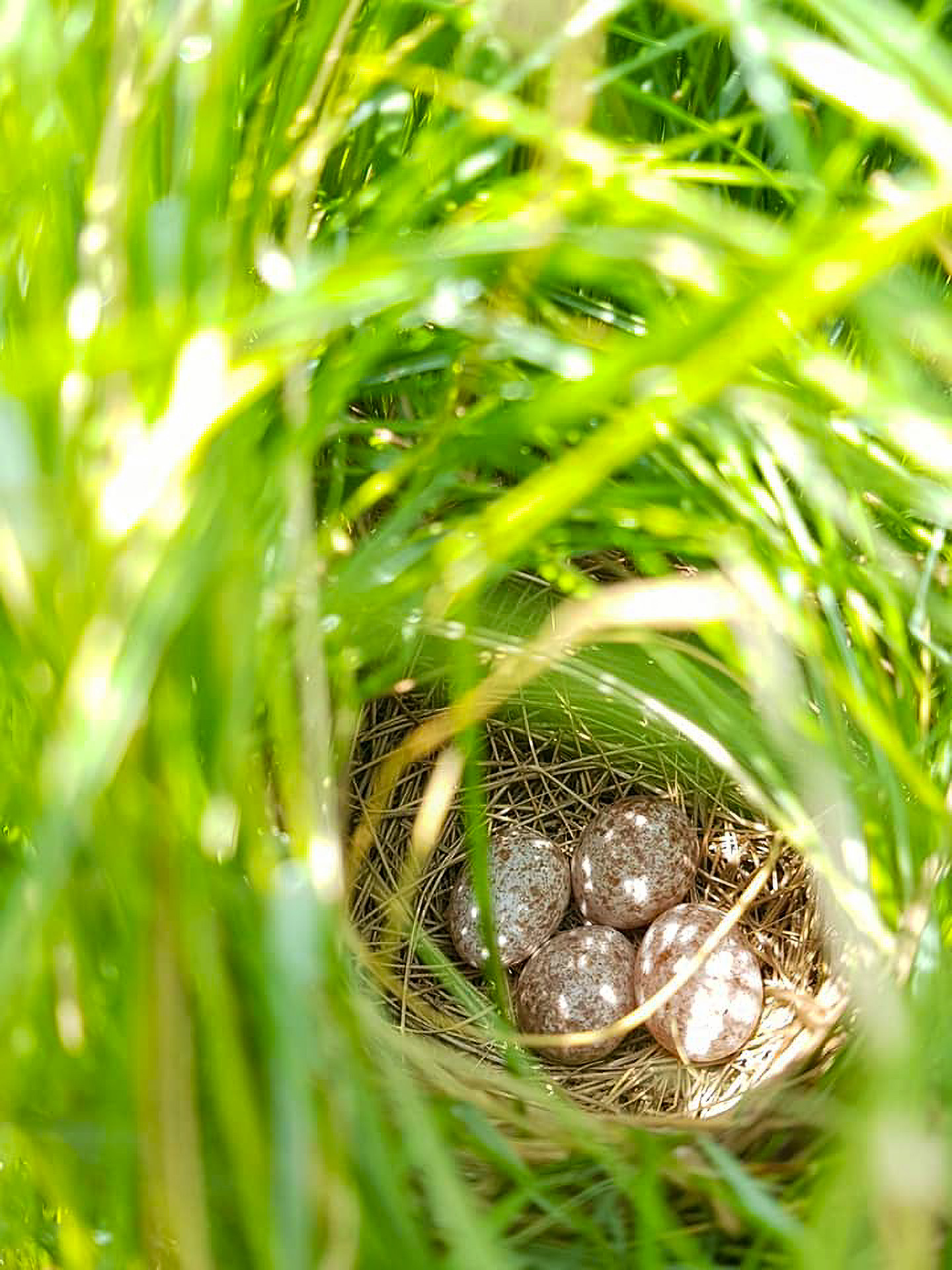
saltmarsh sparrow nest with eggs

Saltmarsh sparrow nests are particularly vulnerable to flooding. If the nest washes away on a high tide, the birds often try again—making a new nest, laying a fresh clutch of eggs, and seeing them hatch all within one lunar tide cycle. Photo courtesy of Alex Cook

During some spring tides or when there are storm surges—caused primarily by the strong winds in a hurricane or tropical storm, which have both worsened with global warming—the mother is forced to flee when the nest floods. Saltmarsh sparrow eggs can remain submerged for up to 90 minutes with no adverse consequences, but if they float out of the nest they die because there is no way for the mother to get the eggs back in the nest to properly brood them.

In 2009, Elphick worked with a graduate student whose study included locating saltmarsh sparrow nests in two Connecticut salt marshes. The student found over 200 nests at Hammonasset Beach State Park and another nearby marsh. But it was a wet and stormy year, with increased wind and flooding. The nests flooded so frequently that the saltmarsh sparrows never had enough time to raise their young. Out of over 200 nests, only about 10 saltmarsh sparrow chicks survived.

“There will reach a threshold when the flooding comes too often to allow the birds’ time to raise their young,” Elphick says. “After that threshold is crossed, the birds may have five or six years before they’re extinct.”


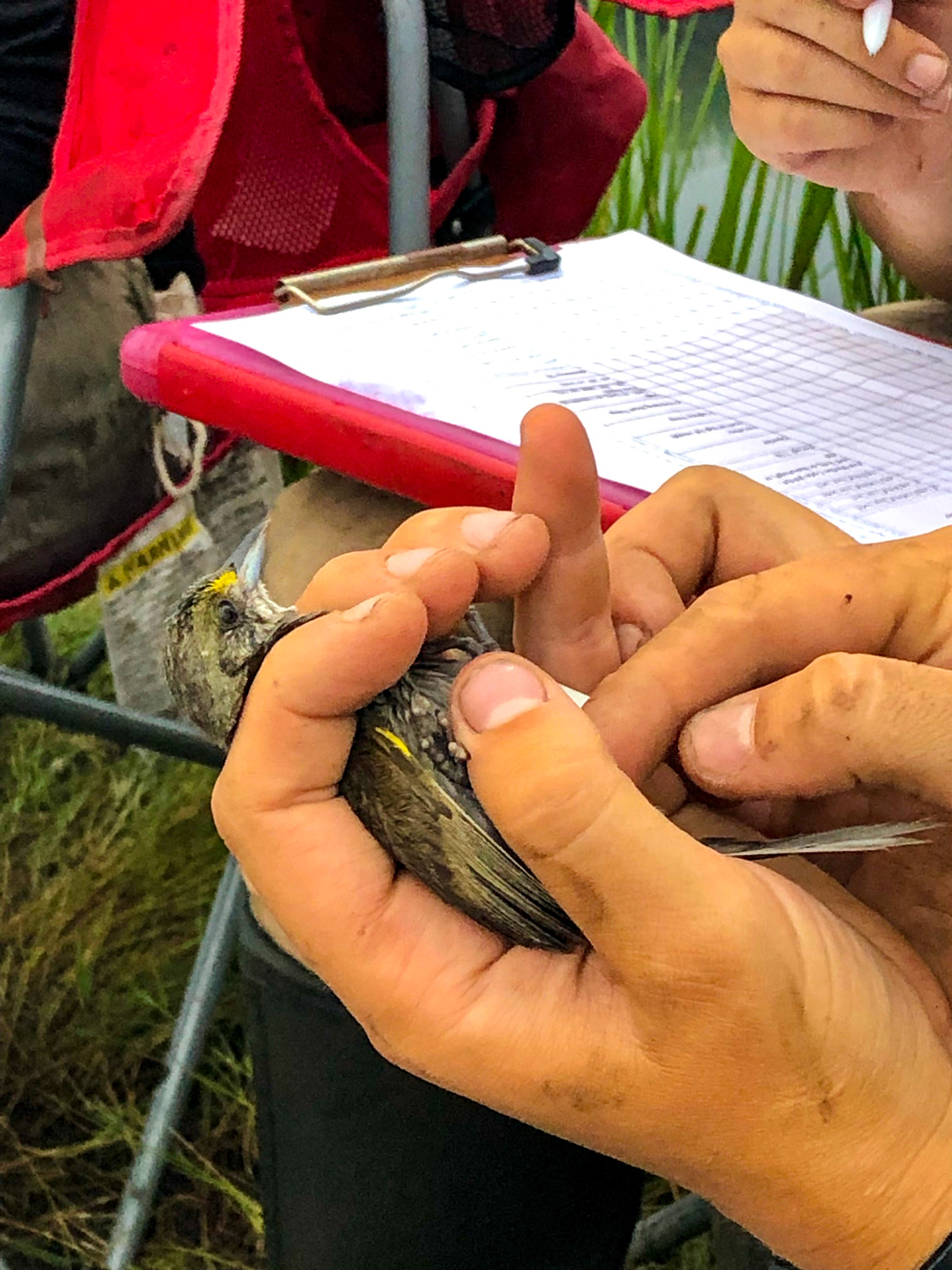
Thirty minutes after setting up the mist nets, we go back into the field, collect a half-dozen captured birds, and bring them back to camp. The researchers work quickly and systematically, recording the specifics of each bird. Using calipers, they measure obscure bird body parts: tarsus, wing chord, skeletal culmen, and nalospi. They poke a needle into a vein under each bird’s wing and use capillary tubes to withdraw fire truck–red blood for DNA and mercury testing. They place the birds in thin tan stockings to weigh them. All of this information will go to SHARP to help assess the strength and migratory habits of the population and note the development of birds they had previously examined.

After a brief lunch, the team sets out upon their second task of the day—monitoring the nests. Although each nest is marked by a fluorescent orange flag, they are still surprisingly hard to spot. We remain on the paths so we don’t step on the nests or wash out the eggs with the splashing from our boots.

Cook, technician Anna Peel, and I examine nearby nests while the rest of the team checks nests in the far corners of the salt marsh. Even though the researchers monitor the nests every three or four days, it still takes a bit of searching to find them. In addition to understanding which areas of the marsh and which types of vegetation the birds are selecting for nests, the researchers want to gather information about the specifics of each nest.

researchers measuring saltmarsh sparrow

The SUNY ESF research team quickly takes a suite of measurements on a saltmarsh sparrow caught in a mist net. Photo by Joseph Quaderer

First, we come across an abandoned nest. While Cook stands with a clipboard waiting to record information, Peel crouches down—her multi-pocketed field vest chock-full of scientific equipment brushing against the top of the grass—and sets up a one-meter perimeter around the empty nest, gently burrowing a measuring stick into the grass and thatch. Then she uses another measuring stick—green and barely thicker than a drinking straw—to note the average height of the grass and thatch.

We continue walking and spot another palm-sized nest nestled deep in the grass. Although we approach cautiously and gently, the mother flees before we ever see her. Furtive creatures. At active nests, the researchers move quickly to minimize the disturbance for the mother. Peel peeks into the nest to see how any fledgling birds or eggs are faring.

Saltmarsh sparrow clutches typically contain three to five eggs. This nest has one hatchling, a tiny featherless creature with its eyes still glued closed. Cook briefly removes it and colors its leg red with a harmless marker so the other researchers would know it has been discovered and recorded. She holds it for me to look at. The bird is calm and quiet. At the second active nest, she counts one egg. She plucks it from the nest and cups it in her palm to gauge its temperature.

“It’s cold,” she says. That means it’s dead. Cook is matter-of-fact when noting this. It’s not something she wants to see, but with the tide rising this morning the team needs to work quickly and there’s no time to linger. The third active nest has four live eggs. The last has three cold eggs: two in the nest and one on the ground. Cook gathers the three eggs and places them in my hand. They’re small—like oblong marbles—and beautiful, with a terrazzo-like pattern of tan and caramel splotches.

The cold eggs—which researchers are finding more and more these days—are collected in an empty Skippy peanut butter jar for another scientist in SHARP to examine. The field crew calls it the jar of death. “It smells like death,” Peel says as she unscrews the lid, arching her face away to avoid its repugnant odor.

A newly hatched saltmarsh sparrow chick

A newly hatched saltmarsh sparrow chick. A dab of red is added to its leg, so it won’t be counted again during other studies. Photo by Joseph Quaderer

In recent years, some of the nests have been fitted with chrome-plated, nickel-sized thermometers set to automatically record the temperature every 15 minutes, like an airliner’s black box. The aggregated data from the thermometers has not been analyzed, but the heat tells the story of each individual nest. An active nest is almost constantly warm. The mother broods on it, keeping it a steady temperature day and night, with only slight fluctuations for 20 to 30 minutes when she needs to leave the nest to feed. If the transponders show a temperature drop that lasts an hour or two, it means the nest was underwater. If the flooding isn’t too extreme, and the chicks don’t drown or the eggs don’t float away, the mother will continue to brood after the flooding subsides. But if the chicks drown or the eggs float away, the mother will abandon the nest. In studying all this information, scientists have determined that nests can flood up to nine times and the eggs still hatch and that a variance in nest height of six centimeters can be the difference between a successful and a flooded nest.

But even if flooding does wipe out all their young, saltmarsh sparrows get right back to laying eggs. Elphick tells me that he doesn’t think female saltmarsh sparrows can somehow divine where they are in the lunar cycle when they start laying eggs. Rather, they arbitrarily start their reproductive cycle, and if it’s not in sync with the lunar cycle, the flooding will likely wipe out the nest. Undeterred, as soon as the flooding subsides, they’ll start laying eggs again—this time perfectly synchronized with the lunar cycle and with a full 28 days to raise their young. It’s a brutal yet efficient way for these tiny birds to harmonize with the moon spinning around the Earth.

At 11 a.m., Cook, Peel, and I head back to the field camp. High tide is just 30 minutes away, and we don’t want to be splashing around with big boots, creating waves that could lift the eggs out of their nests.

The water level has risen nearly a meter, and the desiccated canal behind the camp has become a teeming rivulet. A flock of Canada geese in the canal, debating whether to come ashore, suspiciously watch us as we fold chairs, wrap bungee cords around the bamboo poles, load the scientific gear into bags, and roll up the muddied tarp.


As we’re preparing to leave the salt marsh, my mind drifts back to the eight eggs we found, half of which were added to the jar of death. I wonder what the next tide will bring for these beleaguered creatures.

When I meet with Elphick in Connecticut, he tells me that the clichéd metaphor of a canary in the coal mine is very applicable to the saltmarsh sparrow’s saga.

“The point is not that the canary didn’t do well,” he says. “The point is that the miners took the canary down into the mine because the bird was more sensitive to the gases than humans, but eventually those gases would have affected the humans. The saltmarsh sparrows are more affected by climate change, but it’s a sign of what is coming for us.”

saltmarsh sparrow on grass

Saltmarsh sparrows are one of North America’s most threatened birds. Much of their habitat is in or near heavily urbanized areas on the Atlantic Coast and is impacted by development, habitat degradation or loss, and the consequences of sea level rise. Photo by Raymond Hennessy/Alamy Stock Photo

Birds and people share the same spaces, and they need those spaces to be healthy. In addition to providing a natural habitat for plants, fish, and other wildlife, the marshes that line the world’s waterways provide buffers against waves and sea level rise, improve water quality, and reduce the damaging effects of hurricanes by absorbing storm energy in ways that neither solid land nor open water can.

There are approximately 1,600 hectares of salt marsh remaining in New York City today, less than 20 percent of the land that existed before human intervention. Slightly over 600 hectares are owned and managed by the New York City Department of Parks and Recreation, which is acquiring additional salt marsh land from other city agencies and private owners so that existing and newly acquired salt marshes can be properly maintained through a number of measures—adding sand to increase the marsh surface elevation, restoring eroded marsh edges, and removing large-scale marine debris.

It is unclear whether these changes will save the saltmarsh sparrow. The city has rebuilt 60 hectares of salt marshes to fortify the New York City coastline and protect its residents, but, thus far, the efforts haven’t appeared to boost the saltmarsh sparrow population.


After finishing all the surveys, Cook’s team grabs the bags full of equipment and we march single file through the noticeably muddier and wetter trail back toward dry land. As we bushwhack back through the taller vegetation, I can no longer see the marsh, but I can still hear the persistent buzz of insects and the staccato calls and songs of the birds behind me. I don’t hear the saltmarsh sparrow. One rarely does. The females never sing, of course, and the males, when they do sing, emit muted wheezy trills and oddly accented syllables. They are quiet birds, but with their vastly declining populations, saltmarsh sparrows are calling out to us as loudly as they can.


from Hacker News https://ift.tt/3vMJ7M8

Incidents Are for Everyone

We’ve spent our lives building products customers love, but we've also been pulled into more incidents than we can count, ranging from small blips quickly solved, to massive incidents that required weeks in an incident room.

We’ve also been lucky enough to work in organisations where everyone engages in the process, leveraging incidents as a super power to consistently improve their service, products and customer engagement.

Monzo, Cloudflare and Slack are great examples of companies doing this well, both in terms of their response when things go wrong, but also the quality of their follow-up and the learnings they share afterwards.

Handling incidents well isn't just an opportunity to limit the damage. Done well, they are a way to increase customer trust, and can turn the worst day into the best learning opportunity.

However, historically this sort of response and benefit has been confined to incidents happening in engineering and product teams.

We think there's a better version of the world out there, where the same principles that help the world's best technology teams can be enjoyed by the entire organisation. We also think we know why it's not happening, and what can be done about it.

It's time to change how we think about incidents

Incidents involve more people than we think. Tooling just makes it really hard for them to help.

Many think incidents are solely an 'engineering thing'. Our experience is the polar opposite. Incidents often start in product/engineering, but they usually require people from around the organisation to form a temporary team to collaborate, communicate and solve a problem.

We've experienced this first-hand working for companies like Monzo and GoCardless. Incidents required many different teams from around the business to coordinate: regulatory communications, customer support, public relations, legal, finance, product, compliance, engineering. Each of these disciplines had a role to play in seeing the incident through to its conclusion. Excluding them wasn’t an option.

Having the right people in the room is essential for great incident management. Unfortunately, almost all existing tools on the market focus on solving problems for engineers, leaving the rest of the organisation out in the cold. Solving incidents is inherently collaborative — why should engineers get all the goodies?

We have incidents in all parts of the business. We just don't call them incidents

Incidents aren’t just limited to engineering — they happen around the organisation, all of the time:

  • Not enough food delivery riders being on shift, and ETA times spiking as a result is an operational incident.
  • Your largest customer threatening to churn unless you re-negotiate their contract is a customer success incident.
  • An ex-employee threatening to maliciously leak confidential information about the business is a security incident.
  • A customer support agent sending data to the wrong customer is a privacy incident.

You may not call these incidents, but they are. They require urgency in response, multiple people to coordinate, effective communication to different stakeholders and follow-up to investigate and learn. All hallmarks of an incident! Not calling these incidents causes multiple issues:

  • You duplicate your incident management process around the business. You end up with N different processes for handling these situations, siloed in each area of the business. If different parts of the business want to collaborate on an incident (they will!), they need to learn N different processes to solve them. Without a shared mental model for how to solve problems, incidents take longer to resolve with less effective communication.
  • It's impossible to get a single view of all your incidents. Distributing your incident management process around the business means it's impossible to get a single view of all of the incidents. As a leader, you want your finger on the pulse of the organisation — not just the engineering organisation.

We have more incidents than we realise. We just don't hear about them.

In product-led companies, it’s common for companies to only use the label "incident" for large, externally visible problems. Rhetoric in the industry doesn't help - we only hear about the "really bad" incidents, such as global S3 outages, or a major CDN falling over.

Other industries have incidents around this as part of their standard operating procedure, large or small. There's no reason why product-led companies shouldn't take a leaf out of those books.

The bar for 'what is an incident?' is far too high. In reality, software and processes fail all the time, in less severe ways. Think about bugs affecting a small subset of users or a customer support agent adding the incorrect amount of credit to an account. These are incidents, but commonly fall under the bar.

Smaller incidents are extremely valuable! They're a great way to learn about the failure cases of systems and provide an opportunity for teams to practice response to larger issues. However, organisations often don't apply the same process, rigour and follow-up to these smaller issues. Why?

  • Current tooling and processes are hard to use. As a result, you skip declaring an incident, and send a Slack DM to someone to fix the issue directly. Your problems are hidden away.
  • Existing processes set off the wrong alarm bells. If your incident tooling pages the CEO, or wakes someone up, you don't want to be the person who pressed the wrong buttons and caused a panic for a minor issue.
  • People are worried they will be blamed. People don’t want to sound the alarm as they’re worried they’ll be seen as culpable.

We need organisation-wide incident management

Gone are the days when incidents only occurred in technology, with limited understanding for the rest of the organisation. There's just too much value being left on the table.

Instead, organisations must adopt organisation-wide incident management: a single system to help your entire company respond, review and learn when things go wrong, big or small. Tools that everyone loves using, and that help them solve any type of incident, at any scale.

Our experience at Monzo proved that embracing this approach has numerous advantages over what came before:

Your whole team, on the same team

A unified approach to incident management allows you to engage the power of your whole organisation. No matter the role, people approach problems with a shared mental model.

Executives, customer support, product, engineering are all operating in-sync. It's easy to keep the people that need to know, in the know.

As a result, your response becomes easier, higher quality and more predictable — making your customers happier.

Practice makes perfect

With organisation-wide incident management, everyone feels comfortable raising incidents and running them, whether for small issues, or complete outages. For example:

  • Customer support agents feel comfortable raising incidents for process failures, in the knowledge that we'll use the data to improve controls for next time
  • Operations teams use incident tooling to coordinate, communicate and respond when food delivery ETA times are high
  • Engineering teams run simulated incidents to load test their systems, and practice how they'd respond

Incidents are respected, but normalised throughout the organisation. Your whole organisation levels up at responding to problems, no matter how big or small, and learning from them.

A single source of truth for all incident data

A proper organisation-wide incident management system is flexible enough to model your process for any type of incident: be it engineering, security, operational or privacy related. It should glue together the tools that exist in each discipline — from GitHub to OneTrust — and help them work better together, instead of siloing information.

All processes run through the same system, giving you a single view over the issues your organisation faces, and the ways you can improve. You have the data you need to operate and invest your time appropriately, whether it be engineering time or operational capacity — the data you never had before.

If you agree, let's talk!

We believe organisation-wide incident management is the future, and this is the vision for what we're building here at incident.io.

We're currently working with customers who feel the same way and we're already seeing great results:

  • After using incident.io, customers see a change from fewer, larger incidents, to many smaller incidents. Our customers are getting visibility on all the incidents that were flying under the radar before. As our product is so easy to use, and designed for everyone, the friction of creating an incident is a lot lower. Each of these smaller incidents is a chance to skill up more of the team, learn and improve.
  • Many different disciplines use incident.io to collaborate. From engineering to operations, we're used as a tool to solve problems more effectively, together.

If you've felt any of the pain we've described, or resonate with our view of the world, we'd love to chat. Follow @incident_io on twitter, join our Community on Slack or drop us an email via hello@incident.io.


from Hacker News https://ift.tt/3wVKZDG

CellChorus (YC S21) Is Hiring

Location: Houston, Texas

CellChorus applies AI to "watch" thousands of videos of cell movement, interactions, survival and death. Our customers use our platform to determine the best therapies to move forward to clinical trials, to understand patient response and non-response, and to maintain consistent manufacturing.

You will help some of the top immunotherapy companies in the world improve the lives of patients diagnosed with cancer, infectious diseases, auto-immune disorders and other conditions.

We are looking for someone awesome who:

- has extensive programming experience with Python (experience integrating C++ libraries and wrapping functions in Python for faster processing is preferred); - has extensive experience with various visualization tools and GUI development, and is comfortable with libraries such as PyQT and VTK; - has some familiarity with multiprocessing libraries and techniques; - preferably has had educational or professional exposure to cell biology, cancer biology, immunology or a similar field, preferably with a familiarity of bio-image datasets; - is comfortable communicating throughout the organization and with external partners; and - is motivated to help patients.

What you will do and/or be responsible for:

- deploy, maintain and improve existing computational pipelines; - conduct analyses of results generated in the CellChorus imaging lab; - generate statistical summaries, graphs, plots and charts of results; - collaborate with a multidisciplinary team including from scientific, sales and marketing teams, as well as senior leadership and external partners; and - document results and support grant activities.

Other considerations:

- Language: Professional communication skills (both written and verbal) in English are required. - Timing: Candidates should be able to start within 30 days. - Location: Houston, Texas.

For more information on our pipelines, see the Bioinformatics and IEEE papers at https://cellchorus.com/resources. For information on our entire platform, start with the PLOS One paper. You can also see example videos of cells at https://cellchorus.com/videos.

CellChorus is an Equal Opportunity Employer that provides equal opportunities to all employees and applicants for employment. CellChorus prohibits discrimination and harassment of any type without regard to race, color, religion, age, sex, national origin, disability, genetics, protected veteran status, sexual orientation, gender identity or expression, and any other characteristic protected by federal, state, or local laws.

Please apply with a PDF version of your CV/resume.


from Hacker News https://ift.tt/3dvZOoL