This is the fifth and final part (I, II, III, IV) of our series asking the question ‘Who were the Romans?’ How did they understand themselves as a people and the idea of ‘Roman’ as an identity? Was this a homogeneous, ethnically defined group, as some versions of pop folk history would have it, or was ‘Roman’ always a complex identity which encompassed a range of cultural, ethnic, linguistic and religious groups? This week we are at last going to look at the end of the empire.
In the first four parts of this series, we established that by any reasonable measure, the Roman world ought to have been considered ‘diverse,’ from its very beginnings as a frontier town sitting at the crossroads of several different cultural zones in Italy through Rome’s experience incorporating the culturally and linguistically diverse peoples of pre-Roman Italy into its army and later into its citizen body, to the Roman Empire of the third and fourth centuries AD which encompassed a bewildering array of peoples from all over the Mediterranean basin. The Romans didn’t merely conquer and subjugate a wide variety of peoples (though they did that), they also steadily incorporated those people in a process that was mostly motivated by expediency and the desire to wring the maximum amount of military power out of Rome’s conquests but which had the side effect of minting new Romans out of conquered peoples.
Consequently, by the end of the first century BC, the populus Romanus had come to include the many different peoples of pre-Roman Italy and Cisalpine Gaul. Over the decades that followed, Roman identity, rooted in the legal status of citizenship (but often having also linguistic and cultural expressions) would filter through the elite all over the Roman Empire, slowly expanding downward until in 212 the Constitutio Antoniniana extended citizenship to all free people in the Roman empire. People that ‘joined’ the populus Romanus this way didn’t give up their other identities; as we’ve seen their identities tended to layer, with the Roman toga added on top (though as we’ve also seen, that Roman identity, once obtained, tended to be a very important identity).
By this point, I should hope that the Hollywood vision of Rome as a culturally homogeneous society at any point in its history, speaking the Queen’s Latin, has been well and truly vanquished. Yet that vision of Rome ends up being used to support a particular vision of the causes for Rome’s rise and fall which, having now established the nature of our evidence for diversity in Rome, it is time to approach. The argument – a form of it notably made in 2015 by Niall Ferguson (conspicuously not a Roman historian, I might note) – goes thusly, that Rome was once homogeneous, that the superior power of a homogeneous society allowed Rome to expand, that expansion made Rome diverse and that this weakened Rome such that it fell. Often it appears in the more simplistic form that ‘Rome fell because they let the barbarians in’ with lots of attendant political implications for current policy.
Now we already know at the outset that the front half of this argument – the assumption that Rome was initially homogeneous and able to expand because of that – is fatally flawed, because Rome was never homogeneous in that way. But what about the second half of that argument? Did letting all of these folks from Spain, Gaul, Britain, North Africa, the Levant, Greece, the Balkans and so on, did that somehow dilute the special alchemy that made the Romans successful?
But first, as always, if you like what you are reading here, please share it; if you really like it, you can support me on Patreon. And if you want updates whenever a new post appears, you can click below for email updates or follow me on twitter (@BretDevereaux) for updates as to new posts as well as my occasional ancient history, foreign policy or military history musings.
The Gravity of the Situation
I want to start with the observation I offer whenever I am asked (and being a Romanist, this happens frequently) ‘why did Rome fall?’ which is to note that in asking that question we are essentially asking the wrong question or at least a less interesting one. This will, I promise, come back to our core question about diversity and the fall of Rome but first we need to frame this issue correctly, because Rome fell for the same reason all empires fall: gravity.
An analogy, if you will. Imagine I were to build a bridge over a stream and for twenty years the bridge stays up and then one day, quite unexpectedly, the bridge collapses. We can ask why the bridge fell down, but the fundamental force of gravity which caused its collapse was always working on the bridge. As we all know from our physics classes, the force of gravity was always active on the bridge and so some other set of forces, channeled through structural elements was needed to be continually resisting that downward pressure. What we really want to know is ‘what force which was keeping the bridge up in such an unnaturally elevated position stopped?’ Perhaps some key support rotted away? Perhaps rain and weather shifted the ground so that what once was a stable position twenty years ago was no longer stable? Or perhaps the steady work of gravity itself slowly strained the materials, imperceptibly at first, until material fatigue finally collapse the bridge. Whatever the cause, we need to begin by conceding that, as normal as they may seem to us, bridges are not generally some natural construction, but rather a deeply unnatural one, which must be held up and maintained through continual effort; such a thing may fail even if no one actively destroys it, merely by lack of maintenance or changing conditions.
Large, prosperous and successful states are always and everywhere like that bridge: they are unnatural social organizations, elevated above the misery and fragmentation that is the natural state of humankind only by great effort; gravity ever tugs them downward. Of course when states collapse there are often many external factors that play a role, like external threats, climate shifts or economic changes, though in many cases these are pressures that the state in question has long endured. Consequently, the more useful question is not why they fall, but why they stay up at all.
And that question is even more pointed for the Roman Empire than most. While not the largest empire of antiquity, the Roman empire was very large (Walter Scheidel figures that, as a percentage of the world’s population at the time, the Roman Empire was the fifth largest ever, rare company indeed); while not the longest lasting empire of antiquity, it did last an uncommonly long time at that size. It was also geographically positioned in a space that doesn’t seem particularly well-suited for building empires in. While the Mediterranean’s vast maritime-highway made the Roman Empire possible, the geography of the Mediterranean has historically encouraged quite a lot of fragmentation, particularly (but not exclusively) in Europe. Despite repeated attempts, no subsequent empire has managed to recreate Rome’s frontiers (the Ottomans got the closest, effectively occupying the Roman empire’s eastern half – with a bit more besides – but missing most of the west).
The Roman Empire was also, for its time, uncommonly prosperous. As we’ll see, there is at this quite a lot of evidence to suggest that the territory of the Roman Empire enjoyed a meaningfully higher standard of living and a more prosperous economy during the period of Roman control than it did either in the centuries directly before or directly after (though we should not overstate this to the point of assuming that Rome was more prosperous than any point during the Middle Ages). And while the process of creating the Roman empire was extremely violent and traumatic (again, a recommendation for G. Baker, Spare No One: Mass Violence in Roman Warfare (2021) for a sense of just how violent), subsequent to that, the evidence strongly suggests that life in the interior Roman Empire was remarkably peaceful during that period, with conflicts pushed out of the interior to the frontiers (though I would argue this almost certainly reflects an overall decrease in the total amount of military conflict, not merely a displacement of it).
The Roman Empire was thus a deeply unnatural, deeply unusual creature, a hot-house flower blooming untended on a rocky hillside. The question is not why the Roman empire eventually failed – all states do, if one takes a long enough time-horizon – but why it lasted so long in such a difficult position. Of course this isn’t the place to recount all of the reasons why the Roman Empire held together for so long, but we can focus on a few which are immediately relevant to our question about diversity in the empire.
Diversity in the Roman Army
As we’ve seen, there had always been non-Romans fighting alongside Roman citizens in the army, for as long as we have reliable records to judge the point. In the Republic (until the 80s BC) these had consisted mostly of the socii, Rome’s Italian allies. These were supplemented by troops from whatever allies Rome might have at the time, but there was a key difference in that the socii were integrated permanently into the Roman army’s structure, with an established place in the ‘org. chart,’ compared to the forces of allies who might fight under their own leaders with an ad hoc relationship to the Roman army they were fighting with. The end of the Social War (91-87BC) brought the Italians into the Roman citizen body and thus their soldiers into the legions themselves; it marked the effective end of the socii system, which hadn’t been expanded outside of Italy in any case.
But almost immediately we see the emergence of a new system for incorporating non-Romans, this time provincial non-Romans, into the Roman army. These troops, called auxilia (literally, ‘helpers’) first appear in the Civil Wars, particularly with Caesar’s heavy reliance on Gallic cavalry to support his legions (which at this time seem not to have featured their own integrated cavalry support, as they had earlier in the republic and as they would later in the empire). The system is at this point very ad hoc and the auxiliaries here are a fairly small part of Roman armies. But when Augustus sets out to institutionalize and stabilize the Roman army after the Battle of Actium (31BC) and the end of the civil wars, the auxilia emerge as a permanent, institutional part of the Roman army. Clearly, they were vastly expanded; by 23 AD they made up half of the total strength of the Roman army (Tac. Ann. 4.5) a rough equivalence that seems to persist at least as far as the Constitutio Antoniniana in 212.
Of course it was no particular new thing for the Romans to attempt to use their imperial subjects as part of their army. The Achaemenid army had incorporated a bewildering array of subject peoples with their own distinctive fighting styles, a fact that Achaemenid rulers liked to commemorate (see below). The Seleucid army at Magnesia (189) which the Romans defeated also had numerous non-Macedonian supporting troops: Cappadocians, Galatians, Carians, Cilicians, Illyrians, Dahae, Mysians, Arabs, Cyrtians and Elamites. At Raphia (217) the Ptolemaic army incorporated Egyptian troops into the phalanx for the first time, but also included Cretans, Greek mercenaries, Thracians, Gauls and Libyans, inter alia. Most empires try to do this.

The difference here is the relative performance that Rome gets out of these subject-troops (both the socii and the auxilia). Take those examples. Quite a number of the ethnicities on Xerxes monument both served in the armies of Darius III fighting against Alexander but then swiftly switched sides to Alexander after he won the battles – the Ionians, Egypt, and Babylon greeted Alexander as a liberator (at least initially) which is part of why the Achaemenid Empire could crumble so fast so long as Alexander kept winning battles. Apart from Tyre and Gaza, the tough sieges and guerilla resistance didn’t start until he reached the Persian homeland. The auxiliaries in the Seleucid army at Magnesia famously fell apart under pressure, whereas the Roman socii stuck in the fight as well as the legions; our sources give us no sense at any point that the socii were ever meaningfully weaker fighters than the legions (if anything, Livy sometimes represents them as more spirited, though he has an agenda here, as discussed). And the Ptolemaic decision to arm their Egyptian troops in the Macedonian manner won the battle (turns out, Egyptians could fight just as well as Greeks and Macedonians with the right organization and training) but their subsequent apparent decision not to pay or respect those troops as well as their Macedonians seems to have led quite directly to the ‘Great Revolt’ which crippled the kingdom (there is some scholarly argument about this last point, but while I think Polybius’ pro-Greek, anti-Egyptian bias creeps in to his analysis, he is fundamentally right to see the connection, Plb. 5.107. Polybius thinks it was foolish to arm non-Greeks, but the solution here to saving the Ptolemaic kingdom would have been arming the Egyptians and then incorporating them into the system of rule rather than attempting to keep up the ethnic hierarchy with a now-armed, angry and underpaid underclass. The Greek-speakers-only-club system of Ptolemaic rule was unsustainable in either case, especially with Rome on the horizon).
By contrast, the auxilia were mostly very reliable. The one major exception comes from 69 AD – the ‘Year of the Four Emperors’ to give some sense of its chaos – when the Batavian chieftain Julius Civilis (himself an auxiliary veteran and a Roman citizen) revolted and brought one ala and eight cohorts drawn from the Batavi (probably around 4,500 men or so) with him, out of an empire-wide total of c. 150,000 auxilia (so maybe something like 3.3% of the total auxilia). Indeed, the legions had worse mutinies – the mutiny on the Rhine (Tac. Ann. 1.16ff in 14AD) had involved six legions (c. 30,000 troops, nearly a full quarter of Rome’s 25 legions at the time). This despite the fact that the auxilia were often deployed away from the legions, sometimes in their own forts (you’ll see older works of scholarship suggest that the auxilia were kept logistically depend on the legions, but more recent archaeology on exactly where they were has tended to push against this view). Indeed, the auxilia were often the only military forces (albeit in small detachments) in the otherwise demilitarized ‘senatorial’ provinces (which comprised most of the wealthy, populous ‘core’ of the empire); they could be trusted with the job, provided they weren’t the only forces in their own home provinces (and after 69, they never were). And the auxilia fought hard and quite well. The Romans occasionally won battles with nothing but the auxilia, was with the Battle of Mons Graupius (83 AD, Tac. Agricola 35ff) where the legions were held in reserve and never committed, the auxilia winning the battle effectively on their own. Viewers of the Column of Trajan’s spiral frieze have long noted that the auxilia on the monument (the troop-types are recognizable by their equipment) do most of the fighting, while the legions mostly perform support and combat engineering tasks. We aren’t well informed about the training the auxilia went through, but what we do know points to long-service professionals who were drilled every bit as hard as the famously well-drilled legions. Consequently, they had exactly the sort of professional cohesion that we’ve already discussed.
Why this difference in effectiveness and reliability? The answer is to be found in the difference in the terms under which they served. Rather than being treated as the disposable native auxiliaries of other empires, the Romans acted like the auxilia mattered…because they did.
First of all, the auxilia were paid. Our evidence here is imperfect and still much argued about, but it seems that auxilia were paid 5/6ths of the wages of the legionary counterparts, with the cavalry auxilia actually paid more than the infantry legionaries. While it might sound frustrating to be systematically paid 1/6th less than your legionary equivalent, the legions were paid fairly well. The auxilia probably made in wages about as much as a normal day-laborer, but the wage was guaranteed (something very much not the case for civilian laborers) and while the cost of their rations was deducted from their pay, that deduction was a fixed amount that seems to have been set substantially below the market value of their rations, building in another subsidy. Most auxiliaries seem to have been volunteers, because the deal in being an auxiliary was good enough to attract volunteers looking to serve a full tour of duty (around 20 years; this was a long-service professional army now so joining it meant making a career out of it).
And most importantly, eventually (perhaps under Tiberius or shortly thereafter) the auxilia began to receive a special grant of citizenship on finishing that tour of duty, one which covered the soldier, and any children he might have had by his subsequent spouse (including children had, it seems, before he left the army; Roman soldiers in this period were legally barred from contracting legal marriages while serving, so the grant is framed so that it retroactively legitimizes any children produced in a quasi-marriage when the tour of service is completed). Consequently, whereas a soldier being dragooned or hired as a mercenary into other multi-ethnic imperial armies might end his service and go back to being an oppressed subject, the Roman auxiliary, by virtue of his service, became Roman and thus essentially joined the ruling class at least in ethnic status. Auxiliaries also clearly got a share of the loot when offensive warfare happened and while there is a lot of debate as to if they also received the praemia (the large retirement bonus legionaries got), epigraphically it is pretty clear that auxiliaries who were careful with their money could establish themselves fairly well after their service. I should also note that what we see of auxiliaries suggests they were generally well armed (with some exceptions, which may have more to do with stereotyped depictions of certain kinds of ‘barbarians’ than anything else): metal helmets, mail shirts (an expensive and high quality armor for the period), oval shields, a spear and the spatha – a Roman version of the classic Gallic one-handed cutting sword – are the standard visual indicator in Roman artwork for generic ‘auxiliaries.’ That is actually a fairly high-end kit; it is no surprise that the auxilia could win battles with it.

The attentive should already be noting many of the components of the old socii system now in a new form: the non-Roman troops serve under similar conditions with the Romans, get similar pay and rations (forts occupied by the auxilia show no deviation from the standard Roman military diet), a share of loot and glory and can finally be rewarded for loyal service by being inducted into the Roman citizen body itself (which could mean their sons might well enroll in the legions, a thing which does seem to have happened, as we do see a fair bit of evidence for ‘military families’ over multiple generations).
(For those looking for more detail on the auxilia, a lot of this is drawn from a book I have already recommended, Ian Haynes, Blood of the Provinces: The Roman Auxilia and the Making of Provincial Society from Augustus to the Severans (2013). Also still useful for the history of the development of the auxilia is D.B. Saddington, The Development of the Roman Auxiliary Forces from Caesar to Vespasian (1982); this is, alas, not an easy book to find as it is – to my knowledge – long out of print, but your library may be able to track down a copy.)
Helping Helpers
That frankly unusual structure for a multi-ethnic imperial army brought three principle benefits for the Roman army and consequently for the Roman empire itself.
The most obvious of these is manpower. Especially with a long-service professional army, capable and qualified recruits are in limited supply. The size of the Roman army during the imperial period ranged from around 300,000 to around 500,000, but in 14 AD (the year of Augustus’ death) there were only 4,937,000 Roman citizens (Res Gestae 8.11), a figure which probably (a word I using the gloss over one of the most technical and complex arguments in the field) includes women and children. Needless to say, keeping something close to a fifth of the adult male citizen population under arms continually, forever was simply never going to be feasible. After his victory in 31 BC at Actium, Octavian (soon to be Augustus) had acted quickly to pare down the legions, disbanding some, merging others, until he reached a strength of just 28 (25 after the three legions lost in 9 AD were not replaced). It was a necessary move, as the massive armies that had been raised during the fever-pitch climax of the civil wars simply could not be kept under arms indefinitely, nor could a short-term service conscript army be expected to garrison the hundreds of miles of Roman limes (‘frontier, border’) in perpetuity.
Harnessing the manpower of the provinces was simply the necessary solution – so necessary that almost every empire does it. By their very nature, empires consist of a core which rules over a much larger subject region, typically with far greater population; securing all of that territory almost always requires larger forces than the core’s population is able or willing to provide, leading to the recruitment of auxiliaries of all kinds. But whereas many imperial auxiliaries, as noted above, turn out to be potential dangers or weaknesses, Rome’s auxilia seem to have been fairly robustly ‘bought in’ on the system, allowing Rome to access motivated, loyal, cohesive and highly effective manpower, quite literally doubling the amount of military force at their disposal. Which in turn mattered a great deal because the combat role of the auxilia was significant, in stark contrast to many other imperial armies which might use auxiliaries only in subsidiary roles.
The auxilia also served to supply many of the combat arms the Romans themselves weren’t particularly good at. The Romans had always performed very well as heavy infantry and combat engineers, but only passably as light infantry and truly poorly as shock cavalry; they generally hadn’t deploy meaningful numbers of their own missile cavalry or archers at all. We’ve already talked a lot about how social institutions and civilian culture can be important foundational elements for certain kinds of warfare, and this is no less true with the Romans. But by recruiting from subject peoples whose societies did value and practice the kinds of warfare the Romans were, frankly, bad at, the Roman skill-set could be diversified. And early on, this is exactly what we see the auxilia being used for (along with also providing supplemental heavy infantry), with sagitarii (archers), funditores (slingers), exploratores (scouts) and cavalry (light, heavy and missile), giving the Romans access to a combined arms fighting force with considerable flexibility. And the system clearly works – even accounting for exaggerated victories, it is clear that Roman armies, stretched over so long a frontier, were both routinely outnumbered but also routinely victorious anyway.

As Ian Haynes notes, the ethnic distinctiveness of various auxilia units does not seem to have lasted forever, though in some cases distinctive dress, equipment and fighting styles lasted longer. Most auxilia were posted far from their regions of origin and their units couldn’t rely on access to recruits from their ‘homeland’ to sustain their numbers over the long haul (although some number of recruits would almost certainly come from the military families of veterans settled near the forts). But that didn’t mean the loss of the expertise and distinctive fighting styles of the auxilia. Rather skills, weapons and systems which worked tended to get diffused through the Roman army (particularly in the auxilia, but it is hard not to notice that eventually the spatha replaces the gladius as the sword of the legions). As Ovid quips, Fas est et ab hoste doceri, “It is right to learn, even from the enemy” (Met. 4.428); the Romans do that a lot. The long-service professional nature of these units presumably made a lot of this possible, with individual cohortes and alae becoming their own pockets of living tradition in the practice of various kinds of fighting and acclimating new recruits to it. Consequently, not only did the Roman army get access to these fighting-styles, because the auxilia were actually integrated into the military system rather than merely attached to it, they also got the opportunity to adopt or imitate the elements of the fighting styles that worked.
Finally, the auxilia system also minted new Romans. We’ve already mentioned that auxilia veterans received Roman citizenship on retirement, but that wasn’t the extent of it. We can see in inscriptions that the degree of cultural fluency that soldiers in the auxilia gained with Roman culture was high; they often adopted Roman or Romanized names and seem to have basically always learned Latin (presumably because their Roman officers wouldn’t have spoken their language). While some units of the auxilia kept distinctive national dress as a sort of uniform, most of the auxilia seem to have adopted a style of dress that, while distinct from the legions, was generally in keeping with the Roman tradition of military dress (which was not quite the same as Roman civilian dress). They also partook of the Roman military diet (Roman soldiers kept a similar diet all over the empire, even if that meant shipping thousands of amphora of olive-oil and sour wine to northern England) which would have given them a diet in common with many work-a-day Romans too. Once retired, auxilia soldiers tended to settle where they served (rather than returning to their ‘home’ provinces), which meant settling in frontier provinces where their citizenship set them apart as distinctively Roman, wherever they may have come from.

You can imagine a proud auxiliary veteran posting this on the wall of his home for everyone to see. To have been produced in bronze, as this one is, marked the value of it.
Exactly how many auxilia would have retired like this requires a degree of number crunching. Given a 20-year tour of service and zero mortality, we might expect around 7,500 men to pass through the auxilia each year. But of course, mortality wasn’t zero and so we have to expect that of our c. 20-year-old recruits, some number are going to die before retirement. Using some model life tables (following B. Frier, “Demography” in CAH^2 XI (2000)), we should figure that very roughly one third of our recruits will have died before reaching discharge. We then we need to adjust our recruitment figures to retain the same total strength and we get something like 9,000 new recruits each year to keep a strength of c. 150,000 with mortality counted for and 20 year tours. That gives us roughly 6,000 auxilia living to retirement each year. That may seem a small number, but that graduate accretion matters when it runs for decades and centuries and the newly enfranchised family units (recall that the citizenship grant covers children and sort-of-kind-of his spouse*) tend to settle on the frontiers, which is a really handy place to have communities of citizens. If we assume that these new citizen families mostly reproduced themselves (or more correctly that they went extinct or split with multiple children at roughly the same rate with no natural population growth), then we’d expect this process to produce perhaps something like 1.5 million new citizen households up until the Constitutio Antoniniana. Being very back of the envelope then, we might – once we account for women and children descendants of those soldiers – assume that on the eve of the general grant of citizenship in 212, there were perhaps 4 million Romans whose citizenship status was a product of service in the auxilia somewhere in their history; perhaps representing something like 7% of the entire population (including non-free persons). Were we to assume larger households (which seems wise, given that retired auxiliaries are probably more likely than average to be in an economic position to have a larger family), that figure would be even higher.
(*Note on the coverage of the spouse. The grant of citizenship covered any biological children of the discharged auxiliary but did not extend citizenship to his wife. It did however, give an auxiliary the right to contract a lawful marriage with effectively any free woman, including non-citizens and the children resulting from such a union would be citizens themselves. Consequently, it extended one of the core privleges of citizenship to the non-citizen wife of a discharged auxiliary: the right to bear citizen children. Since the wife would be part of the retired auxiliary’s household (and then later, if he predeceased her, potentially in the household of her male citizen children) she’d be legally covered in many cases because a legal action against her would generally be an action against her husband/child. Given that a number of the rights of citizens simply didn’t apply to women in the Roman world (e.g. office holding), this system left the wife of a retired auxiliary with many, but not all, of the privileges of citizenship, so long as her husband and her marriage survived. That said, the legal status remained vested in her husband or her children, which made it more than a little precarious. One of these days, we can talk more about the structure of the Roman familia.)
That is a very meaningful number of new Romans. And those figures don’t account for some of the other ways Roman citizenship tended to expand through communities both through manumission but also the political networks citizenship created (your Latin-speaking former-auxiliary citizen neighbors are a lot more likely to be able to help intercede to get you citizenship or get your community recognized as a municipia with that attendant citizenship grant). And not only are those new Romans by legal status, but new Romans who have, by dint of military training and discipline, absorbed quite a lot of Roman culture. As best we can tell, they tended to view the Roman Empire as their polity, rather than as a foreign or oppressive entity. They were ‘bought in’ as it were. Again, this does not seem to have been the Roman intent, but rather an opportunistic, self-serving response to the need to maintain the loyalty of these troops; citizenship was, after all, a free benefit the emperor might bestow at no cost to the treasury (since citizens who lived outside of Italy still owed taxes) or himself.
Of course that fits the auxilia in to a later pattern in the provinces which becomes perhaps most apparent as the Roman Empire begins to collapse…
Kicking, Gouging and Screaming
The fall of the Roman Empire in the West (please, right now, just mentally add the phrase ‘in the west’ next to every ‘the fall of Rome’ and similar phrase here and elsewhere) is complicated. I don’t mean it is complicated in its causes or effects (though it is that too), I mean it is complicated in its raw events: the who, what, where and when of it. Most students are taught a fairly simple version of this because most of what they need to actually learn is the cause and the effects and so the actual ‘fall’ part is a sort of black box where Huns, Vandals, Goths, plague, climate and economic decline go in and political fragmentation, more economic decline and the European Middle Ages come out. The fall itself ends up feeling like an event rather than a process because it is compressed down to a single point, the black box where all of the causes become all of the effects. That is, frankly, a defensible way to teach the topic at a survey level (where it might get at most a lecture or two either at the end of a Roman History survey or the beginning of a Medieval History survey) and it is honestly more or less how I teach it.
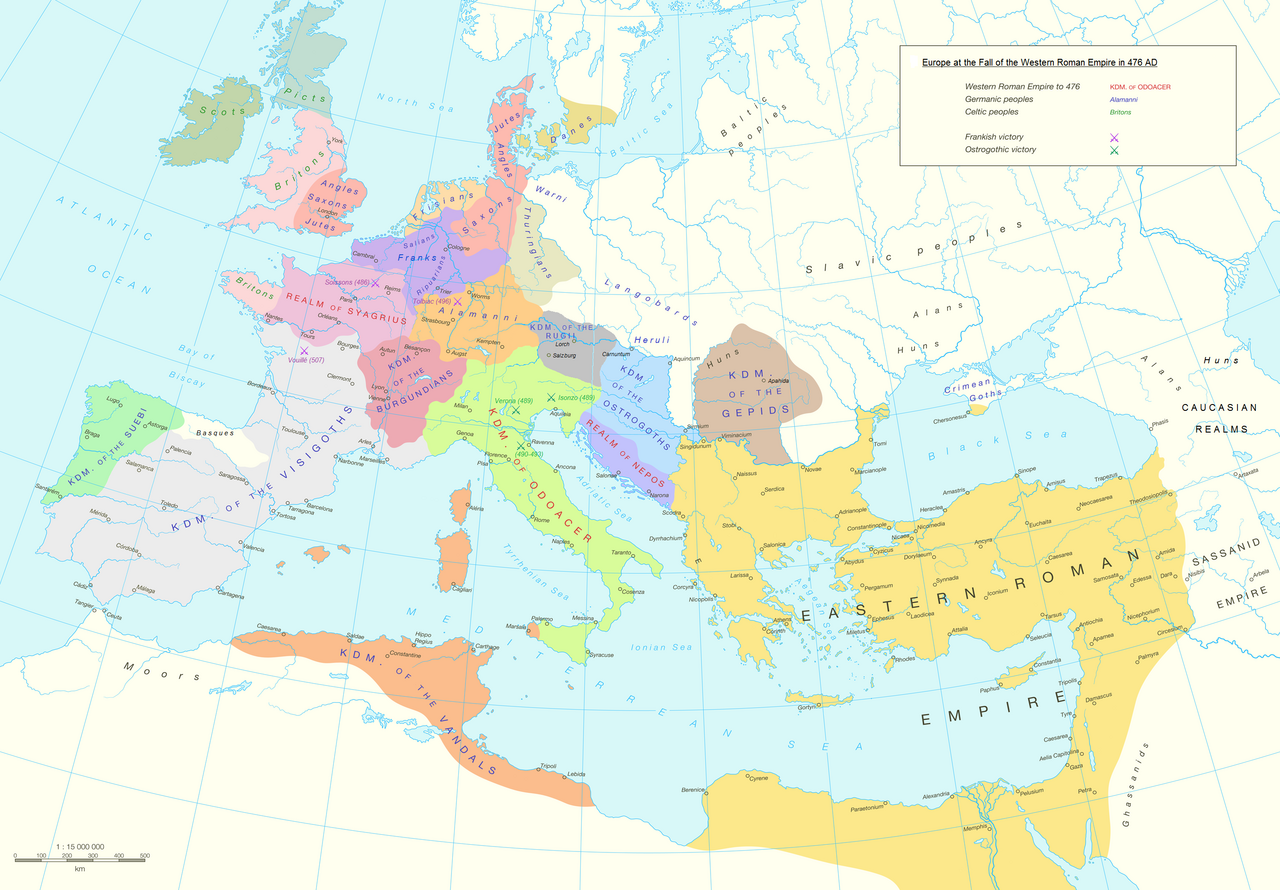
But if you want to actually try to say something intelligent about the whole thing, you need to grapple with what actually happened, rather than the classroom black-box model designed for teaching efficiency rather than detail. We are…not going to do that today…though I will have some bibliography here for those who want to. The key thing here is that the ‘Fall of Rome’ (in the West) is not an event, but a century long process from 376 to 476. Rome power (in the West) contracts for a lot of that, but it expands in periods as well, particularly under the leadership of Aetius (433-454) and Majorian (457-461); there are points where it would have really looked like the Romans might actually be able to recover. Even in 476 it was not obvious to anyone that Roman rule had actually ended; Odoacer, who had just deposed what was to be the last Roman emperor in the west promptly offered the crown to Zeno, the Roman emperor in the East (there is argument about his sincerity but James O’Donnell argues – very well, though I disagree on some key points – that this represented a real opportunity for Rome to rise from defeat in a new form yet again).
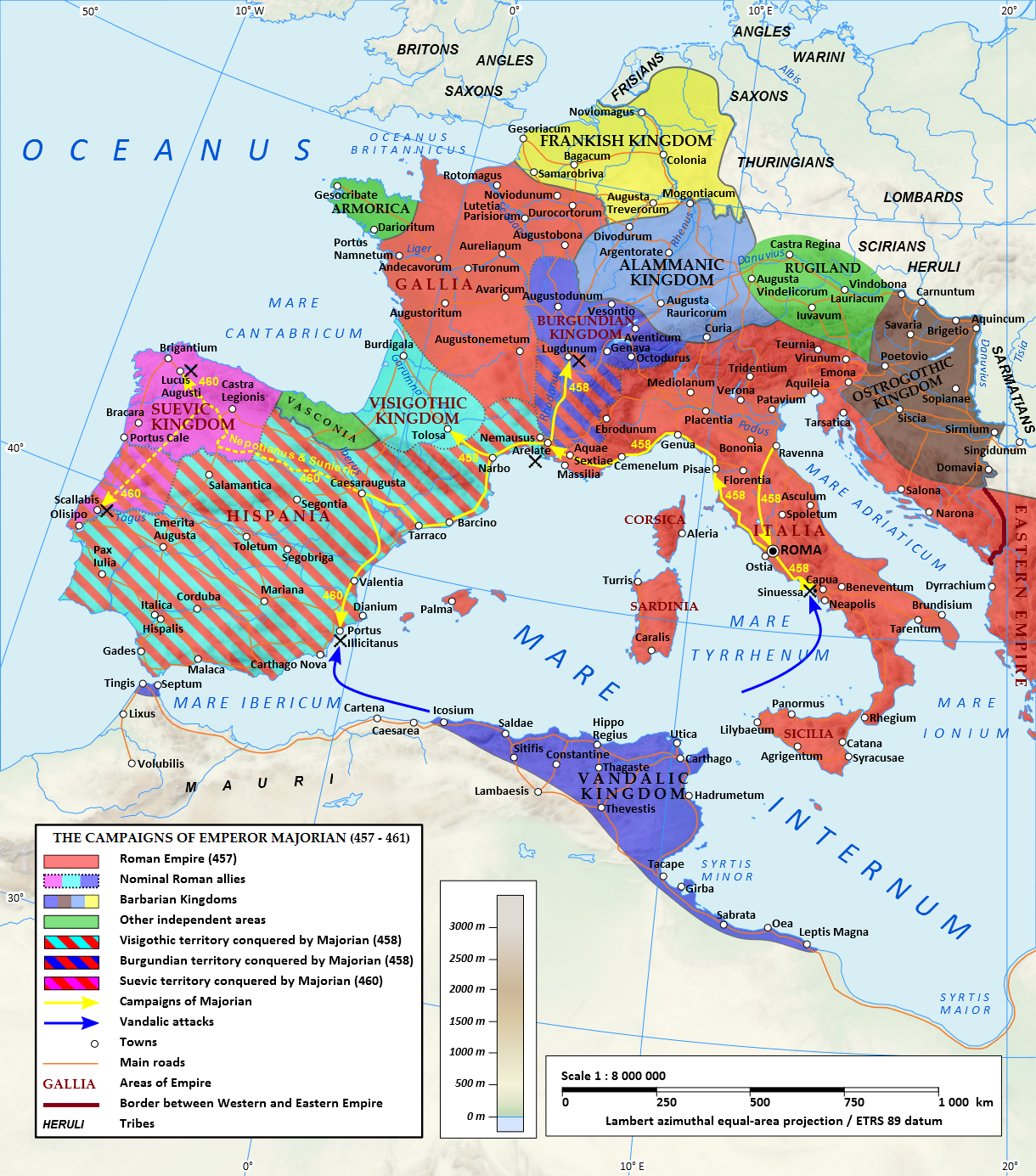
Glancing even further back historically, this wasn’t even the first time the Roman Empire had been on the brink of collapse. Beginning in 238, the Roman Empire had suffered a long series of crippling civil wars and succession crises collectively known as the Crisis of the Third Century (238-284). At one point, the empire was de facto split into three, with one emperor in Britain and Gaul, another in Italy, and the client kingdom of Palmyra essentially running the Eastern half of the empire under their queen Zenobia. Empires do not usually survive those kinds of catastrophes, but the Roman Empire survived the Crisis, recovered all of its territory (save Dacia) and even enjoyed a period of relative peace afterwards, before trouble started up again.
The reason that empires do not generally survive those kinds of catastrophes is that generally when empires weaken, they find that they contain all sorts of people who have been waiting, sometimes patiently, sometimes less so, for any opportunity to break away. The rather sudden collapse of the (Neo-)Assyrian Empire (911-609 BC) is a good case study. After having conquered much of the Near East, the Assyrians fell into a series of succession wars beginning in 627; their Mesopotamian subjects smelled blood and revolted in 625. That was almost under control by 620 when the Medes and Persians, external vassals of the Assyrians, smelled blood too and invaded, allying with the rebelling Babylonians in 616. Assyria was effectively gone by 612 with the loss and destruction of Ninevah; they had gone from the largest empire in the world at that time or at any point prior to non-existent in 15 years. While the Assyrian collapse is remarkable for its speed and finality, the overall process is much the same in most cases; once imperial power begins to wane, revolt suddenly looks more possible and so the downward slope of collapse can be very steep indeed (one might equally use the case study of decolonization after WWII as an example: each newly independent country increased the pressure on all of the rest).
Yet there is no great rush to the doors for Rome. Instead, as Guy Halsall puts it in Barbarian Migrations and the Roman West (2007), “The West did not drift hopelessly towards its inevitable fate. It went down kicking, gouging and screaming.” Among the kicked and gouged of course were Attila and his Huns. Fought to a draw at the Battle of the Catalaunian Plains, his empire disintegrated after his death two years later under pressure from both Germanic tribes and the Eastern Roman Empire (and the standard tendency for Steppe empires to fragment); of his three sons, Ellac was killed by revolting Germanic peoples who had been subject to the Huns, Dengizich by the (Eastern) Romans (we’re told his head was put on display in Constantinople) and the last, Ernak just disappears in our narrative after the death of Dengizich. The Romans, it turns out, did eventually get down to business to defeat the Huns. But the Romans doing all of that kicking, gouging and screaming were not the handful of old families from the early days of the Repulic; most of those hard-fighting Romans were people who in 14 AD would have been provincials. And indeed, the Roman Empire would survive, in the East, where Rome wasn’t, making for a Roman Empire that by 476 consisted effectively entirely of ‘provincial’ Romans.
Instead what we see are essentially three sets of actions by provincial elites who in any other empire would have been leading the charge for the exits. There were the kickers, gougers and screamers, as Halsall notes. There were also, as Ralph Mathisen, Roman Aristocrats in Barbarian Gaul (1993) has noted, elites who – seeing the writing on the wall – made no effort to hasten the collapse of the empire but instead retreated into their estates, their books and their letters; these fellows often end up married into and advising the new ‘barbarian’ kings who set up in the old Roman provinces (which in turn contributes quite a bit to the preservation and continued influence of Roman law and culture in the various fragmented successor states of the early Middle Ages). Finally, there were elites so confident that the empire would survive – because it always had! – that they mostly focused on improving their position within the empire, even at the cost of weakening it, not because they wanted out, but because ‘out’ was inconceivable to them; both Halsall and also James O’Donnell, The Ruin of the Roman Empire (2009) document many of these. If I may continue my analogy, when the exit door was yawning wide open, almost no one walked through; some tried to put out the burning building they were in, others were content to be at the center of the ruins. But no one actually left.
During the Crisis of the Third Century, that set of responses had been crucial for the empire’s survival and for brief moments in the 400s, it looked like they might even have saved it again. For all of the things that brought the Roman Empire down, it is striking that ‘internal revolts’ of long-ruled peoples weren’t one of them. And that speaks to the power of Rome’s effective (if, again, largely unintentional) management of diversity. The Roman willingness to incorporate conquered peoples into the core citizen body and into ‘Roman-ness’ meant that even by 238 to the extent that the residents of the Empire could even imagine its collapse, they saw that potentiality as a disaster, rather than as a liberation. That gave the empire tremendous resiliency in the face of disaster, such that it took a century of unremitting bad luck to bring it down and even then, it only managed to take down half of it.
(As an aside, those provincial Romans were correct in the judgement that the collapse of the empire would mean disaster. The running argument about the fall of the Roman Empire is generally between the ‘decline and fall’ perspective, which presents the collapse of the Roman Empire as a Bad Thing and the ‘change and continuity’ perspective, which both stresses continuity after the collapse but also tends to try minimize the negative impacts of it, even to the point of suggesting that the average Roman peasant might have been better off in the absence of heavy Roman taxes. That latter view is particularly common among many medievalists, who are understandably quite tired of the unfairly poor reputation their period gets. This is an argument that for some time lived in the airy space of narrative and perspective where both sides could put an argument out. Unfortunately for some of the change-and-continuity arguments about living standards, archaeology has a tendency to give us data that is somewhat less malleable. That archaeological data shows, with a high degree of consistency, that while there is certainly some continuity between the Late Antique and the early Middle Ages the fall of Rome (in the West) killed lots of people (precipitous declines in population in societies without reliable birth control; probably this is mostly food scarcity, not direct warfare) and that living standards also declined to a degree that the results are archaeologically visible. As Brian Ward-Perkins notes in The Fall of Rome and the End of Civilization (2005), the collapse causes cows to shrink, speaking to sudden scarcity of winter fodder (which in turn likely speaks to a general reduction in available nutrition). Some areas were worse hit than others; Robin Flemming, Britain After Rome (2010) notes, for instance, that in post-Roman Britain, pot-making technology was lost (because ceramic production had been focused in cities which had been largely depopulated out of existence). The fall of Rome might have been good for some people, but the evidence is, I think, at this point inescapable that it was quite bad for most people. Especially, one assumes, all of the people who got depopulated.)
Foederati Failures
But if the Roman Empire (in the West) went down fighting, why did it collapse? Of course there is no simple answer to that question. The mass migrations of the fourth and fifth century clearly played a very large role, but then the Romans had defeated other such migrations (recall the Cimbri and the Teutones) before. There are strong indicators that other factors, unrelated to our current topic were also at play: the empire had been economically weakened by the Crisis of the Third Century, which may have disrupted a lot of the trade and state functions that created the revenue to fund state activity. At the same time, the Crisis and the more challenging security situation after it meant that Roman armies grew larger and with them the burden of paying and feeding the soldiers which further hurt the economy. Meanwhile, long exposure to Roman armies on the frontiers of the empire had begun to erode the initially quite vast qualitative advantage the Romans enjoyed; the gap between Roman and ‘barbarian’ military capabilities began to shrink (although it never really vanished altogether in this period). But some of the causes do bear on our topic but in quite the other direction from what the Niall Fergusons of the world might assume.
Let’s start with the foederati.
After the Constitutio Antoniniana, there was no longer much need for the auxilia, as all persons in the empire were citizens, and so the structure distinction between the legions and other formations fades away (part of this is also the tendency of the legions in this period to be progressively split up into smaller units called vexillationes, meaning that the unit-sizes wouldn’t have been so different). But during the fourth century, with frontier pressures building, the Romans again looked for ways to utilize the manpower and fighting skill of non-Romans. What is striking here is that whereas in some ways (discussed above) the auxilia had represented almost a revival of the attitudes which had informed the system for the socii, the new system that emerged for using foreign troops, called foederati (‘treaty men’) did not draw on the previously successful auxilia-system (which, to be clear, by this point had been effectively gone for more than a century). Instead, the Romans signed treaties with Germanic-speaking kings, exchanging chunks of (often depopulated, war-torn frontier) land in exchange for military service. Since these troops were bound by treaty (foedus) they were called foederati. They served in their own units, under their own leaders, up to their kings. Consequently, all of the mechanisms that encouraged the auxilia to adopt Roman practices and identify with the Roman Empire were lost; these men might view Rome as a friendly ally (at times) but they were never encouraged to think of themselves as Roman.
The reason for this different system of recruitment seem to be rooted in financial realities. The Roman army had already been expanded during the Crisis of the Third Century and only grew more under Diocletian and Constantine, probably by this point being between 400,000 and 500,000 men (compared to 300,000-350,000 earlier in the empire). Moreover, Diocletian had opted to reform the empire’s administration with a much more intensive, top-down, bureaucratic approach, which imposed further costs. Taxes had become heavy (although elites were increasingly allowed to dodge them), the economy was weak and revenues were short. The value of the foederati was that the empire didn’t have to pay them; they were handed land (again, in war-torn frontier zones) and expected to use that to pay for their military support. At the time, it must have seemed a brilliant work-around to get more military power out of a dwindling tax-base.

(I feel the need to note that I increasingly regard Diocletian (r. 284-305) as a ruinous emperor, even though he lacked the normal moralizing character flaws of ‘bad emperors.’ While he was active, dedicated and focused, almost all of his reforms turned out to be quite bad ideas in the long run even before one gets to the Great Persecution. His currency reforms were catastrophic, his administrative reforms were top-heavy, his tax plan depended on a regular census which was never regular and the tetrarchy was doomed from its inception. Diocletian was pretty much a living, “Well, You Tried” meme. That said, to be clear, Diocletian wasn’t responsible for the foederati; it’s not quite clear who the first foederati were – they may have been the Franks in 358, which would make Julian (as a ‘Caesar’ or junior-emperor under Constantius) the culprit for this bad idea – he had a surplus of those too.)
The problem, of course, is right there: the status of the foederati made it impossible for them to ever fully integrate into the empire. They had, after all, their own kings, their own local laws and served in their own military formations. While, interestingly, they would eventually adopt Latin from the local population which had already done so (leading to French, Spanish and Italian) they could never become Roman. That wasn’t always their choice, either! As O’Donnell (op. cit.) notes, many of these foederati wanted to be ‘in’ in the Roman Empire; it was more frequently the Romans who were busy saying ‘no.‘ It is striking that this occurs in a period where social class in the Roman world was generally calcifying. Whereas citizenship had been an expanding category, after the Constitutio Antoniniana, the legal categories of honestiores and humiliores (lit. ‘respectable’ and ‘humble’ people, but in practice, ‘wealthy’ and ‘commoners’) largely replaced citizenship as the legal dividing lines of Roman society. These were far less flexible categories, as economic social mobility in the ancient world was never very high. Even there, the tax reforms of Diocletian (with some ‘patches’ under Constantine) began, for tax purposes, to tie tenant farmers (‘coloni‘) to their land, essentially barring both physical and economic mobility in the name of more efficient tax collection in a system that strongly resembled later medieval serfdom.
Nevertheless, the consequence of this system of organization was that as often as the foederati provided crucial soldiers to Roman armies, they were just as frequently the problem Roman armies were being sent to address. Never fully incorporated into the Roman army and under the command of their own kings, they proved deeply unreliable allies. Pitting one set of foederati against the next could work in the short-term, but in the long term, without any plan to permanently incorporate the foederati into Roman society, fragmentation was inevitable. The Roman abandonment of the successful older systems for managing diverse armies (on account that they were too expensive) turned the foederati from a potential source of vital manpower into the central cause of imperial collapse in the West.
Losing the Habit
This trend towards calcification had been matched by the loss of Rome’s (admittedly opportunistic and unevenly applied) religious tolerance. This is often attributed to Christianity itself, but is perhaps better understood in light of the increasing demands of emperors during and after the Crisis of the Third Century to insist on unity through uniformity. The first empire-wide systemic persecution of Christians, the Decian Persecution (250 AD) was exactly this – an effort to have all Romans everywhere sacrifice for the safety of the emperor as an act of unity to strengthen his reign which rather backfired because it seems not to have occurred to Decius that Christians (of whom, by 250, there were many) would be unable to participate. Diocletian likewise launched the Great Persecution in 303 as part of a program to stress unity in worship and try to bind the fractured Roman Empire together, particularly by emphasizing the cults of Jupiter and Hercules. From that perspective, Christians were a threat to the enforced, homogeneous unity Diocletian wanted to foster and thus had to be brought back or removed, though of course in the event Christianity’s roots were by 303 far too deep for it to be uprooted.
That is part of the context where we should understand Constantine (r. 306-337). Constantine is famous for declaring the toleration of Christianity in the empire and being the first emperor to convert to Christianity (only on on his death-bed). What is less well known is that, having selected Christianity as his favored religion, Constantine – seeking unity again – promptly set out to unify his new favored religion, by force if necessary. A schism had arose as a consequence of Diocletian’s persecution and – now that Christianity was in the good graces of the emperor – both sides sought Constantine’s aid in suppressing the other in what became known as the Donatism controversy, as the side which was eventually branded heretical supported a Christian bishop named Donatus. Constantine, after failing to get the two groups to agree settled on persecuting one of them (the Donatists) out of existence (which didn’t work either).
It is in that context that later Christian emperor’s efforts to unify the empire behind Christianity (leading to the Edict of Thessalonica in 380) ought to be understood – as the culmination of, by that point, more than a century of on-again, off-again efforts by emperors to try to strengthen the empire by enforcing religious unity. By the end of the fourth century, the Christian empire was persecuting pagans and Jews, not even a full century after it had been persecuting Christians.
These efforts to violently enforce unity through homogeneity had the exact opposite effect. Efforts to persecute Arian Christians (who rejected the Nicene Creed) created further divisions in the empire; they also made it even more difficult to incorporate the newly arriving Germanic peoples, who had mostly converted to the ‘wrong’ (Arian) Christianity. Meanwhile, in the fifth century, the church in the East splintered further, leading to the ‘Nestorian’ (the term is contested) churches of Syria and the Coptic Church in Egypt on the ‘outs’ with the official (Eastern) Roman Church and thus also facing persecution after the Council of Ephesus in 431. The resentment created by the policy of persecution in the East seems to have played a fairly significant role in limiting the amount of local popular resistance faced by the Muslim armies of the Rashidun Caliphate during the conquests of Syria, the Levant and Egypt in the 630s, since in many cases Christian communities viewed as ‘heretical’ by Constantinople could actually expect potentially better treatment under Muslim rule. Needless to say, this both made the Muslim conquests of those regions easier but also go some distance to explaining why Roman/Byzantine reconquest was such a non-starter. Efforts to enforce unity in the empire had, perhaps paradoxically, made it more fragile rather than more resilient.
Conclusions
Reaching back to our initial question, we now have some answers. While the Romans are often presented in popular culture as a homogeneous society consisting of white Northern Europeans who uniformly speak their Latin with a decided British accent, the truth is both more complex and more interesting. At every stage of their development, the Romans were a diverse bunch. Initially this reflected Rome’s origins as a frontier town, positioned at the meeting point of several different cultural, linguistic and religious groups. The Romans themselves understood their own deep past to have been diverse, with Rome drawn together out of peoples from all over Italy and while their founding myths aren’t particularly accurate, on this point the archaeology backs up the fundamental truth that earliest Rome was a fusion-society. That diversity only grew as Rome expanded, first incorporating the different peoples of Italy and then the different peoples of the Mediterranean more broadly.
Contrary to the popular image, Rome was a diverse society, by any definition, from the foundation of the Republic (if not earlier) to the collapse of the empire in the West. This was true when it came to language, culture, and religion. It was also true when it came to skin-color, although this tended to be quite a bit less important to the Romans than it is to many people today. While popular media tends to portray the Romans as uniformly white, typically using British actors, the actual Romans stretched close to the full range of human skin-colors. There was no particular arrangement of skin color, hair color or type , no particular ‘phenotype‘ which was distinctively Roman. There were fair-skinned Romans, dark-skinned Romans and Romans at every point in between. That diversity of appearance was true within Roman Italy but became radically more true in Rome’s Mediterranean-spanning empire. Instead, Roman identity was marked by a legal status, citizenship, which defined belonging in the group; visually, Roman citizenship was conveyed by clothing (the toga in particular), rather than skin, hair, facial structure, etc. The ‘Queen’s Latin’ vision of a Rome homogeneously white is wrong in all respects.
Consequently the theory of empire that is often built up on that cracked foundation, which supposes that the strength of a homogeneous Roman society forged their empire and that the diversity of that empire doomed it is fundamentally flawed, based on an amateurish and catastrophically mistaken understanding of Roman history. Rome was never homogeneous and so there is no pristine, unmixed Roman society to hearken back to. Again, the Romans themselves knew this and declared it openly.
Instead it was Rome’s opportunistic but well-honed ability to effectively manage diverse populations which led to their success. Doubtless this skill had at least some of its origins in the fact that Roman political leaders did not come from a monoculture; the relatively ‘hands off’ strategy (with a strong emphasis on local self-government) Rome had to take to deal with the diversity of Italy provided an effective training ground for managing a vast empire. The Romans do not seem to have ever intended to forge a vast, multi-cultural polity out of their imperial conquests; they were, for the most part, in it for the loot, taxes and military glory. But that Italian toolkit and the habits of politics in Rome’s diverse Republic were things every Roman aristocrat brought with them when they went abroad as a general or a governor (coincidentally, the same job in the Republic and in the Empire, but that’s a story for another day). Indeed, diversity was the root of Roman success. What made the Roman Empire possible, both to create and to hold, was the willingness of the Romans to opportunistically include conquered peoples in the Roman project.
In the end though, when Rome’s conquests ceased, and with the frontiers defended against migrations of fresh peoples into the empire, the Romans clearly got out of the habits that had won them the empire. Emperors more strongly emphasized unity through conformity, particularly in religion, and when the Romans once again had need of non-Romans in their armies, they made the crucial mistake of keeping them separate, rather than incorporating them as they had before. Diversity did not destroy the Roman Empire, but intolerance of diversity contributed greatly to its fall.
Of course part of the reason we are discussing all of this is that these examples – often in their deeply flawed, ‘Queen’s Latin’ form – are mobilized as support for political ends. I am not a policy expert, so I am not going to suggest what particular policy these conclusions lend themselves too. But I am a Roman history expert and so when policy makers are thinking about the examples of history to try to craft effective policies, they should consider the actual Romans rather than the image of Rome crafted by the BBC and Hollywood. Those Romans were not neatly homogeneous, they did not neatly map on to modern racial categories, but nor were they enlightened multiculturalists. They were frequently shrewd and self-interested empire builders who recognized that it actually is true that diversity is strength.
That Rome, the real Rome, the one that exists in our literary sources, in the archaeological record, in Roman artwork (and in my classroom), the real Rome was always diverse.
That’s why they won.
Like this:
Like Loading...
from Hacker News https://ift.tt/3fbxJ7a


No comments:
Post a Comment
Note: Only a member of this blog may post a comment.