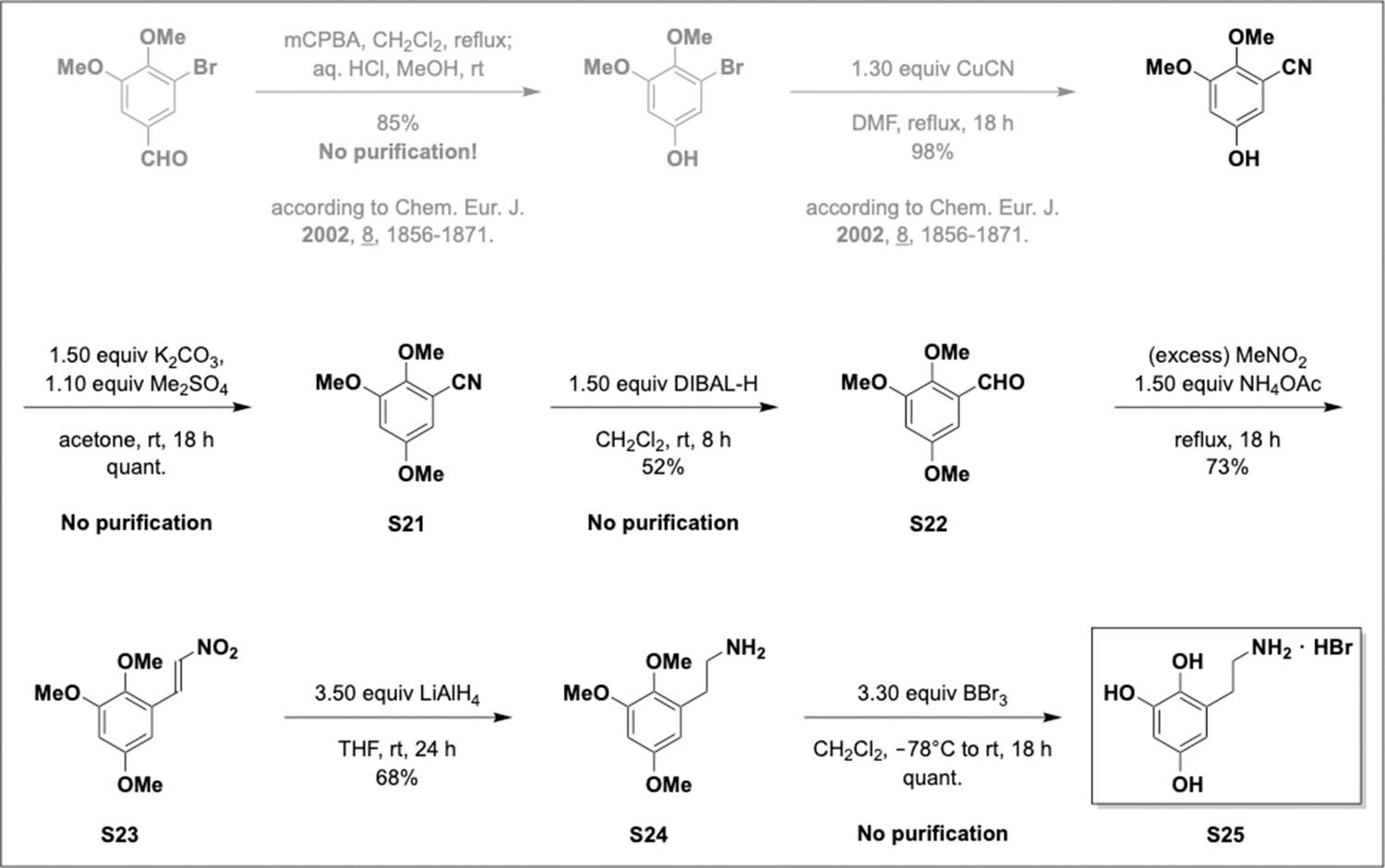
Preparation of aminoethylbenzene triol hydrobromide from aryl nitriles.
Appendix 1—chemical structure 21
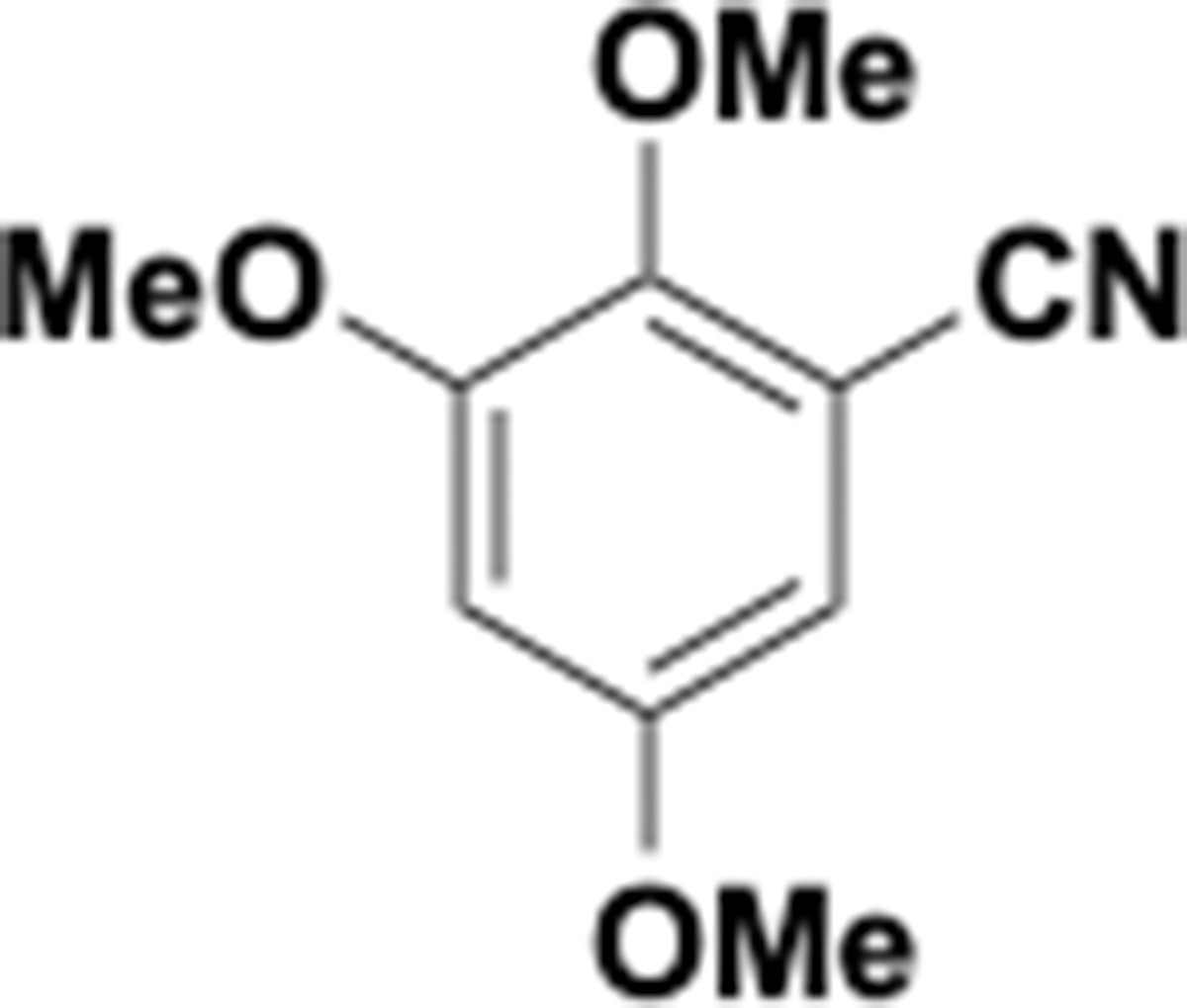
Trimethoxybenzonitrile (S21).
2,3,5-Trimethoxybenzonitrile (S21). K2CO3 (1.90 g, 13.8 mmol, 1.50 equiv) and dimethyl sulfate (0.960 mL, 1.28 g, 10.1 mmol, 1.10 equiv) were added to a solution of 5-hydroxy-2,3-dimethoxybenzonitrile (Fürstner et al., 2002) (1.65 g, 9.21 mmol, 1.00 equiv) in acetone (30 mL) at rt. Stirring was continued for 18 hr to afford a pale beige suspension. The solvent was removed under reduced pressure and the resulting crude material was diluted with a mixture of EtOAc–H2O (1:1; 100 mL). The obtained layers were separated and the aqueous layer was extracted with EtOAc (3 × 20 mL). The combined organic layers were washed with 5% aqueous NaOH (20 mL) and brine (2 × 20 mL), dried over anhydrous Na2SO4, filtered, and concentrated under reduced pressure to afford analytically pure trimethoxybenzonitrile S21 (1.78 g, quant.) as a pale beige solid. 1H NMR (500 MHz, CDCl3): δ 6.68 (d, J = 2.8 Hz, 1H), 6.56 (d, J = 2.8 Hz, 1H), 3.94 (s, 3H), 3.86 (s, 3H), 3.79 (s, 3H). The spectral characteristics were identical to those reported in the current literature (Rizzacasa and Sargent, 1988).
Appendix 1—chemical structure 22
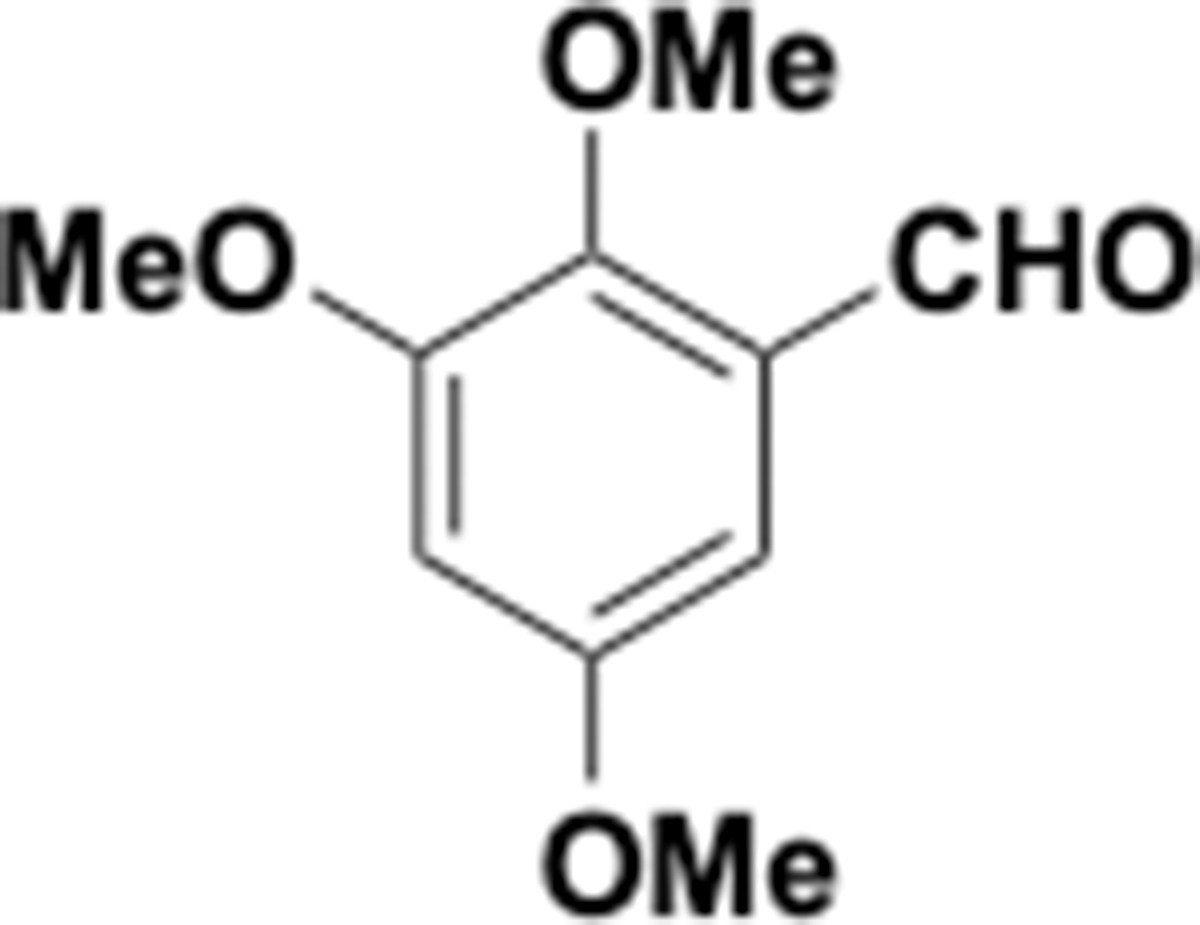
Trimethoxybenzaldehyde (S22).
2,3,5-Trimethoxybenzaldehyde (S22). DIBAL-H (1.0 M in CH2Cl2; 12.4 mL, 12.4 mmol, 1.50 equiv) was added dropwise to a solution of nitrile S21 (1.60 g, 8.28 mmol, 1.00 equiv) in CH2Cl2 (33 mL) at 0°C. The resulting mixture was allowed to warm to rt over 3 hr after which stirring was continued for 8 hr. The reaction was cooled to 0°C and HCl (1.0 M in H2O; 10.0 mL) was added dropwise over 10 min. The mixture was allowed to warm to rt and stirring was continued for 2 hr. The layers were separated, and the aqueous layer was extracted with CH2Cl2 (2 × 15 mL). The combined organic layers were washed with H2O (2 × 15 mL) and brine (20 mL), dried over anhydrous Na2SO4, filtered, and concentrated under reduced pressure to afford analytically pure benzaldehyde S22 (845 mg, 52%) as a beige solid. 1H NMR (500 MHz, CDCl3): δ 10.40 (s, 1H), 6.86 (d, J = 2.9 Hz, 1H), 6.74 (d, J = 2.9 Hz, 1H), 3.93 (s, 3H), 3.89 (s, 3H), 3.82 (s, 3H); 13C NMR (125 MHz, CDCl3): δ 190.2, 156.4, 154.4, 148.2, 129.9, 107.7, 99.7, 63.1, 56.4, 56.1. The spectral characteristics were identical to those reported in the current literature (Singh et al., 1995).
Appendix 1—chemical structure 23

Nitrovinyl benzene (S23).
(E)−1,2,5-Trimethoxy-3-(2-nitrovinyl)benzene (S23). A mixture of benzaldehyde S22 (845 mg, 4.31 mmol, 1.00 equiv) and ammonium acetate (500 mg, 6.46 mmol, 1.50 equiv) in nitromethane (40 mL) was heated to reflux for 18 hr, after which the reaction was found to be complete according to TLC (Rf = 0.38 starting material; Rf = 0.35 product; hexanes:EtOAc 4:1). The resulting mixture was concentrated under reduced pressure and purified by flash column chromatography (hexanes:EtOAc 6:1) to afford nitrovinyl benzene S23 (750 mg, 73%) as a yellow solid. IR (thin film) ν 2959, 2846, 1717, 1633, 1601, 1492, 1465, 1332, 1282, 1206, 1176, 1151 cm-1; 1H NMR (500 MHz, CDCl3): δ 8.16 (d, J = 13.8 Hz, 1H), 7.71 (d, J = 13.8 Hz, 1H), 6.61 (d, J = 2.6 Hz, 1H), 6.48 (d, J = 2.6 Hz, 1H), 3.86 (s, 3H), 3.83 (s, 3H), 3.80 (s, 3H); 13C NMR (125 MHz, CDCl3): δ 156.4, 154.1, 144.2, 138.7, 134.8, 124.0, 104.5, 102.9, 61.6, 56.1, 55.9; Rf = 0.35 (hexanes:EtOAc 4:1); ESI-HRMS calcd for C11H14NO5 [M+H] 240.0866, found 240.0871.
Appendix 1—chemical structure 24
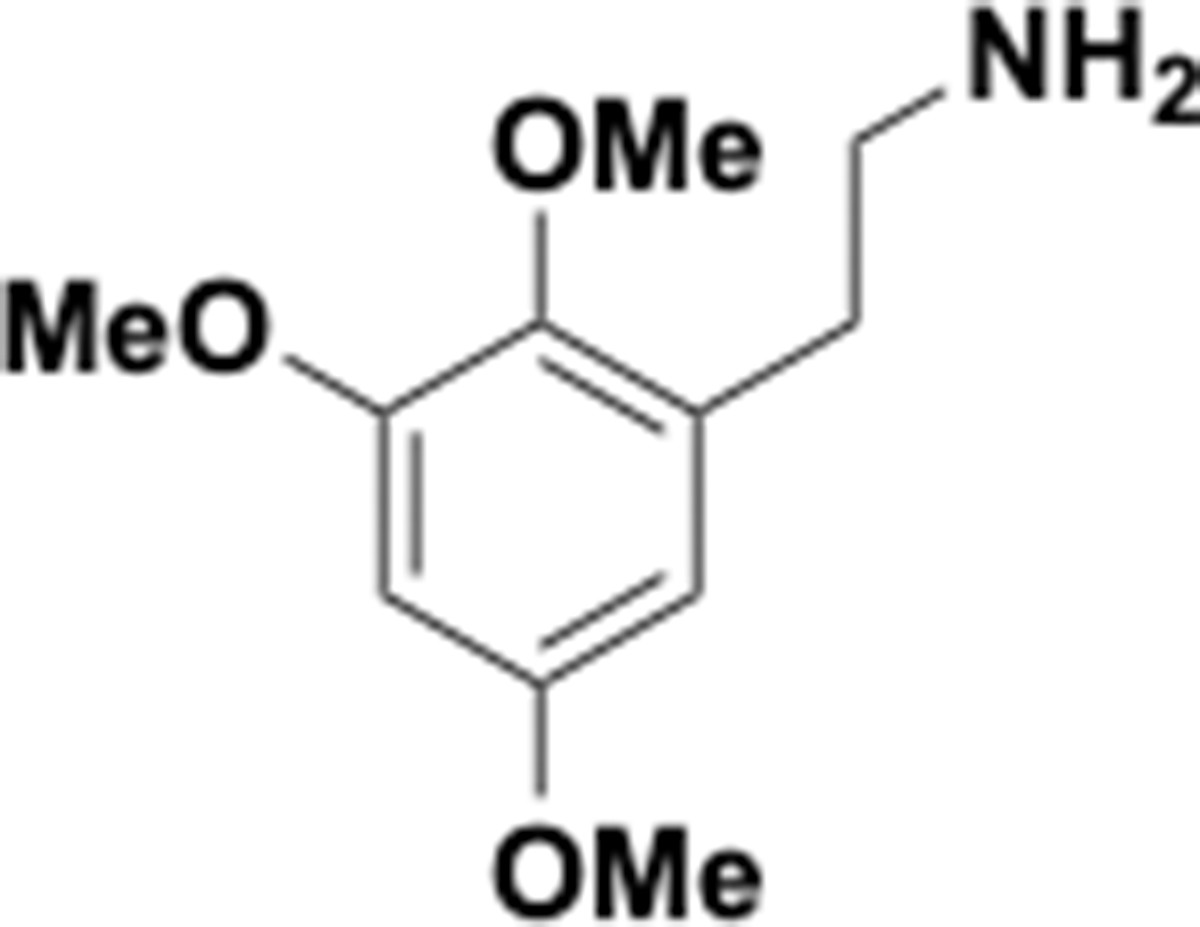
Trimethoxyphenethyl amine (S24).
2-(2,3,5-Trimethoxyphenyl)ethan-1-amine (S24). LiAlH4 (2.0 M in THF; 1.83 mL, 3.66 mmol, 3.50 equiv) was added dropwise over 10 min to a solution of nitrovinyl benzene S23 (250 mg, 1.05 mmol, 1.00 equiv) in THF (6 mL) at 0°C. The resulting mixture was allowed to warm to rt and stirring was continued for 24 hr. The reaction mixture was then cooled to 0°C and 10% aqueous NaOH (5.0 mL) was added dropwise over 10 min, resulting in an exothermic reaction. Stirring was continued for 1 hr, and the resulting suspension was diluted with EtOAc (20 mL) and filtered over a plug of Celite (EtOAc rinse). The filtrate was dried over anhydrous Na2SO4, filtered, and concentrated under reduced pressure to afford crude amine S24. Purification by flash column chromatography (EtOAc:MeOH 85:15 + 0.1% Et3N) afforded amine S24 (150 mg, 68%) as a pale yellow oil. IR (thin film) ν 3363, 2937, 2839, 1599, 1492, 1465, 1427, 1380, 1220, 1175, 1150, 1089, 830 cm-1; 1H NMR (500 MHz, CDCl3): δ 6.39 (d, J = 2.5 Hz, 1H), 6.29 (d, J = 2.5 Hz, 1H), 3.84 (s, 3H), 3.77 (s, 3H), 3.76 (s, 3H), 2.97 (t, J = 7.0 Hz, 2H), 2.78 (t, J = 7.0 Hz, 2H), 2.27 (br s, NH2); 13C NMR (125 MHz, CDCl3): δ 156.0, 153.5, 141.5, 133.4, 105.5, 98.5, 60.9, 55.7, 55.6, 42.7, 34.1; Rf = 0.08 (EtOAc:MeOH 85:15); ESI-HRMS calcd for C11H18NO3 [M+H] 212.1281, found 212.1275.
Appendix 1—chemical structure 25
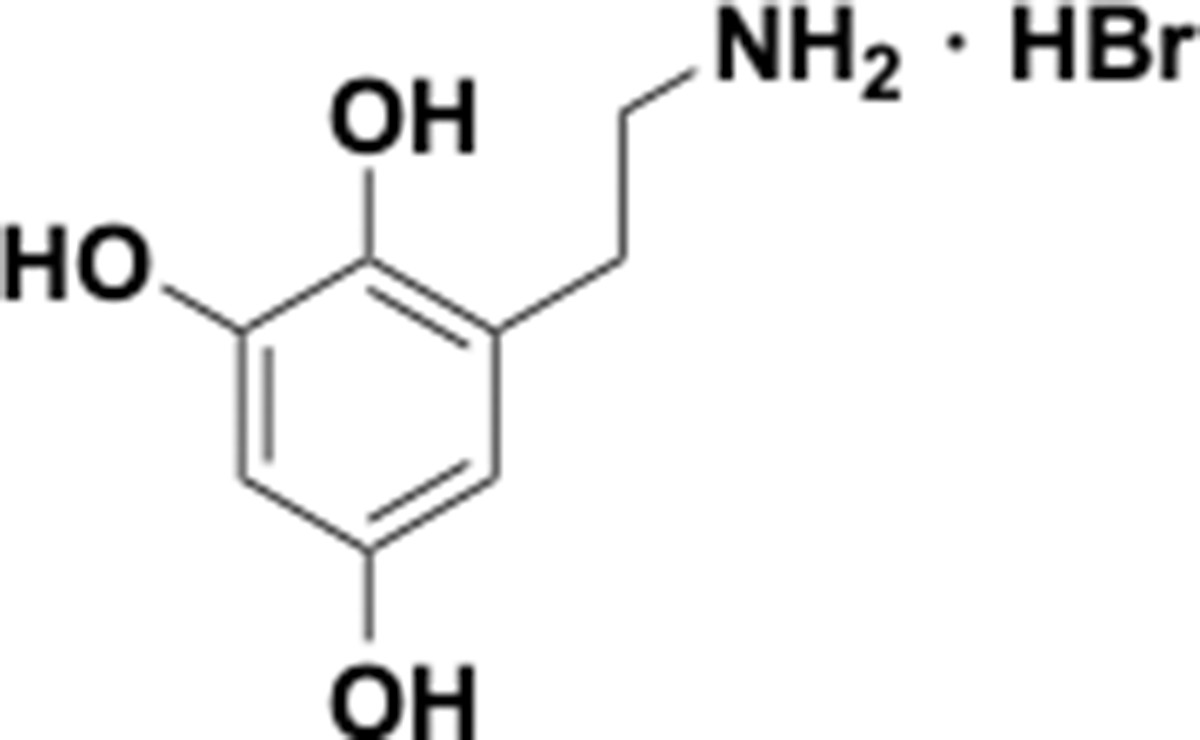
Aminoethylbenzene triol hydrobromide (S25).
3-(2-Aminoethyl)benzene-1,2,5-triol hydrobromide (S25). BBr3 (1.0 M in CH2Cl2; 1.41 mL, 1.41 mmol, 3.30 equiv) was added dropwise over 10 min to a solution of phenol ether S24 (90.0 mg, 0.425 mmol, 1.00 equiv) in CH2Cl2 (0.033 M) at –78°C. The resulting mixture was allowed to warm to rt over 3 hr. Stirring was continued for 18 hr. The resulting suspension was cooled to 0°C and quenched with the dropwise addition of MeOH (ca. 5 mL). Stirring at rt was continued for 1 hr. The resulting solution was concentrated under reduced pressure to afford a pale-brown oil. The obtained residue was dissolved in a small amount of MeOH and again concentrated under reduced pressure; this step was repeated 3–4 times to remove all of the trimethyl borate side product and obtain analytically pure triol amine S25 as the HBr salt. IR (thin film) ν 3358, 3223, 1604, 1452, 1359, 1291, 1108, 1044 cm-1; 1H NMR (500 MHz, CD3OD): δ 6.29 (d, J = 2.6 Hz, 1H), 6.11 (d, J = 2.8 Hz, 1H), 3.15 (t, J = 7.4 Hz, 2H), 2.88 (t, J = 7.3 Hz, 2H), OH- and NH-protons are not visible; 13C NMR (125 MHz, CD3OD): δ 151.4, 147.1, 137.7, 125.0, 108.2, 103.3, 41.0, 29.8; ESI-HRMS calcd for C8H12NO3 [M+H] 170.0812, found 170.0812.
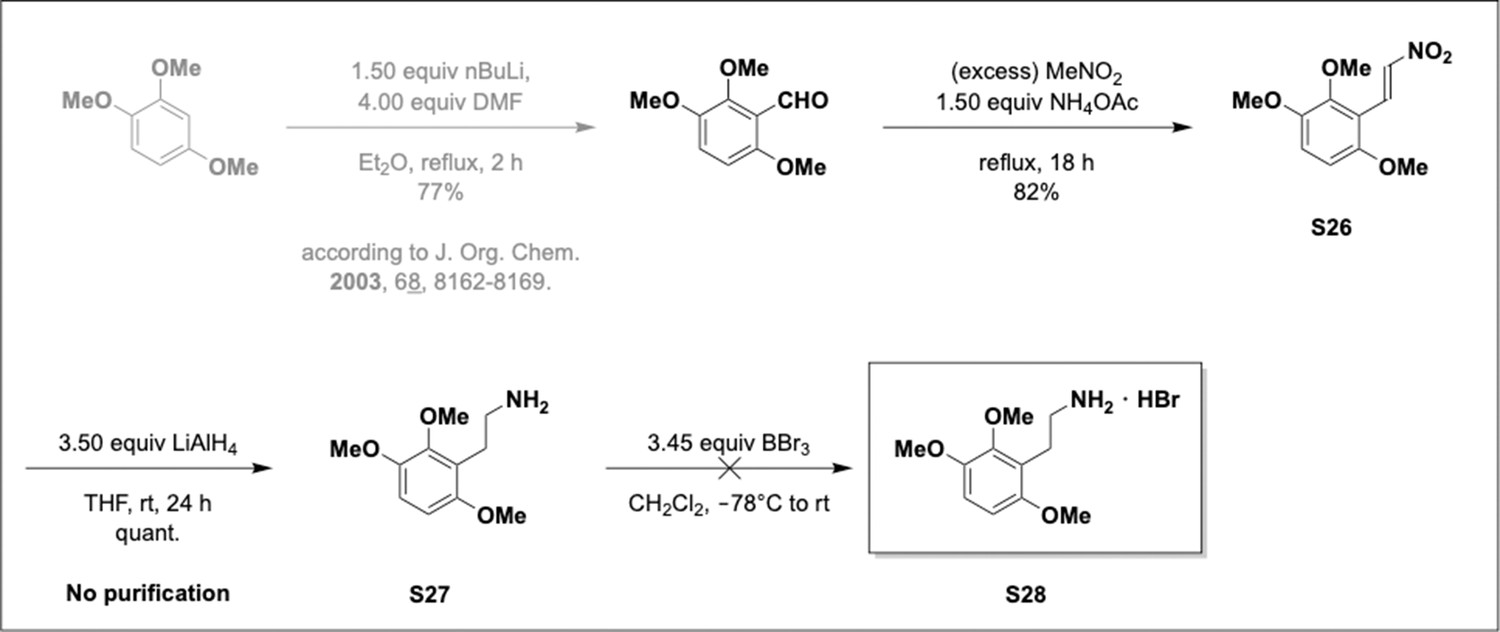
Preparation of aminoethylbenzene triol hydrobromide derivatives from trimethoxybenzene.
Appendix 1—chemical structure 26
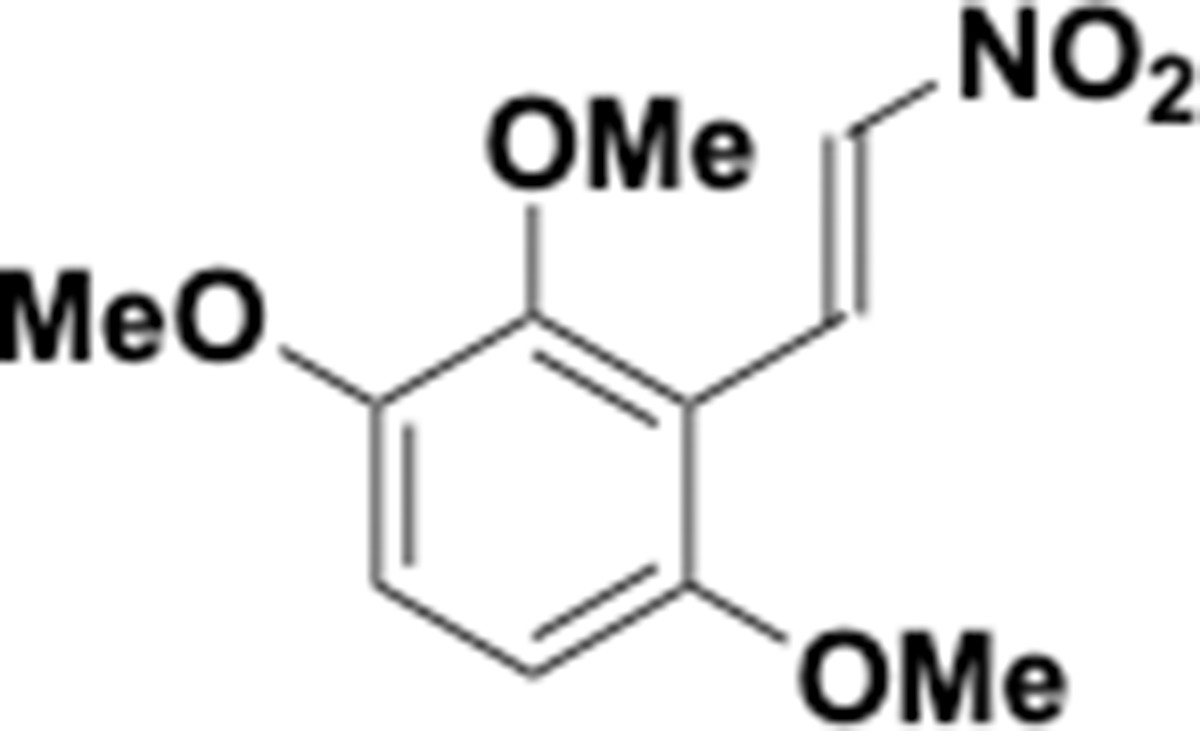
Trimethoxy nitrovinyl benzene (S26).
(E)−1,2,4-Trimethoxy-3-(2-nitrovinyl)benzene (S26). A mixture of 2,3,6-trimethoxybenzaldehyde15 (500 mg, 2.55 mmol, 1.00 equiv) and ammonium acetate (295 mg, 3.82 mmol, 1.50 equiv) in nitromethane (23 mL) was heated to reflux for 18 hr after which the reaction was found to be according to TLC (Rf = 0.30 starting material; Rf = 0.38 product; hexanes:EtOAc 2:1). The resulting mixture was concentrated under reduced pressure and purified by flash column chromatography (hexanes:EtOAc 5:1) to afford nitrovinyl benzene S26 (500 mg, 82%) as a yellow solid. IR (thin film) ν 2939, 2854, 1625, 1583, 1507, 1496, 1330, 1284, 1116, 1009 cm-1; 1H NMR (500 MHz, CD3OD): δ 8.39 (d, J = 13.7 Hz, 1H), 8.09 (d, J = 13.7 Hz, 1H), 7.17 (d, J = 9.2 Hz, 1H), 6.80 (d, J = 9.2 Hz, 1H), 3.91 (s, 3H), 3.91 (s, 3H), 3.85 (s, 3H); 13C NMR (125 MHz, CD3OD): δ 155.5, 151.6, 148.2, 140.8, 130.7, 118.7, 114.7, 107.1, 61.6, 57.0, 56.6; Rf = 0.38 (hexanes:EtOAc 2:1); ESI-HRMS calcd for C11H14NO5 [M+H] 240.0866, found 240.0860.
Appendix 1—chemical structure 27
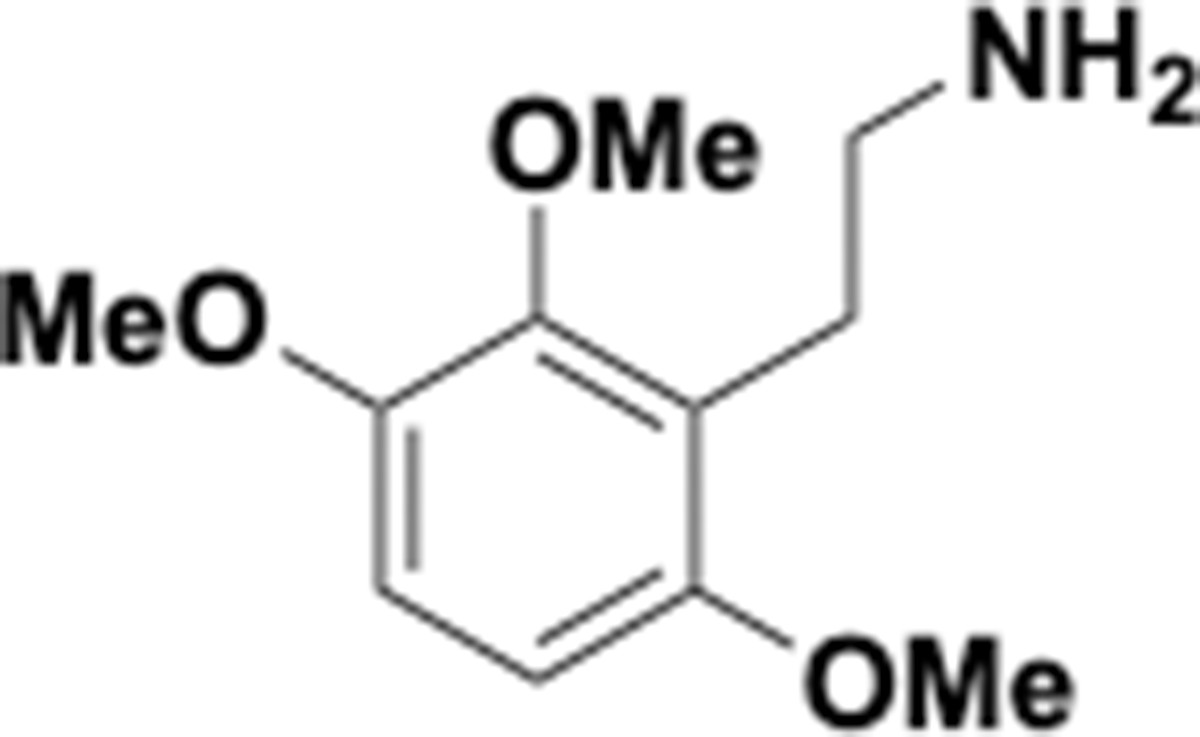
Trimethoxyphenethyl amine (S27).
2-(2,3,6-Trimethoxyphenyl)ethan-1-amine (S27). LiAlH4 (2.0 M in THF; 3.66 mL, 7.32 mmol, 3.50 equiv) was added dropwise over 10 min to a solution of nitrovinyl benzene S26 (200 mg, 2.09 mmol, 1.00 equiv) in THF (12 mL) at 0°C. The resulting mixture was allowed to warm to rt and stirring was continued for 24 hr. The reaction mixture was cooled to 0°C and 10% aqueous NaOH (10.0 mL) was added dropwise over 10 min, resulting in an exothermic reaction. Stirring was stirred continued for 1 hr. The resulting suspension was diluted with EtOAc (20 mL) and filtered over a plug of Celite (EtOAc rinse). The filtrate was dried over anhydrous Na2SO4, filtered, and concentrated under reduced pressure to afford analytically pure amine S27 (438 mg, quant.) as a pale yellow oil. IR (thin film) ν 3363, 2936, 2833, 1648, 1485, 1463, 1253, 1085, 793, 627 cm-1; 1H NMR (500 MHz, CDCl3): δ 6.73 (d, J = 8.8 Hz, 1H), 6.55 (d, J = 8.8 Hz, 1H), 3.82 (s, 3H), 3.82 (s, 3H), 3.76 (s, 3H), 2.88 (d, J = 6.0 Hz, 2H), 2.83 (d, J = 6.0 Hz, 2H), 2.47 (br s, NH2); 13C NMR (125 MHz, CDCl3): δ 152.5, 148.4, 147.2, 122.7, 110.2, 105.4, 60.8, 56.2, 55.9, 42.2, 28.5; Rf = 0.10 (EtOAc:MeOH 85:15); ESI-HRMS calcd for C11H18NO3 [M+H] 212.1281, found 212.1273.
Appendix 1—chemical structure 28

Aminoethylbenzene triol hydrobromide (S28).
3-(2-Aminoethyl)benzene-1,2,4-triol hydrobromide (S28). Following the general phenol ether cleavage protocol described for the preparation of amine hydrobromide S25 using phenol ether S27 as starting material, triol amine S28 was obtained, according to MS identification, in low quantities along with brominated species. Initial attempts in changing the reaction temperature or the number of equivalents of BBr3 resulted in low conversion and the desired product could not be isolated in pure form. Therefore it was not used in any enzyme assays.
from Hacker News https://ift.tt/39HtH14

No comments:
Post a Comment
Note: Only a member of this blog may post a comment.