Comments
from Hacker News https://www.youtube.com/watch?v=FWQGA_n5Z4M
Wednesday, March 29, 2023

Now ChatGPT is being (mis)used to do PeerReview
To use the Mastodon web application, please enable JavaScript. Alternatively, try one of the native apps for Mastodon for your platform.
from Hacker News https://ift.tt/ocxRL6z
WiFi protocol flaw allows attackers to hijack network traffic

Cybersecurity researchers have discovered a fundamental security flaw in the design of the IEEE 802.11 WiFi protocol standard, allowing attackers to trick access points into leaking network frames in plaintext form.
WiFi frames are data containers consisting of a header, data payload, and trailer, which include information such as the source and destination MAC address, control, and management data.
These frames are ordered in queues and transmitted in a controlled matter to avoid collisions and to maximize data exchange performance by monitoring the busy/idle states of the receiving points.
The researchers found that queued/buffered frames are not adequately protected from adversaries, who can manipulate data transmission, client spoofing, frame redirection, and capturing.
"Our attacks have a widespread impact as they affect various devices and operating systems (Linux, FreeBSD, iOS, and Android) and because they can be used to hijack TCP connections or intercept client and web traffic," reads the technical paper published yesterday by Domien Schepers and Aanjhan Ranganathan of Northeastern University, and Mathy Vanhoef of imec-DistriNet, KU Leuven.
Power-saving flaw
The IEEE 802.11 standard includes power-save mechanisms that allow WiFi devices to conserve power by buffering or queuing frames destined for sleeping devices.
When a client station (receiving device) enters sleep mode, it sends a frame to the access point with a header that contains the power-saving bit, so all frames destined for it are queued.
The standard, however, does not provide explicit guidance on managing the security of these queued frames and does not set limitations like how long the frames can stay in this state.
Once the client station wakes up, the access point dequeues the buffered frames, applies encryption, and transmits them to the destination.
An attacker can spoof the MAC address of a device on the network and send power-saving frames to access points, forcing them to start queuing frames destined for the target. Then, the attacker transmits a wake-up frame to retrieve the frame stack.
The transmitted frames are usually encrypted using the group-addressed encryption key, shared among all the devices in the WiFi network, or a pairwise encryption key, which is unique to each device and used to encrypt frames exchanged between two devices.
However, the attacker can change the security context of the frames by sending authentication and association frames to the access point, thus forcing it to transmit the frames in plaintext form or encrypt them with an attacker-provided key.
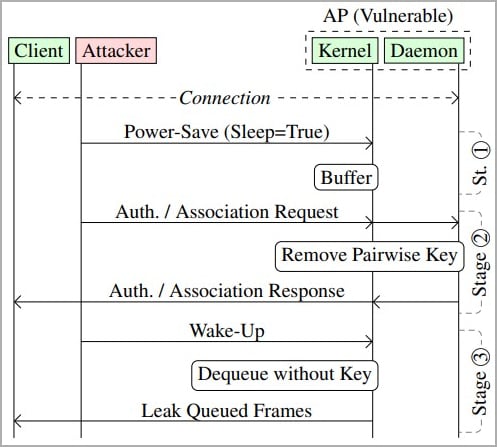
This attack is possible using custom tools created by the researchers called MacStealer, which can test WiFi networks for client isolation bypasses and intercept traffic destined for other clients at the MAC layer.
The researchers report that network device models from Lancom, Aruba, Cisco, Asus, and D-Link are known to be affected by these attacks, with the complete list below.
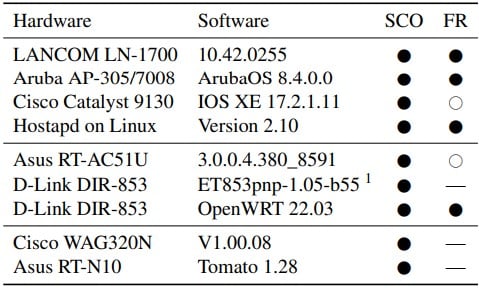
The researchers warn that these attacks could be used to inject malicious content, such as JavaScript, into TCP packets.
"An adversary can use their own Internet-connected server to inject data into this TCP connection by injecting off-path TCP packets with a spoofed sender IP address," warn the researchers.
"This can, for instance, be abused to send malicious JavaScript code to the victim in plaintext HTTP connections with as goal to exploit vulnerabilities in the client's browser."
While this attack could also be used to snoop on traffic, as most web traffic is encrypted using TLS, there would be a limited impact.
The technical details and research are available in USENIX Security 2023 paper, which will be presented at the upcoming BlackHat Asia conference on May 12, 2023.
Cisco acknowledges flaw
The first vendor to acknowledge the impact of the WiFi protocol flaw is Cisco, admitting that the attacks outlined in the paper may be successful against Cisco Wireless Access Point products and Cisco Meraki products with wireless capabilities.
However, Cisco believes says that the retrieved frames are unlikely to jeopardize the overall security of a properly secured network.
"This attack is seen as an opportunistic attack, and the information gained by the attacker would be of minimal value in a securely configured network." - Cisco.
Still, the firm recommends applying mitigation measures like using policy enforcement mechanisms through a system like Cisco Identity Services Engine (ISE), which can restrict network access by implementing Cisco TrustSec or Software Defined Access (SDA) technologies.
"Cisco also recommends implementing transport layer security to encrypt data in transit whenever possible because it would render the acquired data unusable by the attacker," reads the Cisco security advisory.
Currently, there are no known cases of malicious use of the flaw discovered by the researchers.
from Hacker News https://ift.tt/0gXlwGV
Tuesday, March 28, 2023
Brainstorm Questions Not Ideas
We vastly overvalue the idea of “ideas” in design. Meaningful additions to the world rest on novel connections among pre-existing concepts, objects and situations, not self-indulgent originality for its own sake. What we glorify as flashes of brilliance are usually astute observations about the world, improved by critical thinking and critique. And observations often begin from a question.
However, because many of us have been rewarded and praised for having right answers and clever ideas, in school as well as in professional life, the questioning and critiquing part of design can get very uncomfortable. So much easier to sink into the fluffy pillow of groupthink.
Brainstorming ideas and solutions together is an extremely popular activity because it feels collaborative and creativity-enhancing even when it’s really not. Research has shown group brainstorming to be a waste of time. In addition, brainstorming ideas is often anti-collaborative. Everyone secretly, or not so secretly, wants their contribution to "win". And once you frame an exercise as “there are no bad ideas”, well, that’s how you get ants, and really bad ideas that make it out into the world because no one wants to be the bummer or stick their neck out or kill that one lovely darling that already made it into a prototype so we might as well ship it. The Emperor's New Clothes plays out on the daily.
A quick and effective fix is to stop brainstorming ideas with your team, and start brainstorming questions instead. Getting together and listing every question you can think of about a problem, a process, or a situation is uncomfortable at first, and then in very short order enhances collaboration, decreases risk and puts you on the path to being a learning organization.
Whether you’re confronting a lack of clarity or a wellspring of curiosity, getting it out in the open contributes to shared understanding and shared goals, and is far more efficient than pretending mutual understanding. You can fire up the Mystery Machine and investigate together.
Known unknowns are interesting and manageable. Unknown unknowns will jump out and bite you.
How to run the conversation
Excuses to avoid asking questions abound just because it can feel so risky and uncomfortable and daunting at first. So, frame the first try as just that. Take an hour, or even 30 minutes, just to get a bunch out and roughly sorted.
Participants may feel like they need permission to ask anything but the safest, smallest questions, so give it to them. Depending on the group, you may need to prep a couple of more senior people in advance and ask them to model admitting what they don’t know.
I bet you’ll soon start hearing a chorus of “Hey, I was wondering that myself.”
Follow these simple steps in order, and explicitly time-boxed from the top:
-
Identify the most important goal/decision at hand (this could turn into a discussion, or start with prepared material to work from)
-
Take suggestions for any and all, large or small, questions it might be helpful to answer
-
Once you have all your question, plot them according to how little you know and how critical it is to find out
from Hacker News https://ift.tt/2F74x8K
Writing a Profiler in 240 lines of pure Java
A few months back, I started writing a profiler from scratch, and the code since became the base of my profiler validation tools. The only problem with this project: I wanted to write a proper non-safepoint-biased profiler from scratch. This is a noble effort, but it requires lots C/C++/Unix programming which is finicky, and not everyone can read C/C++ code.
For people unfamiliar with safepoint bias: A safepoint is a point in time where the JVM has a known defined state, and all threads have stopped. The JVM itself needs safepoints to do major garbage collections, Class definitions, method deoptimizations, and more. Threads are regularly checking whether they should get into a safepoint, for example, at method entry, exit, or loop backjumps. A profiler that only profiles at a safepoint have an inherent bias because it only includes frames from the locations inside methods where Threads check for a safepoint. The only advantage is that the stack-walking at safepoints is slightly less error-prone, as there are fewer mutations of heap and stack. For more information, consider reading the excellent article Java Safepoint and Async Profiling by Seetha Wenner, the more technical one by JP Bempel, or the classic article Safepoints: Meaning, Side Effects and Overheads by Nitsan Wakart. To conclude: Safepoint-biased profilers don’t give you a holistic view of your application, but can still be helpful to analyze major performance issues where you look at the bigger picture.
This blog post aims to develop a tiny Java profiler in pure Java code that everyone can understand. Profilers are not rocket science, and ignoring safepoint-bias, we can write a usable profiler that outputs a flame graph in just 240 lines of code.
You can find the whole project on GitHub. Feel free to use it as a base for your adventures.
We implement the profiler in a daemon thread started by a Java agent. This allows us to start and run the profiler alongside the Java program we want to profile. The main parts of the profiler are:
- Main: Entry point of the Java agent and starter of the profiling thread
- Options: Parses and stores the agent options
- Profiler: Contains the profiling loop
- Store: Stores and outputs the collected results
Main Class
We start by implementing the agent entry points:
public class Main {
    public static void agentmain(String agentArgs) {
        premain(agentArgs);
    }

    public static void premain(String agentArgs) {
        Main main = new Main();
        main.run(new Options(agentArgs));
    }

    private void run(Options options) {
        Thread t = new Thread(new Profiler(options));
        t.setDaemon(true);
        t.setName("Profiler");
        t.start();
    }
}
The premain is called when the agent is attached to the JVM at the start. This is typical because the user passed the -javagent to the JVM. In our example, this means that the user runs Java with
java -javaagent:./target/tiny_profiler.jar=agentArgs ...
But there is also the possibility that the user attaches the agent at runtime. In this case, the JVM calls the method agentmain. To learn more about Java agent, visit the JDK documentation.
Please be aware that we have to set the Premain-Class and the Agent-Class attributes in the MANIFEST file of our resulting JAR file.
Our Java agent parses the agent arguments to get the options. The options are modeled and parsed by the Options class:
public class Options {
    /** interval option */
    private Duration interval = Duration.ofMillis(10);

    /** flamegraph option */
    private Optional<Path> flamePath;

    /** table option */
    private boolean printMethodTable = true;
    ...
}
The exciting part of the Main class is its run method: The Profiler class implements the Runnable interface so that we can create a thread directly:
Thread t = new Thread(new Profiler(options));
We then mark the profiler thread as a daemon thread; this means that the JVM does terminate at the end of the profiled application even when the profiler thread is running:
t.setDaemon(true);
No, we’re almost finished; we only have to start the thread. Before we do this, we name the thread, this is not required, but it makes debugging easier.
t.setName("Profiler");
t.start();
Profiler Class
The actual sampling takes place in the Profiler class:
public class Profiler implements Runnable {
    private final Options options;
    private final Store store;

    public Profiler(Options options) {
        this.options = options;
        this.store = new Store(options.getFlamePath());
        Runtime.getRuntime().addShutdownHook(new Thread(this::onEnd));
    }

    private static void sleep(Duration duration) {
        // ...
    }

    @Override
    public void run() {
        while (true) {
            Duration start = Duration.ofNanos(System.nanoTime());
            sample();
            Duration duration = Duration.ofNanos(System.nanoTime())
                                        .minus(start);
            Duration sleep = options.getInterval().minus(duration);
            sleep(sleep);
        }
    }

    private void sample() {
        Thread.getAllStackTraces().forEach(
          (thread, stackTraceElements) -> {
            if (!thread.isDaemon()) {
                // exclude daemon threads
                store.addSample(stackTraceElements);
            }
        });
    }

    private void onEnd() {
        if (options.printMethodTable()) {
            store.printMethodTable();
        }
        store.storeFlameGraphIfNeeded();
    }
We start by looking at the constructor. The interesting part is
Runtime.getRuntime().addShutdownHook(new Thread(this::onEnd));
which causes the JVM to call the Profiler::onEnd when it shuts down. This is important as the profiler thread is silently aborted, and we still want to print the captured results. You can read more on shutdown hooks in the Java documentation.
After this, we take a look at the profiling loop in the run method:
while (true) {
    Duration start = Duration.ofNanos(System.nanoTime());
    sample();
    Duration duration = Duration.ofNanos(System.nanoTime())
                                .minus(start);
    Duration sleep = options.getInterval().minus(duration);
    sleep(sleep);
}
This calls the sample method and sleeps the required time afterward, to ensure that the sample method is called every interval (typically 10 ms).
The core sampling takes place in this sample method:
Thread.getAllStackTraces().forEach(
  (thread, stackTraceElements) -> {
    if (!thread.isDaemon()) {
        // exclude daemon threads
        store.addSample(stackTraceElements);
    }
});
We use here the Thread::getAllStackTraces method to obtain the stack traces of all threads. This triggers a safepoint and is why this profiler is safepoint-biased. Taking the stack traces of a subset of threads would not make sense, as there is no method in the JDK for this. Calling Thread::getStackTrace on a subset of threads would trigger many safepoints, not just one, resulting in a more significant performance penalty than obtaining the traces for all threads.
The result of Thread::getAllStackTraces is filtered so that we don’t include daemon threads (like the Profiler thread or unused Fork-Join-Pool threads). We pass the appropriate traces to the Store, which deals with the post-processing.
Store Class
This is the last class of this profiler and also the by far most significant, post-processing, storing, and outputting of the collected information:
package me.bechberger;

import java.io.BufferedOutputStream;
import java.io.OutputStream;
import java.io.PrintStream;
import java.nio.file.Path;
import java.util.HashMap;
import java.util.List;
import java.util.Map;
import java.util.Optional;
import java.util.stream.Stream;

/**
 * store of the traces
 */
public class Store {

    /** too large and browsers can't display it anymore */
    private final int MAX_FLAMEGRAPH_DEPTH = 100;

    private static class Node {
        // ...
    }

    private final Optional<Path> flamePath;
    private final Map<String, Long> methodOnTopSampleCount =
        new HashMap<>();
    private final Map<String, Long> methodSampleCount =
        new HashMap<>();

    private long totalSampleCount = 0;

    /**
     * trace tree node, only populated if flamePath is present
     */
    private final Node rootNode = new Node("root");

    public Store(Optional<Path> flamePath) {
        this.flamePath = flamePath;
    }

    private String flattenStackTraceElement(
      StackTraceElement stackTraceElement) {
        // call intern to safe some memory
        return (stackTraceElement.getClassName() + "." +
            stackTraceElement.getMethodName()).intern();
    }

    private void updateMethodTables(String method, boolean onTop) {
        methodSampleCount.put(method,
            methodSampleCount.getOrDefault(method, 0L) + 1);
        if (onTop) {
            methodOnTopSampleCount.put(method,
                methodOnTopSampleCount.getOrDefault(method, 0L) + 1);
        }
    }

    private void updateMethodTables(List<String> trace) {
        for (int i = 0; i < trace.size(); i++) {
            String method = trace.get(i);
            updateMethodTables(method, i == 0);
        }
    }

    public void addSample(StackTraceElement[] stackTraceElements) {
        List<String> trace =
            Stream.of(stackTraceElements)
                   .map(this::flattenStackTraceElement)
                   .toList();
        updateMethodTables(trace);
        if (flamePath.isPresent()) {
            rootNode.addTrace(trace);
        }
        totalSampleCount++;
    }

    // the only reason this requires Java 17 :P
    private record MethodTableEntry(
        String method,
        long sampleCount,
        long onTopSampleCount) {
    }

    private void printMethodTable(PrintStream s,
      List<MethodTableEntry> sortedEntries) {
        // ...
    }

    public void printMethodTable() {
        // sort methods by sample count
        // the print a table
        // ...
    }

    public void storeFlameGraphIfNeeded() {
        // ...
    }
}
The Profiler calls the addSample method which flattens the stack trace elements and stores them in the trace tree (for the flame graph) and counts the traces that any method is part of.
The interesting part is the trace tree modeled by the Node class. The idea is that every trace A -> B -> C (A calls B, B calls C, [C, B, A]) when returned by the JVM) can be represented as a root node with a child node A with child B with child C, so that every captured trace is a path from the root node to a leaf. We count how many times a node is part of the trace. This can then be used to output the tree data structure for d3-flame-graph which we use to create nice flamegraphs like:

Keep in my mind that the actual Node class is as follows:
private static class Node {
    private final String method;
    private final Map<String, Node> children = new HashMap<>();
    private long samples = 0;

    public Node(String method) {
        this.method = method;
    }

    private Node getChild(String method) {
        return children.computeIfAbsent(method, Node::new);
    }

    private void addTrace(List<String> trace, int end) {
        samples++;
        if (end > 0) {
            getChild(trace.get(end)).addTrace(trace, end - 1);
        }
    }

    public void addTrace(List<String> trace) {
        addTrace(trace, trace.size() - 1);
    }

    /**
     * Write in d3-flamegraph format
     */
    private void writeAsJson(PrintStream s, int maxDepth) {
        s.printf("{ \"name\": \"%s\", \"value\": %d, \"children\": [",
                 method, samples);
        if (maxDepth > 1) {
            for (Node child : children.values()) {
                child.writeAsJson(s, maxDepth - 1);
                s.print(",");
            }
        }
        s.print("]}");
    }

    public void writeAsHTML(PrintStream s, int maxDepth) {
        s.print("""
                <head>
                  <link rel="stylesheet"
                   type="text/css"
                   href="https://cdn.jsdelivr.net/npm/d3-flame-graph@4.1.3/dist/d3-flamegraph.css">
                </head>
                <body>
                  <div id="chart"></div>
                  <script type="text/javascript"
                   src="https://d3js.org/d3.v7.js"></script>
                  <script type="text/javascript"
                   src="https://cdn.jsdelivr.net/npm/d3-flame-graph@4.1.3/dist/d3-flamegraph.min.js"></script>
                  <script type="text/javascript">
                  var chart = flamegraph().width(window.innerWidth);
                  d3.select("#chart").datum(""");
        writeAsJson(s, maxDepth);
        s.print("""
                ).call(chart);
                  window.onresize =
                      () => chart.width(window.innerWidth);
                  </script>
                </body>
                """);
    }
}
Tiny-Profiler
I named the final profiler tiny-profiler and its sources are on GitHub (MIT licensed). The profiler should work on any platform with a JDK 17 or newer. The usage is fairly simple:
# build it
mvn package

# run your program and print the table of methods sorted by their sample count
# and the flame graph, taking a sample every 10ms
java -javaagent:target/tiny-profiler.jar=flamegraph=flame.html ...
You can easily run it on the renaissance benchmark and create the flame graph shown earlier:
# download a benchmark
> test -e renaissance.jar || wget https://github.com/renaissance-benchmarks/renaissance/releases/download/v0.14.2/renaissance-gpl-0.14.2.jar -O renaissance.jar

> java -javaagent:./target/tiny_profiler.jar=flamegraph=flame.html -jar renaissance.jar dotty
...
===== method table ======
Total samples: 11217
Method                                      Samples Percentage  On top Percentage
dotty.tools.dotc.typer.Typer.typed            59499     530.44       2       0.02
dotty.tools.dotc.typer.Typer.typedUnadapted   31050     276.81       7       0.06
scala.runtime.function.JProcedure1.apply      24283     216.48      13       0.12
dotty.tools.dotc.Driver.process               19012     169.49       0       0.00
dotty.tools.dotc.typer.Typer.typedUnnamed$1   18774     167.37       7       0.06
dotty.tools.dotc.typer.Typer.typedExpr        18072     161.11       0       0.00
scala.collection.immutable.List.foreach       16271     145.06       3       0.03
...
The overhead for this example is around 2% on my MacBook Pro 13″ for a 10ms interval, which makes the profiler usable when you ignore the safepoint-bias.
Conclusion
Writing a Java profiler in 240 lines of pure Java is possible and the resulting profiler could even be used to analyze performance problems. This profiler is not designed to replace real profilers like async-profiler, but it demystifies the inner workings of simple profilers.
I hope you enjoyed this code-heavy blog post. As always I’m happy for any feedback, issue, or PR.
This blog post is part of my work in the SapMachine team at SAP, making profiling easier for everyone. Significant parts of this post have been written below the English channel…
from Hacker News https://ift.tt/rDY01Et
Modern software performance is firmly in its “beyond parody” stage
Modern software performance is firmly in its "beyond parody" stage.https://t.co/jA0jSc8rsp
— Casey Muratori (@cmuratori) March 28, 2023
from Hacker News https://twitter.com/cmuratori/status/1640827575437250561
OpenPGP master key on Nitrokey Start
I’ve used hardware-backed OpenPGP keys since 2006 when I imported newly generated rsa1024 subkeys to a FSFE Fellowship card. This worked well for several years, and I recall buying more ZeitControl cards for multi-machine usage and backup purposes. As a side note, I recall being unsatisfied with the weak 1024-bit RSA subkeys at the time – my primary key was a somewhat stronger 1280-bit RSA key created back in 2002 — but OpenPGP cards at the time didn’t support more than 1024 bit RSA, and were (and still often are) also limited to power-of-two RSA key sizes which I dislike.
I had my master key on disk with a strong password for a while, mostly to refresh expiration time of the subkeys and to sign other’s OpenPGP keys. At some point I stopped carrying around encrypted copies of my master key. That was my main setup when I migrated to a new stronger RSA 3744 bit key with rsa2048 subkeys on a YubiKey NEO back in 2014. At that point, signing other’s OpenPGP keys was a rare enough occurrence that I settled with bringing out my offline machine to perform this operation, transferring the public key to sign on USB sticks. In 2019 I re-evaluated my OpenPGP setup and ended up creating a offline Ed25519 key with subkeys on a FST-01G running Gnuk. My approach for signing other’s OpenPGP keys were still to bring out my offline machine and sign things using the master secret using USB sticks for storage and transport. Which meant I almost never did that, because it took too much effort. So my 2019-era Ed25519 key still only has a handful of signatures on it, since I had essentially stopped signing other’s keys which is the traditional way of getting signatures in return.
None of this caused any critical problem for me because I continued to use my old 2014-era RSA3744 key in parallel with my new 2019-era Ed25519 key, since too many systems didn’t handle Ed25519. However, during 2022 this changed, and the only remaining environment that I still used my RSA3744 key for was in Debian — and they require OpenPGP signatures on the new key to allow it to replace an older key. I was in denial about this sub-optimal solution during 2022 and endured its practical consequences, having to use the YubiKey NEO (which I had replaced with a permanently inserted YubiKey Nano at some point) for Debian-related purposes alone.
In December 2022 I bought a new laptop and setup a FST-01SZ with my Ed25519 key, and while I have taken a vacation from Debian, I continue to extend the expiration period on the old RSA3744-key in case I will ever have to use it again, so the overall OpenPGP setup was still sub-optimal. Having two valid OpenPGP keys at the same time causes people to use both for email encryption (leading me to have to use both devices), and the WKD Key Discovery protocol doesn’t like two valid keys either. At FOSDEM’23 I ran into Andre Heinecke at GnuPG and I couldn’t help complain about how complex and unsatisfying all OpenPGP-related matters were, and he mildly ignored my rant and asked why I didn’t put the master key on another smartcard. The comment sunk in when I came home, and recently I connected all the dots and this post is a summary of what I did to move my offline OpenPGP master key to a Nitrokey Start.
First a word about device choice, I still prefer to use hardware devices that are as compatible with free software as possible, but the FST-01G or FST-01SZ are no longer easily available for purchase. I got a comment about Nitrokey start in my last post, and had two of them available to experiment with. There are things to dislike with the Nitrokey Start compared to the YubiKey (e.g., relative insecure physical architecture, the bulkier form factor and lack of FIDO/U2F/OATH support) but – as far as I know – there is no more widely available owner-controlled device that is manufactured for an intended purpose of implementing an OpenPGP card. Thus it hits the sweet spot for me.
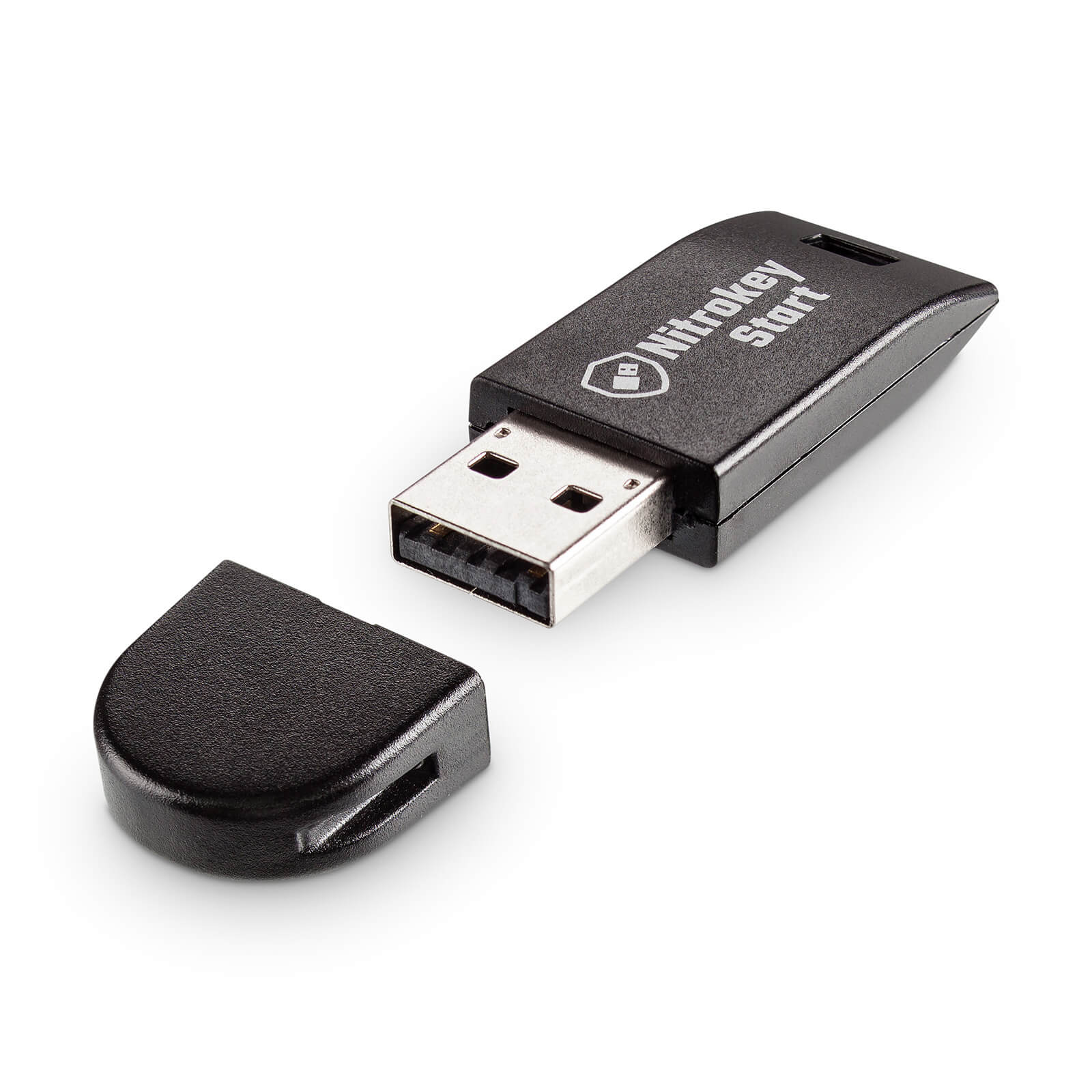
The first step is to run latest firmware on the Nitrokey Start – for bug-fixes and important OpenSSH 9.0 compatibility – and there are reproducible-built firmware published that you can install using pynitrokey. I run Trisquel 11 aramo on my laptop, which does not include the Python Pip package (likely because it promotes installing non-free software) so that was a slight complication. Building the firmware locally may have worked, and I would like to do that eventually to confirm the published firmware, however to save time I settled with installing the Ubuntu 22.04 packages on my machine:
$ sha256sum python3-pip*
ded6b3867a4a4cbaff0940cab366975d6aeecc76b9f2d2efa3deceb062668b1c  python3-pip_22.0.2+dfsg-1ubuntu0.2_all.deb
e1561575130c41dc3309023a345de337e84b4b04c21c74db57f599e267114325  python3-pip-whl_22.0.2+dfsg-1ubuntu0.2_all.deb
$ doas dpkg -i python3-pip*
...
$ doas apt install -f
...
$
Install pynitrokey downloaded a bunch of dependencies, and it would be nice to audit the license and security vulnerabilities for each of them.
jas@kaka:~$ pip3 install --user pynitrokey
Collecting pynitrokey
  Downloading pynitrokey-0.4.34-py3-none-any.whl (572 kB)
     ━━━━━━━━━━━━━━━━━━━━━━━━━━━━━━━━━━━━━━━ 572.3/572.3 KB 5.8 MB/s eta 0:00:00
Collecting frozendict~=2.3.4
  Downloading frozendict-2.3.5-cp310-cp310-manylinux_2_17_x86_64.manylinux2014_x86_64.whl (113 kB)
     ━━━━━━━━━━━━━━━━━━━━━━━━━━━━━━━━━━━━━━━ 113.4/113.4 KB 5.3 MB/s eta 0:00:00
Requirement already satisfied: click<9,>=8.0.0 in /usr/lib/python3/dist-packages (from pynitrokey) (8.0.3)
Collecting ecdsa
  Downloading ecdsa-0.18.0-py2.py3-none-any.whl (142 kB)
     ━━━━━━━━━━━━━━━━━━━━━━━━━━━━━━━━━━━━━━━ 142.9/142.9 KB 6.0 MB/s eta 0:00:00
Collecting python-dateutil~=2.7.0
  Downloading python_dateutil-2.7.5-py2.py3-none-any.whl (225 kB)
     ━━━━━━━━━━━━━━━━━━━━━━━━━━━━━━━━━━━━━━━ 225.7/225.7 KB 7.4 MB/s eta 0:00:00
Collecting fido2<2,>=1.1.0
  Downloading fido2-1.1.0-py3-none-any.whl (201 kB)
     ━━━━━━━━━━━━━━━━━━━━━━━━━━━━━━━━━━━━━━━ 201.1/201.1 KB 5.5 MB/s eta 0:00:00
Collecting tlv8
  Downloading tlv8-0.10.0.tar.gz (16 kB)
  Preparing metadata (setup.py) ... done
Requirement already satisfied: certifi>=14.5.14 in /usr/lib/python3/dist-packages (from pynitrokey) (2020.6.20)
Requirement already satisfied: pyusb in /usr/lib/python3/dist-packages (from pynitrokey) (1.2.1.post1)
Collecting urllib3~=1.26.7
  Downloading urllib3-1.26.15-py2.py3-none-any.whl (140 kB)
     ━━━━━━━━━━━━━━━━━━━━━━━━━━━━━━━━━━━━━━━ 140.9/140.9 KB 6.8 MB/s eta 0:00:00
Collecting spsdk<1.8.0,>=1.7.0
  Downloading spsdk-1.7.1-py3-none-any.whl (684 kB)
     ━━━━━━━━━━━━━━━━━━━━━━━━━━━━━━━━━━━━━━━ 684.7/684.7 KB 8.3 MB/s eta 0:00:00
Collecting typing_extensions~=4.3.0
  Downloading typing_extensions-4.3.0-py3-none-any.whl (25 kB)
Requirement already satisfied: cryptography<37,>=3.4.4 in /usr/lib/python3/dist-packages (from pynitrokey) (3.4.8)
Collecting intelhex
  Downloading intelhex-2.3.0-py2.py3-none-any.whl (50 kB)
     ━━━━━━━━━━━━━━━━━━━━━━━━━━━━━━━━━━━━━━━━ 50.9/50.9 KB 4.9 MB/s eta 0:00:00
Collecting nkdfu
  Downloading nkdfu-0.2-py3-none-any.whl (16 kB)
Requirement already satisfied: requests in /usr/lib/python3/dist-packages (from pynitrokey) (2.25.1)
Collecting tqdm
  Downloading tqdm-4.65.0-py3-none-any.whl (77 kB)
     ━━━━━━━━━━━━━━━━━━━━━━━━━━━━━━━━━━━━━━━━ 77.1/77.1 KB 5.4 MB/s eta 0:00:00
Collecting nrfutil<7,>=6.1.4
  Downloading nrfutil-6.1.7.tar.gz (845 kB)
     ━━━━━━━━━━━━━━━━━━━━━━━━━━━━━━━━━━━━━━━ 845.3/845.3 KB 7.1 MB/s eta 0:00:00
  Preparing metadata (setup.py) ... done
Requirement already satisfied: cffi in /usr/lib/python3/dist-packages (from pynitrokey) (1.15.0)
Collecting crcmod
  Downloading crcmod-1.7.tar.gz (89 kB)
     ━━━━━━━━━━━━━━━━━━━━━━━━━━━━━━━━━━━━━━━━ 89.7/89.7 KB 3.9 MB/s eta 0:00:00
  Preparing metadata (setup.py) ... done
Collecting libusb1==1.9.3
  Downloading libusb1-1.9.3-py3-none-any.whl (60 kB)
     ━━━━━━━━━━━━━━━━━━━━━━━━━━━━━━━━━━━━━━━━ 60.5/60.5 KB 3.7 MB/s eta 0:00:00
Collecting pc_ble_driver_py>=0.16.4
  Downloading pc_ble_driver_py-0.17.0-cp310-cp310-manylinux_2_17_x86_64.manylinux2014_x86_64.whl (2.9 MB)
     ━━━━━━━━━━━━━━━━━━━━━━━━━━━━━━━━━━━━━━━━ 2.9/2.9 MB 8.2 MB/s eta 0:00:00
Collecting piccata
  Downloading piccata-2.0.3-py3-none-any.whl (21 kB)
Collecting protobuf<4.0.0,>=3.17.3
  Downloading protobuf-3.20.3-cp310-cp310-manylinux_2_12_x86_64.manylinux2010_x86_64.whl (1.1 MB)
     ━━━━━━━━━━━━━━━━━━━━━━━━━━━━━━━━━━━━━━━━ 1.1/1.1 MB 8.0 MB/s eta 0:00:00
Collecting pyserial
  Downloading pyserial-3.5-py2.py3-none-any.whl (90 kB)
     ━━━━━━━━━━━━━━━━━━━━━━━━━━━━━━━━━━━━━━━━ 90.6/90.6 KB 4.7 MB/s eta 0:00:00
Collecting pyspinel>=1.0.0a3
  Downloading pyspinel-1.0.3.tar.gz (58 kB)
     ━━━━━━━━━━━━━━━━━━━━━━━━━━━━━━━━━━━━━━━━ 58.7/58.7 KB 3.7 MB/s eta 0:00:00
  Preparing metadata (setup.py) ... done
Requirement already satisfied: pyyaml in /usr/lib/python3/dist-packages (from nrfutil<7,>=6.1.4->pynitrokey) (5.4.1)
Requirement already satisfied: six>=1.5 in /usr/lib/python3/dist-packages (from python-dateutil~=2.7.0->pynitrokey) (1.16.0)
Collecting pylink-square<0.11.9,>=0.8.2
  Downloading pylink_square-0.11.1-py2.py3-none-any.whl (78 kB)
     ━━━━━━━━━━━━━━━━━━━━━━━━━━━━━━━━━━━━━━━━ 78.4/78.4 KB 5.0 MB/s eta 0:00:00
Collecting jinja2<3.1,>=2.11
  Downloading Jinja2-3.0.3-py3-none-any.whl (133 kB)
     ━━━━━━━━━━━━━━━━━━━━━━━━━━━━━━━━━━━━━━━ 133.6/133.6 KB 6.7 MB/s eta 0:00:00
Collecting bincopy<17.11,>=17.10.2
  Downloading bincopy-17.10.3-py3-none-any.whl (17 kB)
Collecting fastjsonschema>=2.15.1
  Downloading fastjsonschema-2.16.3-py3-none-any.whl (23 kB)
Collecting astunparse<2,>=1.6
  Downloading astunparse-1.6.3-py2.py3-none-any.whl (12 kB)
Collecting oscrypto~=1.2
  Downloading oscrypto-1.3.0-py2.py3-none-any.whl (194 kB)
     ━━━━━━━━━━━━━━━━━━━━━━━━━━━━━━━━━━━━━━━━ 194.6/194.6 KB 7.3 MB/s eta 0:00:00
Collecting deepmerge==0.3.0
  Downloading deepmerge-0.3.0-py2.py3-none-any.whl (7.6 kB)
Collecting pyocd<=0.31.0,>=0.28.3
  Downloading pyocd-0.31.0-py3-none-any.whl (12.5 MB)
     ━━━━━━━━━━━━━━━━━━━━━━━━━━━━━━━━━━━━━━━━ 12.5/12.5 MB 3.9 MB/s eta 0:00:00
Collecting click-option-group<0.6,>=0.3.0
  Downloading click_option_group-0.5.5-py3-none-any.whl (12 kB)
Collecting pycryptodome<4,>=3.9.3
  Downloading pycryptodome-3.17-cp35-abi3-manylinux_2_17_x86_64.manylinux2014_x86_64.whl (2.1 MB)
     ━━━━━━━━━━━━━━━━━━━━━━━━━━━━━━━━━━━━━━━━ 2.1/2.1 MB 7.9 MB/s eta 0:00:00
Collecting pyocd-pemicro<1.2.0,>=1.1.1
  Downloading pyocd_pemicro-1.1.5-py3-none-any.whl (9.0 kB)
Requirement already satisfied: colorama<1,>=0.4.4 in /usr/lib/python3/dist-packages (from spsdk<1.8.0,>=1.7.0->pynitrokey) (0.4.4)
Collecting commentjson<1,>=0.9
  Downloading commentjson-0.9.0.tar.gz (8.7 kB)
  Preparing metadata (setup.py) ... done
Requirement already satisfied: asn1crypto<2,>=1.2 in /usr/lib/python3/dist-packages (from spsdk<1.8.0,>=1.7.0->pynitrokey) (1.4.0)
Collecting pypemicro<0.2.0,>=0.1.9
  Downloading pypemicro-0.1.11-py3-none-any.whl (5.7 MB)
     ━━━━━━━━━━━━━━━━━━━━━━━━━━━━━━━━━━━━━━━━ 5.7/5.7 MB 8.8 MB/s eta 0:00:00
Collecting libusbsio>=2.1.11
  Downloading libusbsio-2.1.11-py3-none-any.whl (247 kB)
     ━━━━━━━━━━━━━━━━━━━━━━━━━━━━━━━━━━━━━━━━ 247.1/247.1 KB 7.9 MB/s eta 0:00:00
Collecting sly==0.4
  Downloading sly-0.4.tar.gz (60 kB)
     ━━━━━━━━━━━━━━━━━━━━━━━━━━━━━━━━━━━━━━━━ 60.6/60.6 KB 5.1 MB/s eta 0:00:00
  Preparing metadata (setup.py) ... done
Collecting ruamel.yaml<0.18.0,>=0.17
  Downloading ruamel.yaml-0.17.21-py3-none-any.whl (109 kB)
     ━━━━━━━━━━━━━━━━━━━━━━━━━━━━━━━━━━━━━━━━ 109.5/109.5 KB 4.2 MB/s eta 0:00:00
Collecting cmsis-pack-manager<0.3.0
  Downloading cmsis_pack_manager-0.2.10-py2.py3-none-manylinux1_x86_64.whl (25.1 MB)
     ━━━━━━━━━━━━━━━━━━━━━━━━━━━━━━━━━━━━━━━━ 25.1/25.1 MB 8.5 MB/s eta 0:00:00
Collecting click-command-tree==1.1.0
  Downloading click_command_tree-1.1.0-py3-none-any.whl (3.6 kB)
Requirement already satisfied: bitstring<3.2,>=3.1 in /usr/lib/python3/dist-packages (from spsdk<1.8.0,>=1.7.0->pynitrokey) (3.1.7)
Collecting hexdump~=3.3
  Downloading hexdump-3.3.zip (12 kB)
  Preparing metadata (setup.py) ... done
Collecting fire
  Downloading fire-0.5.0.tar.gz (88 kB)
     ━━━━━━━━━━━━━━━━━━━━━━━━━━━━━━━━━━━━━━━━ 88.3/88.3 KB 4.7 MB/s eta 0:00:00
  Preparing metadata (setup.py) ... done
Requirement already satisfied: wheel<1.0,>=0.23.0 in /usr/lib/python3/dist-packages (from astunparse<2,>=1.6->spsdk<1.8.0,>=1.7.0->pynitrokey) (0.37.1)
Collecting humanfriendly
  Downloading humanfriendly-10.0-py2.py3-none-any.whl (86 kB)
     ━━━━━━━━━━━━━━━━━━━━━━━━━━━━━━━━━━━━━━━━ 86.8/86.8 KB 4.6 MB/s eta 0:00:00
Collecting argparse-addons>=0.4.0
  Downloading argparse_addons-0.12.0-py3-none-any.whl (3.3 kB)
Collecting pyelftools
  Downloading pyelftools-0.29-py2.py3-none-any.whl (174 kB)
     ━━━━━━━━━━━━━━━━━━━━━━━━━━━━━━━━━━━━━━━━ 174.3/174.3 KB 4.1 MB/s eta 0:00:00
Collecting milksnake>=0.1.2
  Downloading milksnake-0.1.5-py2.py3-none-any.whl (9.6 kB)
Requirement already satisfied: appdirs>=1.4 in /usr/lib/python3/dist-packages (from cmsis-pack-manager<0.3.0->spsdk<1.8.0,>=1.7.0->pynitrokey) (1.4.4)
Collecting lark-parser<0.8.0,>=0.7.1
  Downloading lark-parser-0.7.8.tar.gz (276 kB)
     ━━━━━━━━━━━━━━━━━━━━━━━━━━━━━━━━━━━━━━━━ 276.2/276.2 KB 6.6 MB/s eta 0:00:00
  Preparing metadata (setup.py) ... done
Requirement already satisfied: MarkupSafe>=2.0 in /usr/lib/python3/dist-packages (from jinja2<3.1,>=2.11->spsdk<1.8.0,>=1.7.0->pynitrokey) (2.0.1)
Collecting asn1crypto<2,>=1.2
  Downloading asn1crypto-1.5.1-py2.py3-none-any.whl (105 kB)
     ━━━━━━━━━━━━━━━━━━━━━━━━━━━━━━━━━━━━━━━━ 105.0/105.0 KB 6.8 MB/s eta 0:00:00
Collecting wrapt
  Downloading wrapt-1.15.0-cp310-cp310-manylinux_2_5_x86_64.manylinux1_x86_64.manylinux_2_17_x86_64.manylinux2014_x86_64.whl (78 kB)
     ━━━━━━━━━━━━━━━━━━━━━━━━━━━━━━━━━━━━━━━━ 78.4/78.4 KB 4.6 MB/s eta 0:00:00
Collecting future
  Downloading future-0.18.3.tar.gz (840 kB)
     ━━━━━━━━━━━━━━━━━━━━━━━━━━━━━━━━━━━━━━━━ 840.9/840.9 KB 7.1 MB/s eta 0:00:00
  Preparing metadata (setup.py) ... done
Collecting psutil>=5.2.2
  Downloading psutil-5.9.4-cp36-abi3-manylinux_2_12_x86_64.manylinux2010_x86_64.manylinux_2_17_x86_64.manylinux2014_x86_64.whl (280 kB)
     ━━━━━━━━━━━━━━━━━━━━━━━━━━━━━━━━━━━━━━━━ 280.2/280.2 KB 6.1 MB/s eta 0:00:00
Collecting capstone<5.0,>=4.0
  Downloading capstone-4.0.2-py2.py3-none-manylinux1_x86_64.whl (2.1 MB)
     ━━━━━━━━━━━━━━━━━━━━━━━━━━━━━━━━━━━━━━━━ 2.1/2.1 MB 7.0 MB/s eta 0:00:00
Collecting naturalsort<2.0,>=1.5
  Downloading naturalsort-1.5.1.tar.gz (7.4 kB)
  Preparing metadata (setup.py) ... done
Collecting prettytable<3.0,>=2.0
  Downloading prettytable-2.5.0-py3-none-any.whl (24 kB)
Collecting intervaltree<4.0,>=3.0.2
  Downloading intervaltree-3.1.0.tar.gz (32 kB)
  Preparing metadata (setup.py) ... done
Collecting ruamel.yaml.clib>=0.2.6
  Downloading ruamel.yaml.clib-0.2.7-cp310-cp310-manylinux_2_17_x86_64.manylinux2014_x86_64.manylinux_2_24_x86_64.whl (485 kB)
     ━━━━━━━━━━━━━━━━━━━━━━━━━━━━━━━━━━━━━━━━ 485.6/485.6 KB 7.4 MB/s eta 0:00:00
Collecting termcolor
  Downloading termcolor-2.2.0-py3-none-any.whl (6.6 kB)
Collecting sortedcontainers<3.0,>=2.0
  Downloading sortedcontainers-2.4.0-py2.py3-none-any.whl (29 kB)
Requirement already satisfied: wcwidth in /usr/lib/python3/dist-packages (from prettytable<3.0,>=2.0->pyocd<=0.31.0,>=0.28.3->spsdk<1.8.0,>=1.7.0->pynitrokey) (0.2.5)
Building wheels for collected packages: nrfutil, crcmod, sly, tlv8, commentjson, hexdump, pyspinel, fire, intervaltree, lark-parser, naturalsort, future
  Building wheel for nrfutil (setup.py) ... done
  Created wheel for nrfutil: filename=nrfutil-6.1.7-py3-none-any.whl size=898520 sha256=de6f8803f51d6c26d24dc7df6292064a468ff3f389d73370433fde5582b84a10
  Stored in directory: /home/jas/.cache/pip/wheels/39/2b/9b/98ab2dd716da746290e6728bdb557b14c1c9a54cb9ed86e13b
  Building wheel for crcmod (setup.py) ... done
  Created wheel for crcmod: filename=crcmod-1.7-cp310-cp310-linux_x86_64.whl size=31422 sha256=5149ac56fcbfa0606760eef5220fcedc66be560adf68cf38c604af3ad0e4a8b0
  Stored in directory: /home/jas/.cache/pip/wheels/85/4c/07/72215c529bd59d67e3dac29711d7aba1b692f543c808ba9e86
  Building wheel for sly (setup.py) ... done
  Created wheel for sly: filename=sly-0.4-py3-none-any.whl size=27352 sha256=f614e413918de45c73d1e9a8dca61ca07dc760d9740553400efc234c891f7fde
  Stored in directory: /home/jas/.cache/pip/wheels/a2/23/4a/6a84282a0d2c29f003012dc565b3126e427972e8b8157ea51f
  Building wheel for tlv8 (setup.py) ... done
  Created wheel for tlv8: filename=tlv8-0.10.0-py3-none-any.whl size=11266 sha256=3ec8b3c45977a3addbc66b7b99e1d81b146607c3a269502b9b5651900a0e2d08
  Stored in directory: /home/jas/.cache/pip/wheels/e9/35/86/66a473cc2abb0c7f21ed39c30a3b2219b16bd2cdb4b33cfc2c
  Building wheel for commentjson (setup.py) ... done
  Created wheel for commentjson: filename=commentjson-0.9.0-py3-none-any.whl size=12092 sha256=28b6413132d6d7798a18cf8c76885dc69f676ea763ffcb08775a3c2c43444f4a
  Stored in directory: /home/jas/.cache/pip/wheels/7d/90/23/6358a234ca5b4ec0866d447079b97fedf9883387d1d7d074e5
  Building wheel for hexdump (setup.py) ... done
  Created wheel for hexdump: filename=hexdump-3.3-py3-none-any.whl size=8913 sha256=79dfadd42edbc9acaeac1987464f2df4053784fff18b96408c1309b74fd09f50
  Stored in directory: /home/jas/.cache/pip/wheels/26/28/f7/f47d7ecd9ae44c4457e72c8bb617ef18ab332ee2b2a1047e87
  Building wheel for pyspinel (setup.py) ... done
  Created wheel for pyspinel: filename=pyspinel-1.0.3-py3-none-any.whl size=65033 sha256=01dc27f81f28b4830a0cf2336dc737ef309a1287fcf33f57a8a4c5bed3b5f0a6
  Stored in directory: /home/jas/.cache/pip/wheels/95/ec/4b/6e3e2ee18e7292d26a65659f75d07411a6e69158bb05507590
  Building wheel for fire (setup.py) ... done
  Created wheel for fire: filename=fire-0.5.0-py2.py3-none-any.whl size=116951 sha256=3d288585478c91a6914629eb739ea789828eb2d0267febc7c5390cb24ba153e8
  Stored in directory: /home/jas/.cache/pip/wheels/90/d4/f7/9404e5db0116bd4d43e5666eaa3e70ab53723e1e3ea40c9a95
  Building wheel for intervaltree (setup.py) ... done
  Created wheel for intervaltree: filename=intervaltree-3.1.0-py2.py3-none-any.whl size=26119 sha256=5ff1def22ba883af25c90d90ef7c6518496fcd47dd2cbc53a57ec04cd60dc21d
  Stored in directory: /home/jas/.cache/pip/wheels/fa/80/8c/43488a924a046b733b64de3fac99252674c892a4c3801c0a61
  Building wheel for lark-parser (setup.py) ... done
  Created wheel for lark-parser: filename=lark_parser-0.7.8-py2.py3-none-any.whl size=62527 sha256=3d2ec1d0f926fc2688d40777f7ef93c9986f874169132b1af590b6afc038f4be
  Stored in directory: /home/jas/.cache/pip/wheels/29/30/94/33e8b58318aa05cb1842b365843036e0280af5983abb966b83
  Building wheel for naturalsort (setup.py) ... done
  Created wheel for naturalsort: filename=naturalsort-1.5.1-py3-none-any.whl size=7526 sha256=bdecac4a49f2416924548cae6c124c85d5333e9e61c563232678ed182969d453
  Stored in directory: /home/jas/.cache/pip/wheels/a6/8e/c9/98cfa614fff2979b457fa2d9ad45ec85fa417e7e3e2e43be51
  Building wheel for future (setup.py) ... done
  Created wheel for future: filename=future-0.18.3-py3-none-any.whl size=492037 sha256=57a01e68feca2b5563f5f624141267f399082d2f05f55886f71b5d6e6cf2b02c
  Stored in directory: /home/jas/.cache/pip/wheels/5e/a9/47/f118e66afd12240e4662752cc22cefae5d97275623aa8ef57d
Successfully built nrfutil crcmod sly tlv8 commentjson hexdump pyspinel fire intervaltree lark-parser naturalsort future
Installing collected packages: tlv8, sortedcontainers, sly, pyserial, pyelftools, piccata, naturalsort, libusb1, lark-parser, intelhex, hexdump, fastjsonschema, crcmod, asn1crypto, wrapt, urllib3, typing_extensions, tqdm, termcolor, ruamel.yaml.clib, python-dateutil, pyspinel, pypemicro, pycryptodome, psutil, protobuf, prettytable, oscrypto, milksnake, libusbsio, jinja2, intervaltree, humanfriendly, future, frozendict, fido2, ecdsa, deepmerge, commentjson, click-option-group, click-command-tree, capstone, astunparse, argparse-addons, ruamel.yaml, pyocd-pemicro, pylink-square, pc_ble_driver_py, fire, cmsis-pack-manager, bincopy, pyocd, nrfutil, nkdfu, spsdk, pynitrokey
  WARNING: The scripts pyserial-miniterm and pyserial-ports are installed in '/home/jas/.local/bin' which is not on PATH.
  Consider adding this directory to PATH or, if you prefer to suppress this warning, use --no-warn-script-location.
  WARNING: The script tqdm is installed in '/home/jas/.local/bin' which is not on PATH.
  Consider adding this directory to PATH or, if you prefer to suppress this warning, use --no-warn-script-location.
  WARNING: The script humanfriendly is installed in '/home/jas/.local/bin' which is not on PATH.
  Consider adding this directory to PATH or, if you prefer to suppress this warning, use --no-warn-script-location.
  WARNING: The scripts futurize and pasteurize are installed in '/home/jas/.local/bin' which is not on PATH.
  Consider adding this directory to PATH or, if you prefer to suppress this warning, use --no-warn-script-location.
  WARNING: The script pylink is installed in '/home/jas/.local/bin' which is not on PATH.
  Consider adding this directory to PATH or, if you prefer to suppress this warning, use --no-warn-script-location.
  WARNING: The script pack-manager is installed in '/home/jas/.local/bin' which is not on PATH.
  Consider adding this directory to PATH or, if you prefer to suppress this warning, use --no-warn-script-location.
  WARNING: The script bincopy is installed in '/home/jas/.local/bin' which is not on PATH.
  Consider adding this directory to PATH or, if you prefer to suppress this warning, use --no-warn-script-location.
  WARNING: The scripts pyocd and pyocd-gdbserver are installed in '/home/jas/.local/bin' which is not on PATH.
  Consider adding this directory to PATH or, if you prefer to suppress this warning, use --no-warn-script-location.
  WARNING: The script nrfutil is installed in '/home/jas/.local/bin' which is not on PATH.
  Consider adding this directory to PATH or, if you prefer to suppress this warning, use --no-warn-script-location.
  WARNING: The script nkdfu is installed in '/home/jas/.local/bin' which is not on PATH.
  Consider adding this directory to PATH or, if you prefer to suppress this warning, use --no-warn-script-location.
  WARNING: The scripts blhost, elftosb, nxpcertgen, nxpcrypto, nxpdebugmbox, nxpdevhsm, nxpdevscan, nxpimage, nxpkeygen, pfr, pfrc, sdphost, sdpshost, shadowregs, spsdk, tpconfig and tphost are installed in '/home/jas/.local/bin' which is not on PATH.
  Consider adding this directory to PATH or, if you prefer to suppress this warning, use --no-warn-script-location.
  WARNING: The script nitropy is installed in '/home/jas/.local/bin' which is not on PATH.
  Consider adding this directory to PATH or, if you prefer to suppress this warning, use --no-warn-script-location.
Successfully installed argparse-addons-0.12.0 asn1crypto-1.5.1 astunparse-1.6.3 bincopy-17.10.3 capstone-4.0.2 click-command-tree-1.1.0 click-option-group-0.5.5 cmsis-pack-manager-0.2.10 commentjson-0.9.0 crcmod-1.7 deepmerge-0.3.0 ecdsa-0.18.0 fastjsonschema-2.16.3 fido2-1.1.0 fire-0.5.0 frozendict-2.3.5 future-0.18.3 hexdump-3.3 humanfriendly-10.0 intelhex-2.3.0 intervaltree-3.1.0 jinja2-3.0.3 lark-parser-0.7.8 libusb1-1.9.3 libusbsio-2.1.11 milksnake-0.1.5 naturalsort-1.5.1 nkdfu-0.2 nrfutil-6.1.7 oscrypto-1.3.0 pc_ble_driver_py-0.17.0 piccata-2.0.3 prettytable-2.5.0 protobuf-3.20.3 psutil-5.9.4 pycryptodome-3.17 pyelftools-0.29 pylink-square-0.11.1 pynitrokey-0.4.34 pyocd-0.31.0 pyocd-pemicro-1.1.5 pypemicro-0.1.11 pyserial-3.5 pyspinel-1.0.3 python-dateutil-2.7.5 ruamel.yaml-0.17.21 ruamel.yaml.clib-0.2.7 sly-0.4 sortedcontainers-2.4.0 spsdk-1.7.1 termcolor-2.2.0 tlv8-0.10.0 tqdm-4.65.0 typing_extensions-4.3.0 urllib3-1.26.15 wrapt-1.15.0
jas@kaka:~$
Then upgrading the device worked remarkable well, although I wish that the tool would have printed URLs and checksums for the firmware files to allow easy confirmation.
jas@kaka:~$ PATH=$PATH:/home/jas/.local/bin
jas@kaka:~$ nitropy start list
Command line tool to interact with Nitrokey devices 0.4.34
:: 'Nitrokey Start' keys:
FSIJ-1.2.15-5D271572: Nitrokey Nitrokey Start (RTM.12.1-RC2-modified)
jas@kaka:~$ nitropy start update
Command line tool to interact with Nitrokey devices 0.4.34
Nitrokey Start firmware update tool
Platform: Linux-5.15.0-67-generic-x86_64-with-glibc2.35
System: Linux, is_linux: True
Python: 3.10.6
Saving run log to: /tmp/nitropy.log.gc5753a8
Admin PIN:
Firmware data to be used:
- FirmwareType.REGNUAL: 4408, hash: ...b'72a30389' valid (from ...built/RTM.13/regnual.bin)
- FirmwareType.GNUK: 129024, hash: ...b'25a4289b' valid (from ...prebuilt/RTM.13/gnuk.bin)
Currently connected device strings:
Device:
    Vendor: Nitrokey
   Product: Nitrokey Start
    Serial: FSIJ-1.2.15-5D271572
  Revision: RTM.12.1-RC2-modified
    Config: *:*:8e82
       Sys: 3.0
     Board: NITROKEY-START-G
initial device strings: [{'name': '', 'Vendor': 'Nitrokey', 'Product': 'Nitrokey Start', 'Serial': 'FSIJ-1.2.15-5D271572', 'Revision': 'RTM.12.1-RC2-modified', 'Config': '*:*:8e82', 'Sys': '3.0', 'Board': 'NITROKEY-START-G'}]
Please note:
- Latest firmware available is:
  RTM.13 (published: 2022-12-08T10:59:11Z)
- provided firmware: None
- all data will be removed from the device!
- do not interrupt update process - the device may not run properly!
- the process should not take more than 1 minute
Do you want to continue? [yes/no]: yes
...
Starting bootloader upload procedure
Device: Nitrokey Start FSIJ-1.2.15-5D271572
Connected to the device
Running update!
Do NOT remove the device from the USB slot, until further notice
Downloading flash upgrade program...
Executing flash upgrade...
Waiting for device to appear:
  Wait 20 seconds.....

Downloading the program
Protecting device
Finish flashing
Resetting device
Update procedure finished. Device could be removed from USB slot.

Currently connected device strings (after upgrade):
Device:
    Vendor: Nitrokey
   Product: Nitrokey Start
    Serial: FSIJ-1.2.19-5D271572
  Revision: RTM.13
    Config: *:*:8e82
       Sys: 3.0
     Board: NITROKEY-START-G
device can now be safely removed from the USB slot
final device strings: [{'name': '', 'Vendor': 'Nitrokey', 'Product': 'Nitrokey Start', 'Serial': 'FSIJ-1.2.19-5D271572', 'Revision': 'RTM.13', 'Config': '*:*:8e82', 'Sys': '3.0', 'Board': 'NITROKEY-START-G'}]
finishing session 2023-03-16 21:49:07.371291
Log saved to: /tmp/nitropy.log.gc5753a8
jas@kaka:~$

jas@kaka:~$ nitropy start list
Command line tool to interact with Nitrokey devices 0.4.34
:: 'Nitrokey Start' keys:
FSIJ-1.2.19-5D271572: Nitrokey Nitrokey Start (RTM.13)
jas@kaka:~$
Before importing the master key to this device, it should be configured. Note the commands in the beginning to make sure scdaemon/pcscd is not running because they may have cached state from earlier cards. Change PIN code as you like after this, my experience with Gnuk was that the Admin PIN had to be changed first, then you import the key, and then you change the PIN.
jas@kaka:~$ gpg-connect-agent "SCD KILLSCD" "SCD BYE" /bye
OK
ERR 67125247 Slut på fil <GPG Agent>
jas@kaka:~$ ps auxww|grep -e pcsc -e scd
jas        11651  0.0  0.0   3468  1672 pts/0    R+   21:54   0:00 grep --color=auto -e pcsc -e scd
jas@kaka:~$ gpg --card-edit

Reader ...........: 20A0:4211:FSIJ-1.2.19-5D271572:0
Application ID ...: D276000124010200FFFE5D2715720000
Application type .: OpenPGP
Version ..........: 2.0
Manufacturer .....: unmanaged S/N range
Serial number ....: 5D271572
Name of cardholder: [not set]
Language prefs ...: [not set]
Salutation .......:
URL of public key : [not set]
Login data .......: [not set]
Signature PIN ....: forced
Key attributes ...: rsa2048 rsa2048 rsa2048
Max. PIN lengths .: 127 127 127
PIN retry counter : 3 3 3
Signature counter : 0
KDF setting ......: off
Signature key ....: [none]
Encryption key....: [none]
Authentication key: [none]
General key info..: [none]

gpg/card> admin
Admin commands are allowed

gpg/card> kdf-setup

gpg/card> passwd
gpg: OpenPGP card no. D276000124010200FFFE5D2715720000 detected

1 - change PIN
2 - unblock PIN
3 - change Admin PIN
4 - set the Reset Code
Q - quit

Your selection? 3
PIN changed.

1 - change PIN
2 - unblock PIN
3 - change Admin PIN
4 - set the Reset Code
Q - quit

Your selection? q

gpg/card> name
Cardholder's surname: Josefsson
Cardholder's given name: Simon

gpg/card> lang
Language preferences: sv

gpg/card> sex
Salutation (M = Mr., F = Ms., or space): m

gpg/card> login
Login data (account name): jas

gpg/card> url
URL to retrieve public key: https://josefsson.org/key-20190320.txt

gpg/card> forcesig

gpg/card> key-attr
Changing card key attribute for: Signature key
Please select what kind of key you want:
   (1) RSA
   (2) ECC
Your selection? 2
Please select which elliptic curve you want:
   (1) Curve 25519
   (4) NIST P-384
Your selection? 1
The card will now be re-configured to generate a key of type: ed25519
Note: There is no guarantee that the card supports the requested size.
      If the key generation does not succeed, please check the
      documentation of your card to see what sizes are allowed.
Changing card key attribute for: Encryption key
Please select what kind of key you want:
   (1) RSA
   (2) ECC
Your selection? 2
Please select which elliptic curve you want:
   (1) Curve 25519
   (4) NIST P-384
Your selection? 1
The card will now be re-configured to generate a key of type: cv25519
Changing card key attribute for: Authentication key
Please select what kind of key you want:
   (1) RSA
   (2) ECC
Your selection? 2
Please select which elliptic curve you want:
   (1) Curve 25519
   (4) NIST P-384
Your selection? 1
The card will now be re-configured to generate a key of type: ed25519

gpg/card>
jas@kaka:~$ gpg --card-edit

Reader ...........: 20A0:4211:FSIJ-1.2.19-5D271572:0
Application ID ...: D276000124010200FFFE5D2715720000
Application type .: OpenPGP
Version ..........: 2.0
Manufacturer .....: unmanaged S/N range
Serial number ....: 5D271572
Name of cardholder: Simon Josefsson
Language prefs ...: sv
Salutation .......: Mr.
URL of public key : https://josefsson.org/key-20190320.txt
Login data .......: jas
Signature PIN ....: not forced
Key attributes ...: ed25519 cv25519 ed25519
Max. PIN lengths .: 127 127 127
PIN retry counter : 3 3 3
Signature counter : 0
KDF setting ......: on
Signature key ....: [none]
Encryption key....: [none]
Authentication key: [none]
General key info..: [none]

jas@kaka:~$
Once setup, bring out your offline machine and boot it and mount your USB stick with the offline key. The paths below will be different, and this is using a somewhat unorthodox approach of working with fresh GnuPG configuration paths that I chose for the USB stick.
jas@kaka:/media/jas/2c699cbd-b77e-4434-a0d6-0c4965864296$ cp -a gnupghome-backup-masterkey gnupghome-import-nitrokey-5D271572
jas@kaka:/media/jas/2c699cbd-b77e-4434-a0d6-0c4965864296$ gpg --homedir $PWD/gnupghome-import-nitrokey-5D271572 --edit-key B1D2BD1375BECB784CF4F8C4D73CF638C53C06BE
gpg (GnuPG) 2.2.27; Copyright (C) 2021 Free Software Foundation, Inc.
This is free software: you are free to change and redistribute it.
There is NO WARRANTY, to the extent permitted by law.

Secret key is available.

sec  ed25519/D73CF638C53C06BE
     created: 2019-03-20  expired: 2019-10-22  usage: SC
     trust: ultimate      validity: expired
[ expired] (1). Simon Josefsson <simon@josefsson.org>

gpg> keytocard
Really move the primary key? (y/N) y
Please select where to store the key:
   (1) Signature key
   (3) Authentication key
Your selection? 1

sec  ed25519/D73CF638C53C06BE
     created: 2019-03-20  expired: 2019-10-22  usage: SC
     trust: ultimate      validity: expired
[ expired] (1). Simon Josefsson <simon@josefsson.org>

gpg>
Save changes? (y/N) y
jas@kaka:/media/jas/2c699cbd-b77e-4434-a0d6-0c4965864296$
At this point it is useful to confirm that the Nitrokey has the master key available and that is possible to sign statements with it, back on your regular machine:
jas@kaka:~$ gpg --card-status
Reader ...........: 20A0:4211:FSIJ-1.2.19-5D271572:0
Application ID ...: D276000124010200FFFE5D2715720000
Application type .: OpenPGP
Version ..........: 2.0
Manufacturer .....: unmanaged S/N range
Serial number ....: 5D271572
Name of cardholder: Simon Josefsson
Language prefs ...: sv
Salutation .......: Mr.
URL of public key : https://josefsson.org/key-20190320.txt
Login data .......: jas
Signature PIN ....: not forced
Key attributes ...: ed25519 cv25519 ed25519
Max. PIN lengths .: 127 127 127
PIN retry counter : 3 3 3
Signature counter : 1
KDF setting ......: on
Signature key ....: B1D2 BD13 75BE CB78 4CF4  F8C4 D73C F638 C53C 06BE
      created ....: 2019-03-20 23:37:24
Encryption key....: [none]
Authentication key: [none]
General key info..: pub  ed25519/D73CF638C53C06BE 2019-03-20 Simon Josefsson <simon@josefsson.org>
sec>  ed25519/D73CF638C53C06BE  created: 2019-03-20  expires: 2023-09-19
                                card-no: FFFE 5D271572
ssb>  ed25519/80260EE8A9B92B2B  created: 2019-03-20  expires: 2023-09-19
                                card-no: FFFE 42315277
ssb>  ed25519/51722B08FE4745A2  created: 2019-03-20  expires: 2023-09-19
                                card-no: FFFE 42315277
ssb>  cv25519/02923D7EE76EBD60  created: 2019-03-20  expires: 2023-09-19
                                card-no: FFFE 42315277
jas@kaka:~$ echo foo|gpg -a --sign|gpg --verify
gpg: Signature made Thu Mar 16 22:11:02 2023 CET
gpg:                using EDDSA key B1D2BD1375BECB784CF4F8C4D73CF638C53C06BE
gpg: Good signature from "Simon Josefsson <simon@josefsson.org>" [ultimate]
jas@kaka:~$
Finally to retrieve and sign a key, for example Andre Heinecke’s that I could confirm the OpenPGP key identifier from his business card.
jas@kaka:~$ gpg --locate-external-keys aheinecke@gnupg.com
gpg: key 1FDF723CF462B6B1: public key "Andre Heinecke <aheinecke@gnupg.com>" imported
gpg: Total number processed: 1
gpg:               imported: 1
gpg: marginals needed: 3  completes needed: 1  trust model: pgp
gpg: depth: 0  valid:   2  signed:   7  trust: 0-, 0q, 0n, 0m, 0f, 2u
gpg: depth: 1  valid:   7  signed:  64  trust: 7-, 0q, 0n, 0m, 0f, 0u
gpg: next trustdb check due at 2023-05-26
pub   rsa3072 2015-12-08 [SC] [expires: 2025-12-05]
      94A5C9A03C2FE5CA3B095D8E1FDF723CF462B6B1
uid           [ unknown] Andre Heinecke <aheinecke@gnupg.com>
sub   ed25519 2017-02-13 [S]
sub   ed25519 2017-02-13 [A]
sub   rsa3072 2015-12-08 [E] [expires: 2025-12-05]
sub   rsa3072 2015-12-08 [A] [expires: 2025-12-05]

jas@kaka:~$ gpg --edit-key "94A5C9A03C2FE5CA3B095D8E1FDF723CF462B6B1"
gpg (GnuPG) 2.2.27; Copyright (C) 2021 Free Software Foundation, Inc.
This is free software: you are free to change and redistribute it.
There is NO WARRANTY, to the extent permitted by law.


pub  rsa3072/1FDF723CF462B6B1
     created: 2015-12-08  expires: 2025-12-05  usage: SC
     trust: unknown       validity: unknown
sub  ed25519/2978E9D40CBABA5C
     created: 2017-02-13  expires: never       usage: S
sub  ed25519/DC74D901C8E2DD47
     created: 2017-02-13  expires: never       usage: A
The following key was revoked on 2017-02-23 by RSA key 1FDF723CF462B6B1 Andre Heinecke <aheinecke@gnupg.com>
sub  cv25519/1FFE3151683260AB
     created: 2017-02-13  revoked: 2017-02-23  usage: E
sub  rsa3072/8CC999BDAA45C71F
     created: 2015-12-08  expires: 2025-12-05  usage: E
sub  rsa3072/6304A4B539CE444A
     created: 2015-12-08  expires: 2025-12-05  usage: A
[ unknown] (1). Andre Heinecke <aheinecke@gnupg.com>

gpg> sign

pub  rsa3072/1FDF723CF462B6B1
     created: 2015-12-08  expires: 2025-12-05  usage: SC
     trust: unknown       validity: unknown
 Primary key fingerprint: 94A5 C9A0 3C2F E5CA 3B09  5D8E 1FDF 723C F462 B6B1

     Andre Heinecke <aheinecke@gnupg.com>

This key is due to expire on 2025-12-05.
Are you sure that you want to sign this key with your
key "Simon Josefsson <simon@josefsson.org>" (D73CF638C53C06BE)

Really sign? (y/N) y

gpg> quit
Save changes? (y/N) y
jas@kaka:~$
This is on my day-to-day machine, using the NitroKey Start with the offline key. No need to boot the old offline machine just to sign keys or extend expiry anymore! At FOSDEM’23 I managed to get at least one DD signature on my new key, and the Debian keyring maintainers accepted my Ed25519 key. Hopefully I can now finally let my 2014-era RSA3744 key expire in 2023-09-19 and not extend it any further. This should finish my transition to a simpler OpenPGP key setup, yay!
from Hacker News https://ift.tt/Q2oRJtV
Subscribe to:
Posts (Atom)