Computer scientists at Kobe University in Japan have built a computer that draws inspiration from the swarming behavior of soldier crabs.
The computer is based on theories from the early 1980s that studies how it could be possible to build a computer out of billiard balls. Proposed by Edward Fredkin and Tommaso Toffoli, the mechanical computer was based on Newtonian dynamics and relied on the motion of billiard balls in an idealized, friction-free environment instead of electronic signals like a conventional computer.
The model was developed to investigate the relation between computation and reversible processes in physics. A channel in this computational system would carry information encoded in the form of the presence or absence of billiard balls. The information is processed through a series of gates which the balls either bump into and emerge in a predictable direction based on the ballistics of the collision or which they don't bump into and emerge with the same velocity.
[partner id="wireduk"]
Picking up where Fredkin and Toffoli left off, Yukio-Pegio Gunji and colleagues at Kobe University have essentially built a billiard ball computer using soldier crabs. In their report (.pdf), they demonstrate that "swarms of soldier crabs can crabs can implement logical gates when placed in a geometrically constrained environment."
Soldier crabs or Mictyris guinotae live in flat lagoons and form huge colonies of hundreds of thousands of individuals. When they emerge during low tides and form enormous swarms, the crabs exhibit two different behaviors. Individuals on the edge of the swarm show aggressive leadership, keeping a solid edge to the group as they move forwards (or, more likely, sideways) in unison. Those in the middle of the swarm just follow their neighbors and so move in a more dynamic way. The crabs on the edge of the swam tend to continually fold back into the body of the swarm, only to be replaced by another.
When a swarm of crabs is placed into a corridor with walls on each side, the crabs will closely follow the wall like a rolling billiard ball. This sort of behavior can be easily controlled, for example, by casting a shadow from above on the swarm to mimic the presence of crab-eating birds. The soldier crabs will move away from any shadowed areas for fear of being munched on. When two swarms of crabs -- or "crab balls" -- collide, they appear to merge and continue in a direction that is the sum of their respective velocities.
Some of Brutal Legend's missions have you drive alongside your band's tour van, protecting it from marauding motorcycle demons. Image courtesy Electronic Arts.
Based on these observations of crab behavior, the team built a pattern of channels that act like logic gates. They first simulated the soldier crab swarming behavior in special patterns of channels. They then created a real system of channels in their lab and unleashed groups of 40 real crabs, which were guided using the fake bird shadow.
They found that they could build a decent OR-gate using the crabs -- this was the place where one or two crab swarms are merged into a single one. However, the more complicated AND-gate required the combined swarm heading down one of three paths. This was found to be less reliable. However, the team believe that they could improve the results by creating a more crab-friendly environment.
The findings open up the possibility of creating an unconventional computing model where the zeros and 1s are represented by the absence or presence of a swarm of crabs.
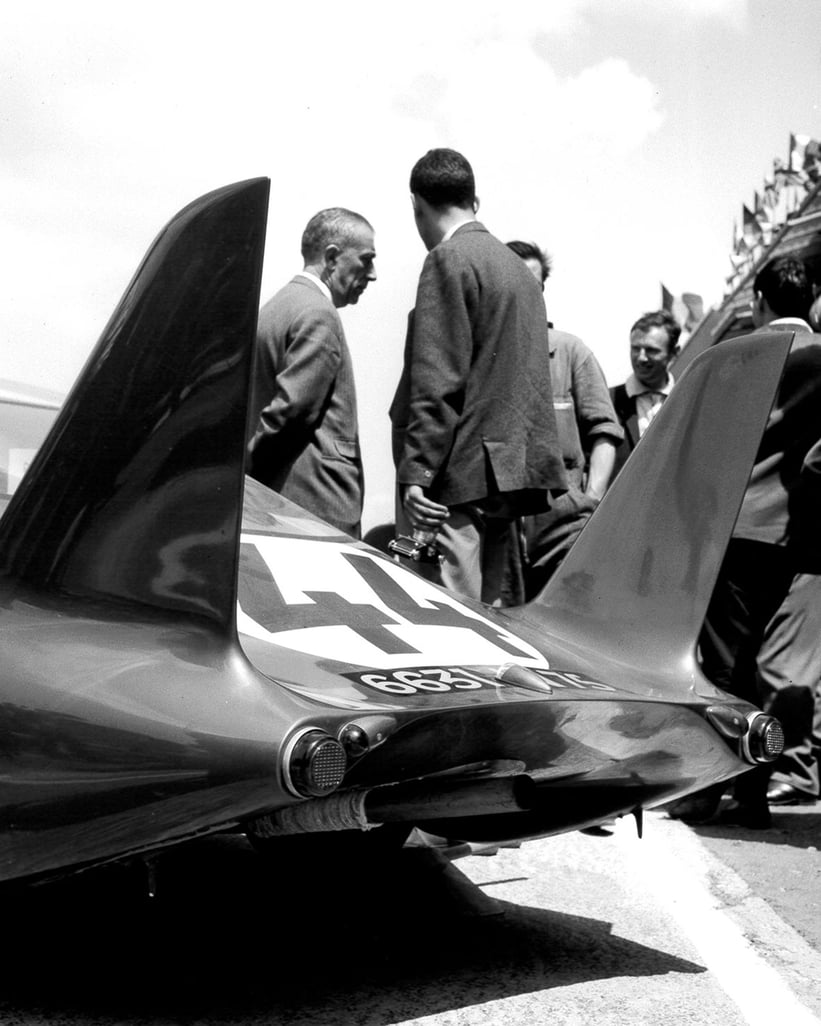
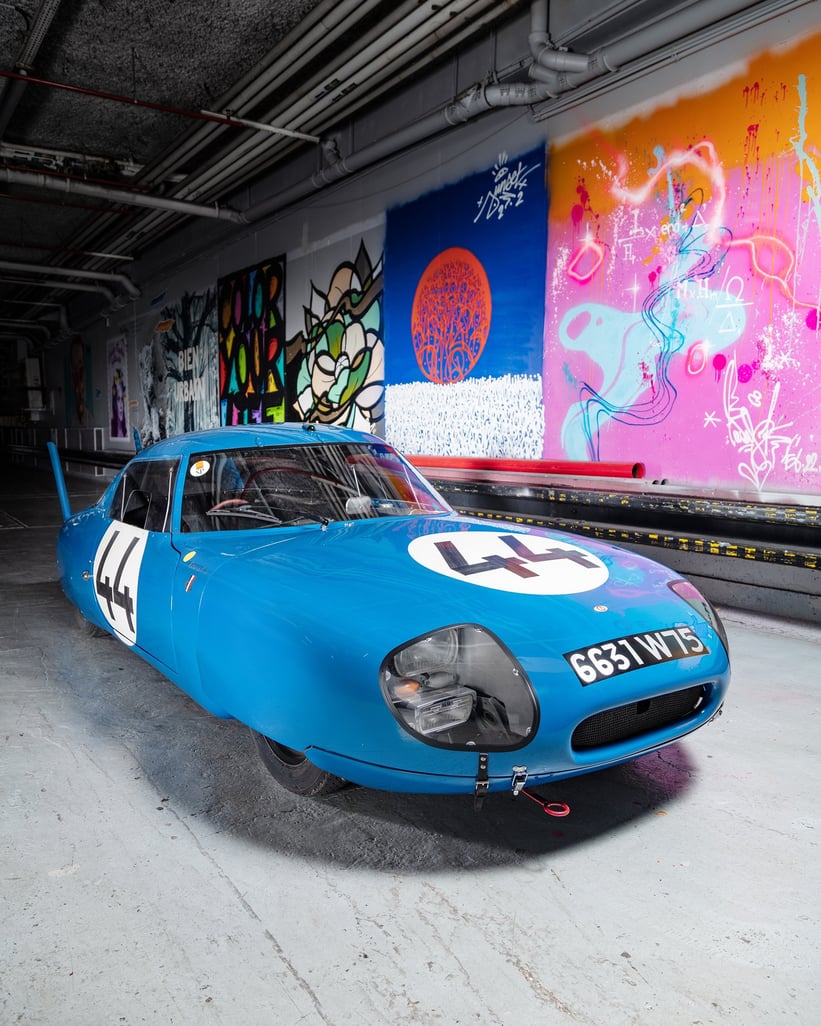
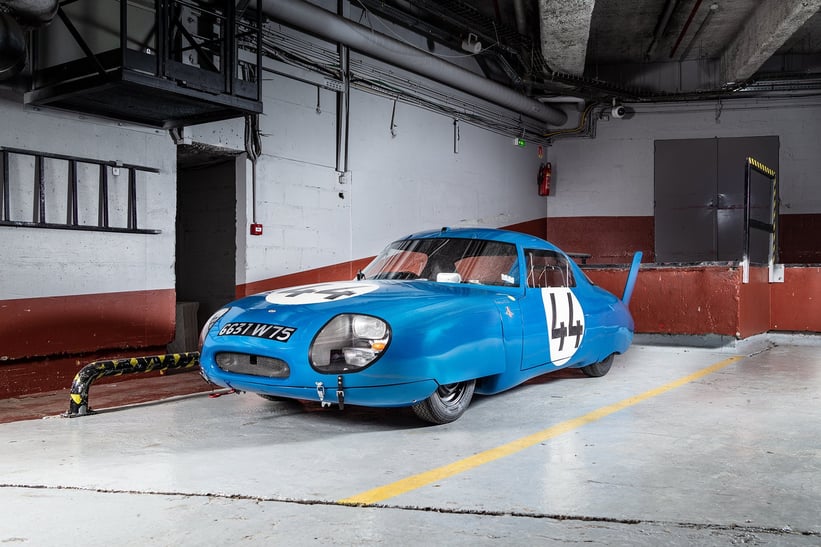
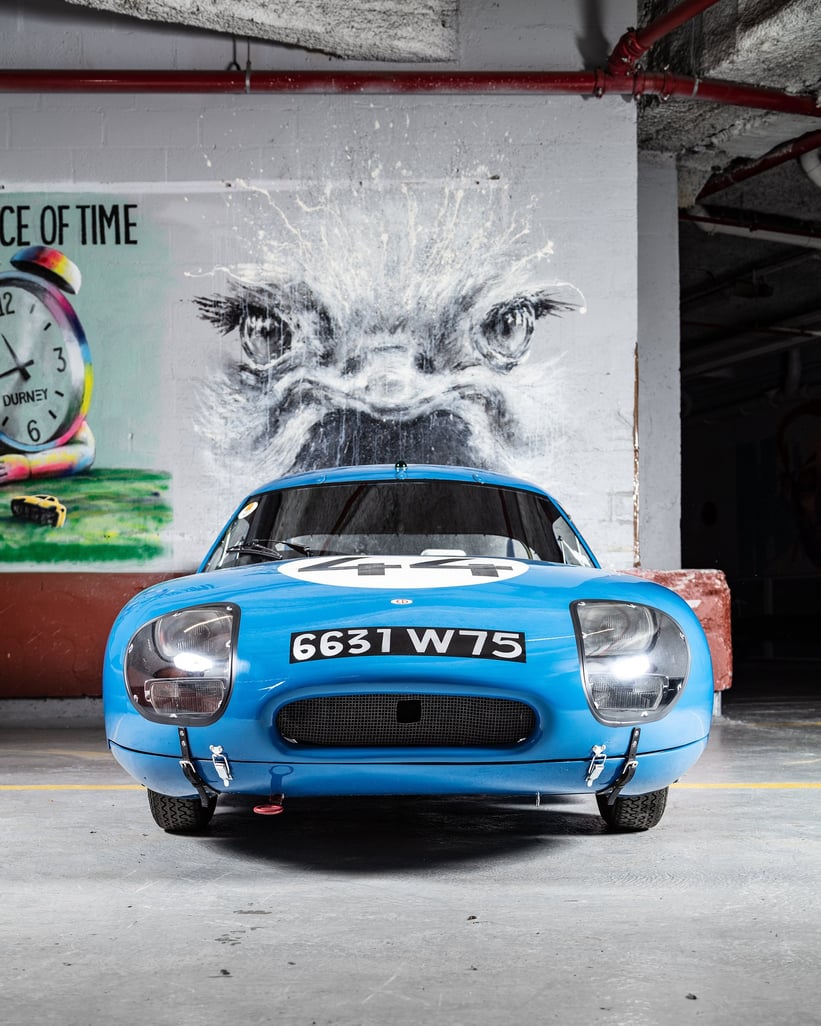
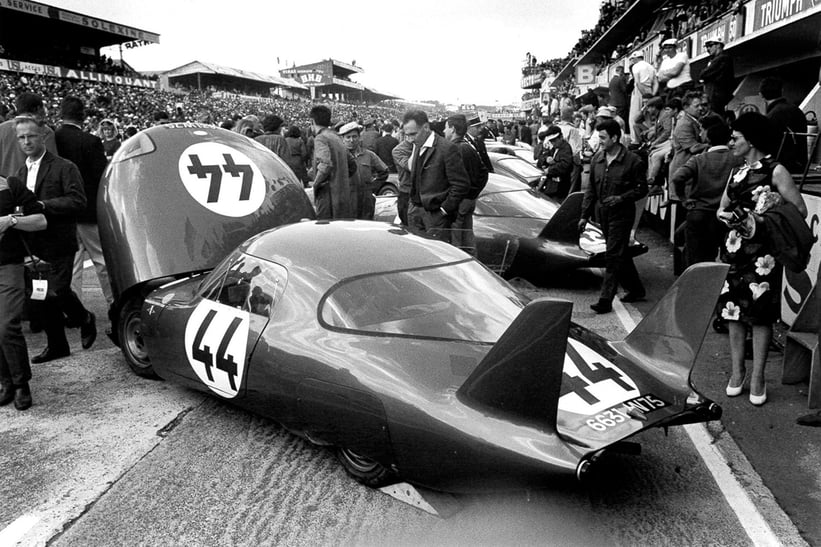
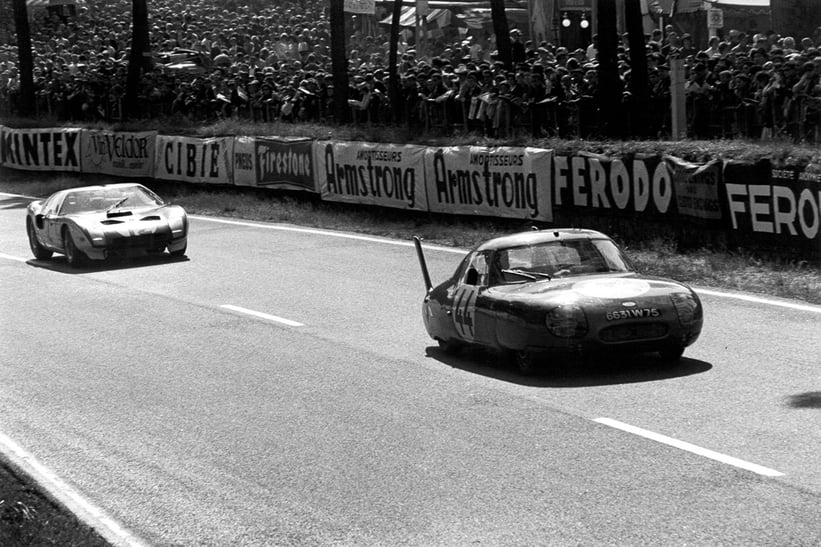
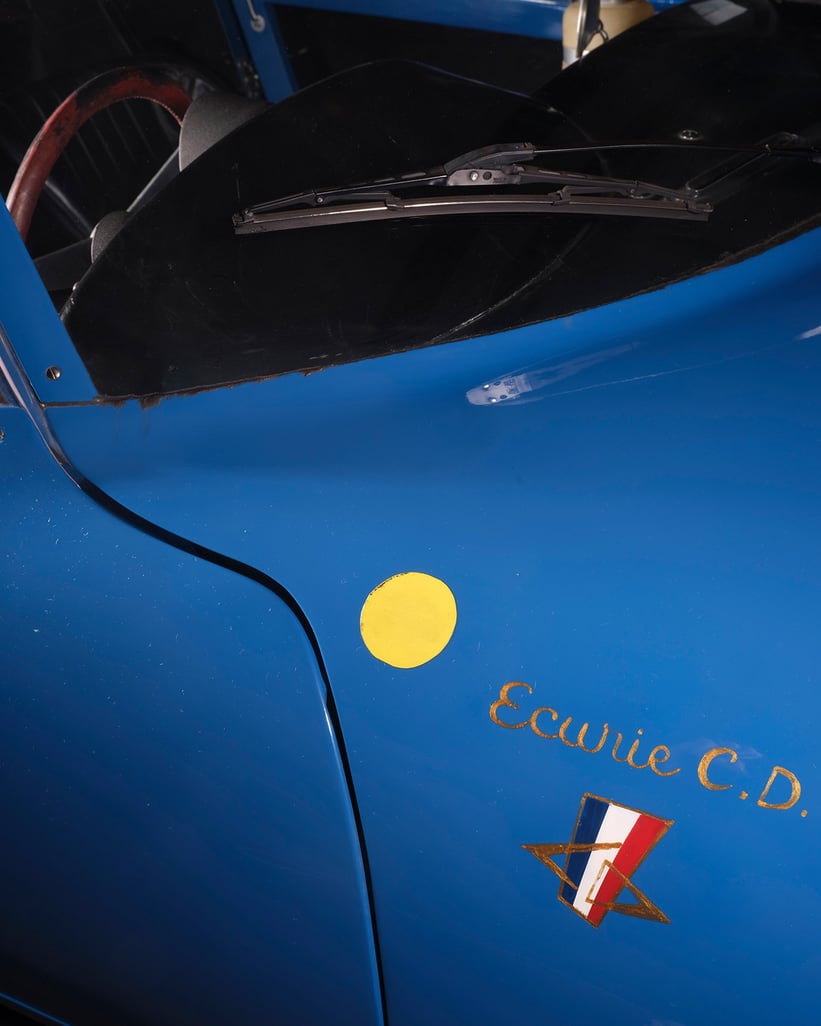
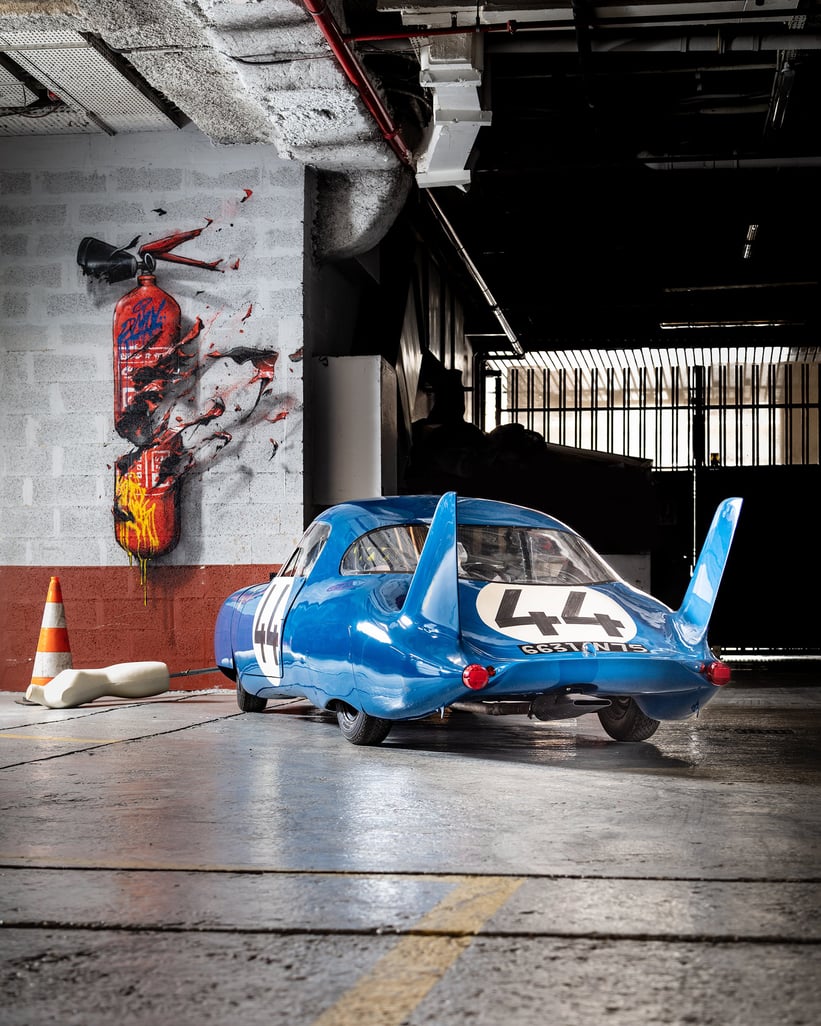
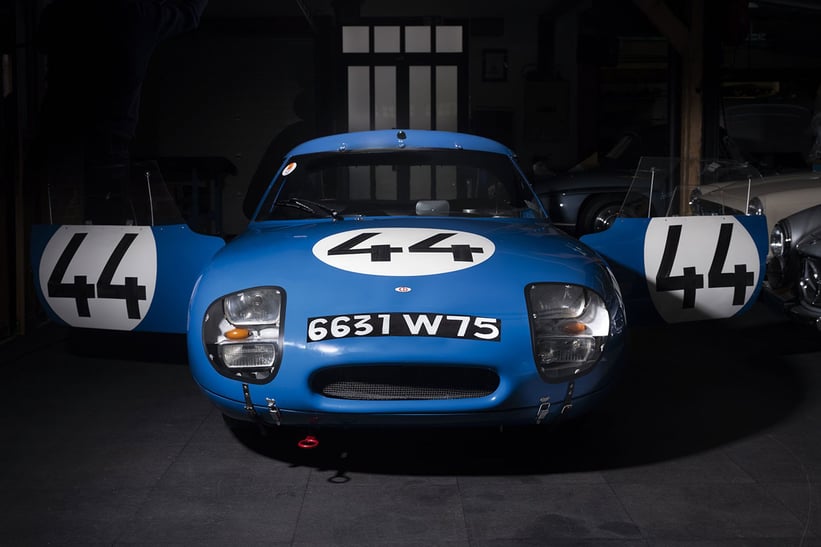
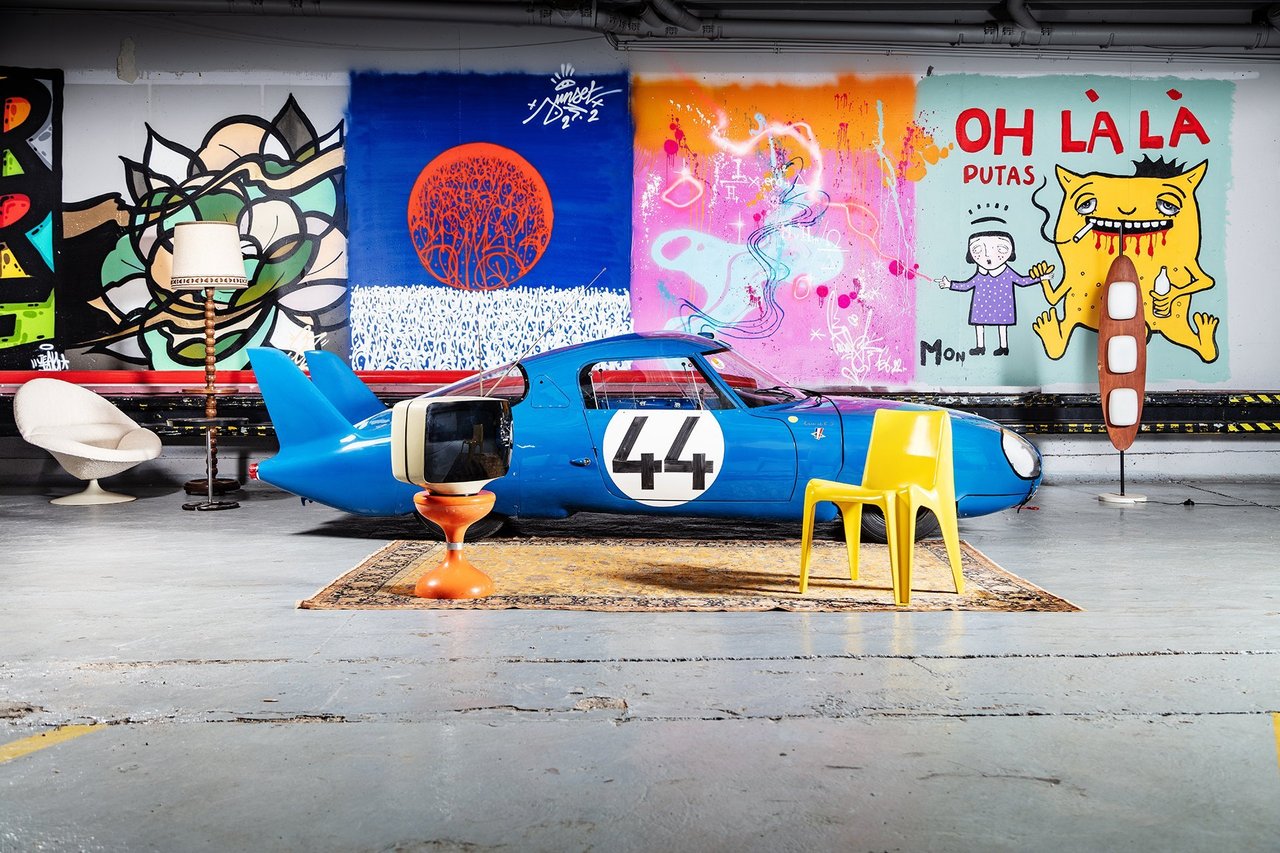
With its streamlined shape and twin tail wings, the Panhard CD is one of the most iconic prototypes that ever raced in Le Mans. Now the car that was driven by Alain Bertaut and André Guilhaudin during the legendary 1964 edition of the 24 Hours of Le Mans is coming up for auction.
It’s easy to be sceptical about the idea of ‘destiny’, but no one could deny the serendipity between Charles Deutsch’s initials and the fact that he became famous for his aerodynamic vehicle designs. And this Panhard Le Mans prototype being sold on 6 June 2023 at Hotel Drouot in a one-lot auction by Giquello represents the epitomy of CD’s work since it boasts the lowest ‘Cd’ (co-efficient of drag) of any car ever built.
To put that into perspective, the JCB ‘Dieselmax’ diesel-powered car that achieved a record-breaking 529 kmh in 2006 had a Cd of 0.15; that of the Panhard CD Le Mans car built 42 years earlier was just 0.12. The radical and historic Le Mans racer was based on the Panhard CD road car that Deutsch designed as his first project after parting company with René Bonnet following the 25-year partnership that took the Deutsch-Bonnet marque to fame as a builder of lightweight, aerodynamic sports cars.
The pair broke-up after falling-out about whether their future cars should be front-wheel drive (Deutsch’s view) or mid-engined (Bonnet’s), leaving Deutsch to move to Panhard, which had previously supplied components to Deutsch-Bonnet. Prior to creating the CD Prototype LM64 pictured here, Deutsch had engineered the CD Dyna as Panhard’s entry for Le Mans in 1962. Five were built in a time of little more than four months, with bodywork being designed by Deutsch and fellow aerodynamicist Lucien Romani.
Air-cooled, 702cc, two-stroke boxer engines provided the motive power and four of the cars were entered for Le Mans but only three made it to the grid , one of which crashed-out while a second was forced to retire with engine trouble. The third car, however, finished an impressive 16th overall, won its class on the ‘performance index’ basis and came third in the ‘efficiency’ category, completing the race at an average fuel consumption of 11.4 litres per 100 km for an average speed of 142 kmh.
This success preceded the unveiling of the road-going Panhard CD the same year at the Salon d’Auto in Paris, with a total of 179 examples of the glass fibre-bodied cars being built and sold from 1963 until production stopped two years later. A three-cylinder, DKW-engined car was entered for Le Mans in ’63, but owner/driver André Guilhaudin lost control of it at crashed at the Indianapolis curve causing irreparable damage.
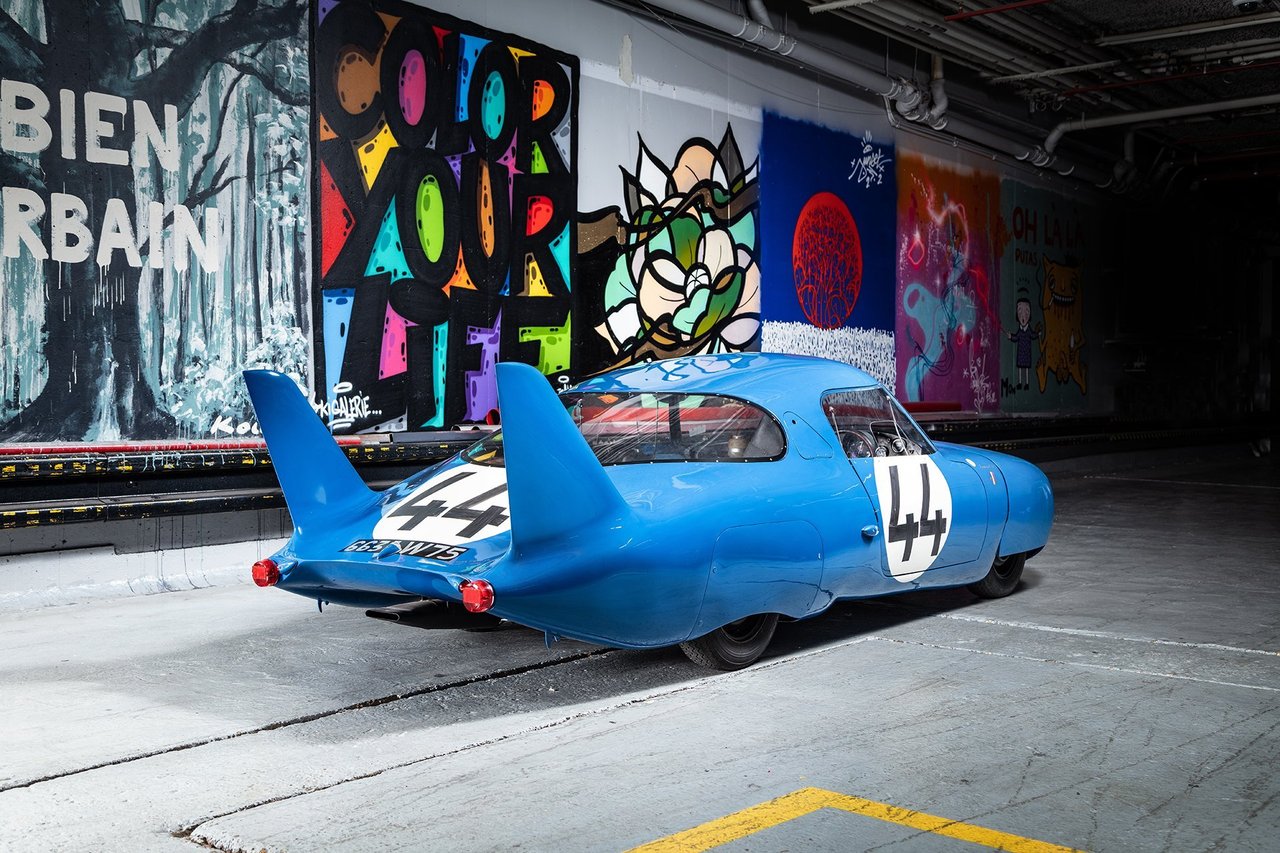
Durng the following months, however, Deutsch and the Panhard team set to work creating the LM64, two examples of which were built - LM64-01, and LM 64-02, the car being sold by Giquello. While the Dyna had been slippery enough, the LM64s all but made a mockery of the wind with their spectacularly smooth bodywork that gave them the look of something that was a cross between a Buck Rogers space ship and a dolphin.
Developed in a wind tunnel at the Gustave Eiffel aerodynamics laboratory in Auteuil, Paris, the cars featured spats front and rear to encase the drag-inducing wheels, sides as smooth as a bar of soap and a fully-enclosed underfloor that, combined with a diffuser-like tail, helped to create a simple ‘ground-effect’.
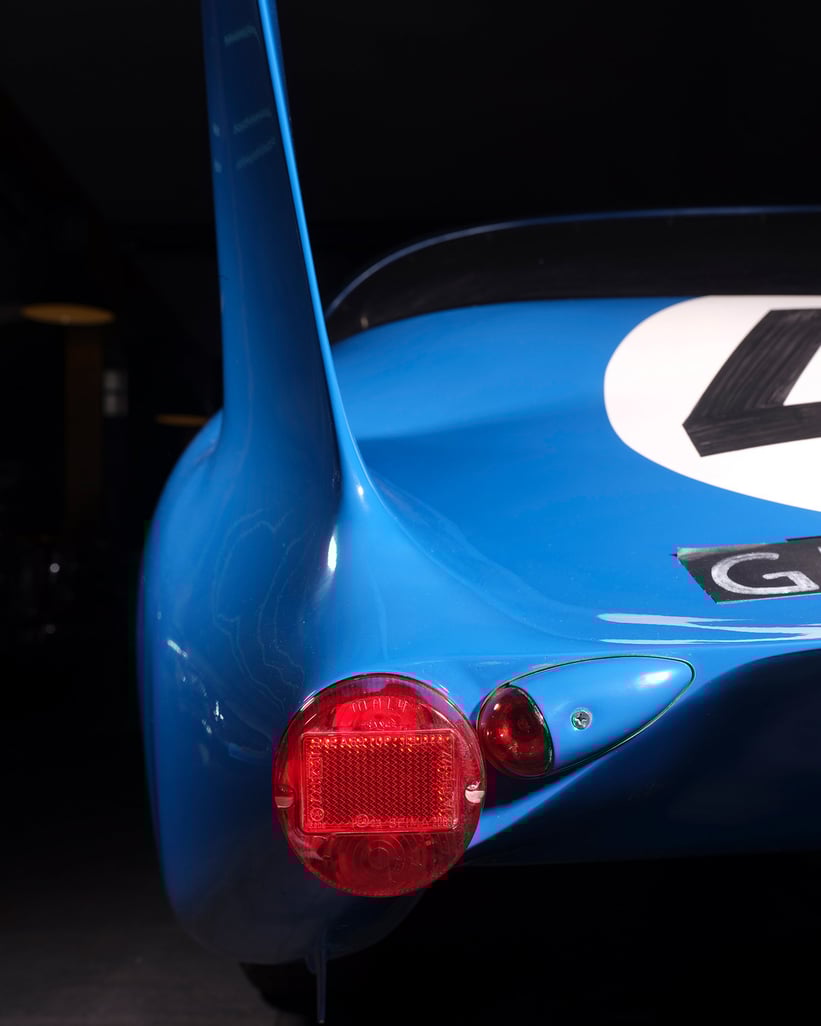
The most noticeable feature of the cars, however, was undoubtedly the twin fin arrangement at the rear that further helped the Panhard to slice through the wind. But without seeing an LM64 in real life, it’s difficult to appreciate just how small they they were – a fact that demanded a suitably diminutive engine of just 848cc.
That, however, made them ineligible for Le Mans – meaning they were fitted with a Sferma supercharger to take advantage of the 1.4 multiplication factor applied for forced-induction engines. The resulting ‘official’ capacity of 1187cc meant the cars could run in the under 1200cc class, in which form LM64-02 took to the grid with drivers Alain Bertant and Andre Guillhoudin.
With an unremarkable 78 horsepower on tap, the Panhards should have been the tortoises in a field of hares – but their remarkable aerodynamic qualities enabled them to hit a top speed of 230 kmh, as much as competitors powered by engines of twice the capacity. Both cars were entered for the race, but LM64-01 retired with gearbox problems after a respectable 13 hours and 124 laps., while LM64-02 – the car on sale – managed 77 laps and 10 hours before its engine failed.
It proved to be a brave but final attempt at Le Mans for Deutsch, with the last Panhard passenger cars being built in 1967 before the marque was absorbed by Citroen. LM64-2 spent the following two decades in storage before being displayed at the Le Mans museum in 1981, a mark of both its historical significance to the race and of Panhard’s exceptional ability to develop highly efficient, small-engined cars.
That recognition is even more notable today during the Le Mans centenary year, which is partly why Panhard CD Prototype LM64-02 is tipped to realise between Euros 600,000 and 1.2m when it crosses the block on Tuesday, June 6. And whoever buys it won’t just be getting a remarkable piece of Le Mans history but also a gilt-edged invitation to some of the most prestigious historic motoring events in the world – and that includes road rallies because, believe or not, the car is entirely road legal. So if you’re looking to turn heads without ruffling feathers...
When I first gave up my running shoes for a road racing bike in 2016, I was confronted by a scroll of unspoken rules I would be expected to follow if I were to be taken seriously as a congregant in the Church of Cycling.
The edicts were compiled by the Velominati—an anonymous cycling cognoscenti that presents them as holy writ. Cycling shorts must always be black, though socks can be any color you like. The color of your saddle, however, must match the color of your handlebar tape and tires without exception. Which is to say, these, too, must always be black because tires only come in one color. And so it was for pre-ride coffees: black only, preferably espresso. Anything dulled by milk was purely for the unsaved.
Who was I to disagree? It was a demand of my new culture. I bought a razor and shaved my legs.
There were others. Never, under any circumstances, lift your bike over your head—it is undignified for the machine. If you are ever unfortunate enough to draw the number 13 at a race, it must be pinned to your jersey upside down. And speaking of bad luck, accidents are not to be spoken of unless they involved a visit to the emergency room. Road rash, scraped elbows, bruised hips, and other evidence of unexpectedly meeting the pavement are just part of the discipline.
Some rules were intuitive, like showing up for training rides on time because they start exactly when they are supposed to—and I have never known that not to be the case. Others were more bizarre, such as never putting a bike on a car’s roof rack unless the bike is worth more than the car—and you might be surprised at how often that is the case.
Helpfully, these rules were emailed to me by my first serious riding companion, a multi-time state champ who took his coffee black, drove a $19,000 Volkswagen, and dragged me for months along rural roads until I was strong enough to compete in our city’s weekend group rides.
Clearly, he told me, some of the rules are open to interpretation and convenience. But there is one that is not: Shave your legs.
There were no exceptions. Even the flamboyant Peter Sagan, then the world’s most revered cyclist, was once chastised by the elder brethren of the sport for having the nerve to turn up at a race au naturel.
Who was I to disagree? It was a demand of my new culture. I bought a razor and have been shaving my legs ever since.
As the summer tradition of the Tour de France once again descends upon us, a few hundred million devotees of the sport will watch, parse, argue about, and rejoice over the frenetic three-week-long procession that’s powered by some of the smoothest male legs on Earth.
But why, since the Tour began in 1903, have its participants shaved their legs? A matter of hygiene? An offering to the velo gods? Is it purely a question of peer pressure, guided by fear of wrath from the fussy deities on cycling’s Mount Olympus? Or is there something more earthbound behind it—some matter of utility that the great grandfathers of le ciclisme suspected long ago but couldn’t quite articulate as they first dragged a razor up their shins?
As it turns out, there is. Shaven legs are much, much faster. It just took until this century to prove it.
In 2012, as a recently minted graduate from the Massachusetts Institute of Technology, with a degree in mechanical engineering, Marc Cote came to Specialized, a dominant manufacturer of high-end bikes headquartered in California. Cote had a hypothesis: bicycle frames, wheels, helmets, jerseys, shorts, and shoes were all conspiring to cost elite cyclists valuable seconds in aerodynamic drag.
Aerodynamic drag, Cote explained to me in a recent chat, consists of two forces—air pressure drag and direct friction (known also as surface friction or skin friction). Direct friction is the force that occurs when wind meets the surface of rider and bike, but is nearly insignificant at the comparatively low speeds a cyclist travels. However, it is critical to consider when designing, say, an airplane.
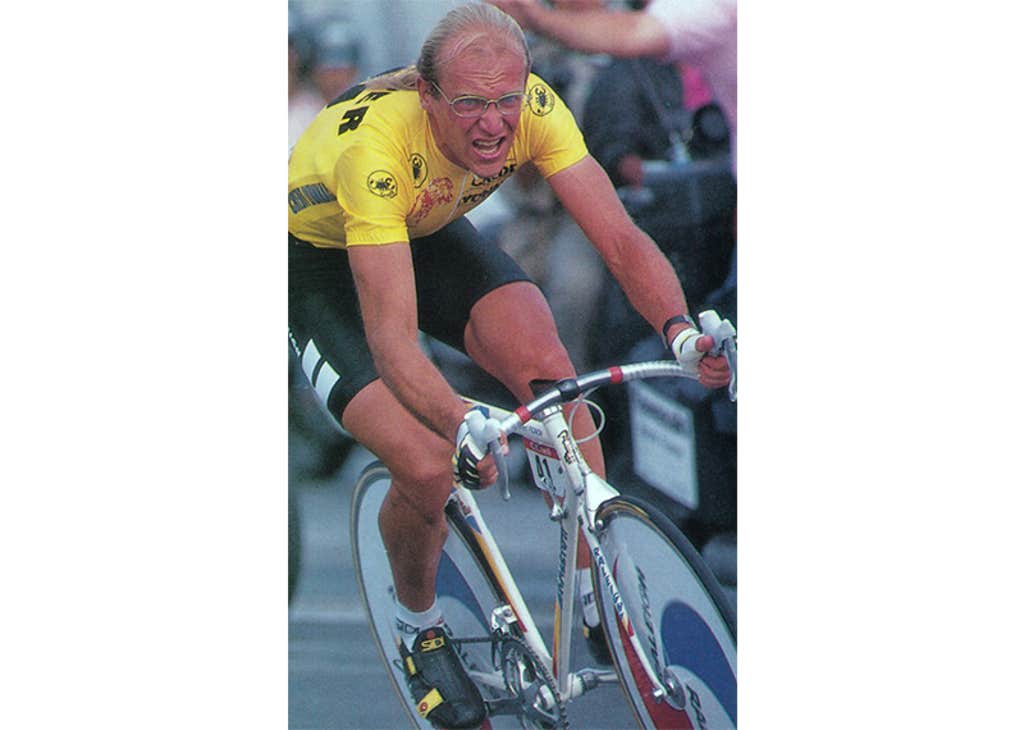
GET A HAIRCUT: Laurent Fignon lost the 1989 Tour de France by eight seconds, the closest margin in Tour de France history. An experiment by Marc Cote, a mechanical engineer and cycling expert, showed Fignon would have won had he cut his drag-causing ponytail. Photo by Anders / Flickr.
On the bike, air pressure drag is the main beast. A cyclist and his machine form a blunt (“bluff” in aero lingo) shape forcing the air to separate around them as they move forward. The harder the cyclist pedals, the more the air in front of him is compressed, meaning that the harder he pushes forward to overcome this resistance, the harder the air pushes back.
Once the air grudgingly parts around the rider, the battle is not over. As the rider moves forward, battering the air out of the way, the air behind him becomes less dense, forming a low-pressure zone, or vacuum, that literally sucks him backward. This is a formidable force. In fact, on a flat road, aerodynamic drag is by far the biggest obstacle to a cyclist’s speed, accounting for 70 to 90 percent of the resistance felt when pedaling.
Reducing the surface area of the cyclist as he confronts the wind is therefore key. The more streamlined the design of an object, the easier it is for the air to close around it, thereby approaching the holy grail of aerodynamic design: laminar flow—that sublime moment when the air closes around a moving object without leaving a turbulent wake.
As there is little that can be done about the awkward shape of the human body—though it must be noted that most pro cyclists are tall and willowy and in constant battle with their weight—the design of the bike and the equipment the rider wears are critical to speed. The less that is flapping about in the wind, the smaller the surface area of cyclist and bike.
The Tour de France is one of the hardest tests of endurance that humanity has sadistically invented for itself.
This was an issue that the titans of yore hadn’t much considered as they pulled their baggy woolen jerseys over their heads. In the 1968 volume King of Sports: Cycle Road Racing, envisioned by its author as the final word on training, British cyclist Peter Ward argued for comfort over style. Clothing that is “the least bit tight or restrictive” should be avoided, he wrote. Cycling shorts, he added, should be held up with “braces,”—British for suspenders—and be “slack and comfortable.”
A few years later, in 1976, the Dutch pro cycling team TI–Raleigh ignored that advice and brought Lycra to the cycling mainstream. There hasn’t been a need for suspenders since. Over the following decades, the fit of cycling apparel has moved steadily skin-ward, cementing the image of the spandex-clad road warrior in the popular imagination. But Cote still suspected that there were a few wrinkles yet to iron out.
By 2013, he and his colleague Chris Yu in the aerodynamic research and development department had cajoled their bosses at Specialized into taking an enormous and cost-intensive leap—building a multimillion-dollar cycling-specific wind tunnel to track down and eliminate those last little bits of turbulence in the quest for a faster ride. The results were—and continue to be—transformative.
Research in cycling aerodynamics—what Cote calls “the invisible science”—has led to helmets that make the head of the wearer look like it has collided with a flying saucer, and shorts and jerseys that are so tight that it takes imagination not to see the more subtle curves of the flesh. The clunky shoes of Ward’s era have shed their laces for shrewder and smoother fasteners that don’t cause the air to hiccup around them. Even socks can be woven in special configurations that reduce drag. And new techniques in molding carbon fiber—the lightweight DNA of modern race bicycle-making—has produced frames that would have been unrecognizable as recently as 2007, when Lance Armstrong and his U.S. Postal team were still riding what amounted to a collection of fused-together cylinders.
Nonetheless, all the technological advantages can’t conquer the inevitable human bulk of the rider, who constitutes about 75 percent of the aerodynamic drag that cyclist-plus-bike must overcome. And that’s where Cote’s most surprising research comes in.
It began with Jesse Thomas, a Specialized-sponsored pro triathlete who dropped by Cote’s wind tunnel in 2014 to dial in his equipment before an upcoming Ironman competition. He, Cote, and Yu ran through different experiments—one comparing wheels, another tires, yet another helmets and skin suits—and chose those that the tunnel data said caused the least amount of drag. Ironman races include a 112-mile bike ride wedged between a 2.4-mile swim and a marathon, so any seconds Thomas could massage out of his equipment would be critical.
Thomas had turned up that day much the way Peter Sagan had at that race in 2016, sporting a full shag up his calves and thighs, though neither he nor Cote had put much stock in that until after completing the tests.
So as more of a gag than anything else, he and Cote thought they would solve the age-old riddle posed by the ancients once and for all: Does shaving your legs make any difference at all? Thomas sheared his guns to see.
The first set of results caused Cote’s jaw to drop. If the data were correct, Thomas could save 70 seconds for every 24.6 miles (or 40 kilometers, a standard time trial distance) he rode on the bike. This was an enormous time gain in a field of sports where victory is often decided by fractions of seconds and tenths of inches over a finish line.
So they tested Thomas again. And again. And the numbers kept showing the same thing.
It was a Eureka moment.
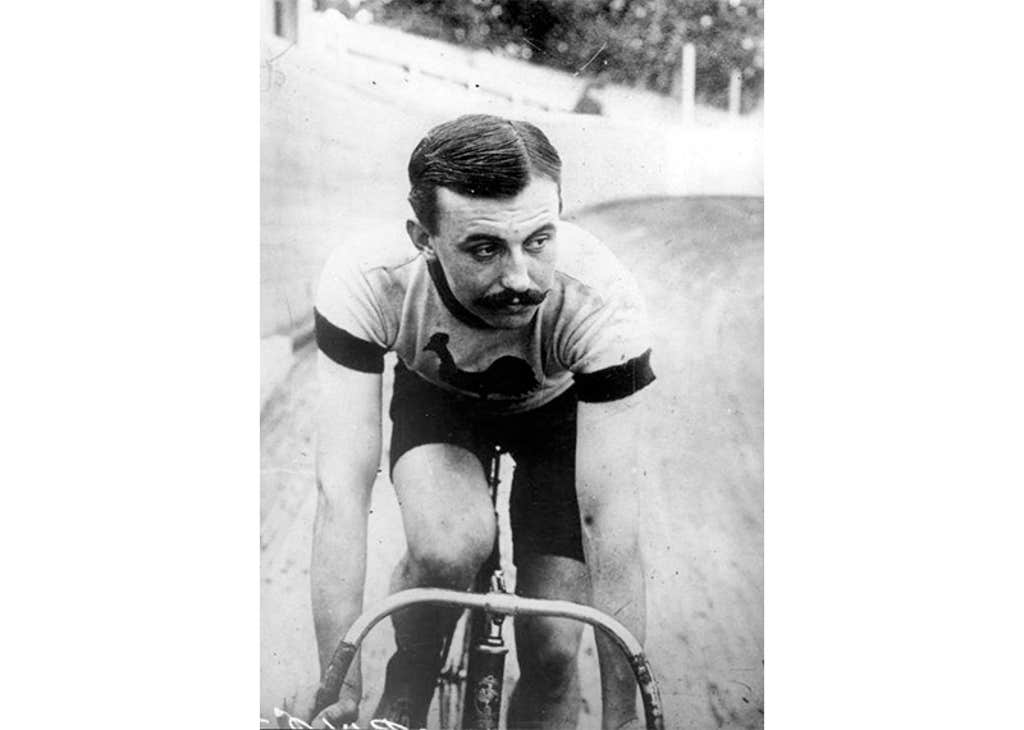
MONSIEUR, THE MUSTACHE MUST GO: Lucien Petit-Breton, who won the Tour de France in 1907 and 1908, looks quite sleek for his time, when many riders wore baggy clothes. Had he lost the facial hair, reducing the surface area on his body, he would have been faster still. Credit: Wikimedia Commons.
Over the next several weeks, Cote and Yu invited more of their cyclist and triathlete friends to come and test hairy, shave, and test again, developing along the way what they called a “Chewbacca scale”—a rating of 1 being a leg with relatively little natural hair all the way to 10, connoting a level of hirsuteness rivaling Hans Solo’s simian sidekick.
Time savings varied slightly depending on where test subjects fell on that scale, but the results continued in each case to be profoundly faster—so much so that it seemed silly for any performance-minded cyclist to forgo shaving. This was the very definition of free speed.
What was remarkable here, said Cote, was this: Most prior work in aerodynamics had been conducted at much higher speeds and the results of those experiments implied that hairy legs might benefit cyclists, the bristly hair acting much like the aerodynamic dimples on a golf ball.
Those characteristic dimples create a thin, turbulent boundary layer of air that clings to the ball’s surface. This allows the smoothly flowing air passing around it to follow the ball’s surface a little farther around the back side of the ball, thereby decreasing the size of the ball’s wake. This reduces turbulence behind it and lessens the area of that low-pressure zone that follows and sucks at cyclists.
But a golf ball driven by a PGA player can travel as fast as 168 miles per hour—far faster than the aspirations of even Tour cyclists. At average speeds between 20 and 40 miles per hour, the bigger factor for cyclists was the surface area of the body meeting the wind—and the surface area of a shaved leg is as much as 10 percent less than that of a hairy counterpart.
“At these speeds, reducing the surface area is the most important thing, and that surprised us,” Cote told me. “Past studies assumed that hair would be insignificant or would work like those divots on the golf ball—but at cycling speeds it just adds to surface area.” Cote determined shaved legs are the second most important aerodynamic adaptation a cyclist can make, the first being whether the rider choses to wear a skin suit—which, with its long sleeves, also covers the hair on the forearms.
Cote’s results were never compiled and published in a scientific journal, but his and Yu’s work has been quasi-peer reviewed by countless imitators, most recently this May by the Global Cycling Network, one of YouTube’s most watched and slickly produced biking-dedicated channels. In fact, GCN has visited the topic at least five times since Cote uploaded his original videos. And each time, the results showed the same thing: Cyclists with shaved legs are faster.
Le Grand Boucle, or Big Loop, as the Tour de France is nicknamed, is the grandest of the grand tours, drawing a viewership on television and in person along France’s winding country roads and mountain switchbacks that dwarfs the Super Bowl. By all accounts, it is one of the hardest tests of endurance that humanity has sadistically invented for itself.
The Tour is also the grandest performance of cycling aerodynamics at work. The Tour de France is ridden by 12 teams and consists of four kinds of stages—flat stages, hilly stages, mountain stages, and time trials, which, confusingly, are ridden on different sorts of bikes and require different styles of riding.
For the first three, riders mount the more familiar-looking road bike, with its ram’s horn handlebars, and race together as a peloton, the first man over the finish line claiming victory. The time trials—of which a typical Tour only has one or two—are when each of the 198 riders are sent out on a course alone to race against the clock.
And it is on time trial bikes that the invisible science has had the most visible impact. Often resembling a wing turned sideways, riders mount these bikes dressed in skin suits, a torso hugging, long-sleeved singlet with low profile stitching. They then hunch over their machines with their elbows perched on aero bars, their arms held before them in the style of a praying mantis. Then they tuck their heads, capped in those absurd turbulence-reducing helmets, and go—each grain of sand through the hourglass a strike against them.
All the technological advantages can’t conquer the inevitable human bulk of the rider.
Road bikes, too, have evolved with the quest for aero. Round tubes have flattened out on their backsides and their leading edges have sharpened so that they pierce the air like a bullet. Seat posts are oval or teardrop-shaped and handlebars are flat in profile across the top and taper to an edge along the backside mimicking a wing. And deep-rimmed carbon wheels have long since replaced their skinny air-stirring aluminum alloy counterparts and offer yet further wind-rending advantages.
When the cyclists are on their road bikes racing in a peloton they take advantage of the aero modification as old as cycling itself—drafting. It is this technique that allows cyclists to capitalize on the turbulent low-pressure zones left by the cyclist riding immediately ahead of them. The low pressure behind the leading cyclist will help pull the following cyclist forward, while the vortices produced by the lead cyclist’s wake will also swirl around the following cyclist and push him forward. So significant is the effect of drafting that cyclists who are riding in a group can save up to 40 percent in energy expenditure over a cyclist who is riding solo. Anyone who has ever cast their gaze skyward at a flock of migrating birds has seen aerodynamic drafting in action.
On the ground, the technique is most apparent in the so-called lead-out trains preceding the final sprints in the Tour’s flat stages. In these chaotic charges, it’s easy to spot the jerseys of each team forming monochromatic lines as they weave through the peloton.
The idea is that several team members will burrow through the air for their designated sprinter, who sits on their wheels as the riders in front of him provide a wake full of those helpful vacuums and eddies. One by one, the leading riders will take a turn at the front and dig as deep as they can, ratcheting up the speed before they peel off to the side, exhausted. Finally, the last leading rider will pull off, launching the sprinter at breakneck speed a few dozen meters from the finish line. But each of these trains must have a highly aerodynamic engine for the sprinter to have any hope at all.
The evolution of all this air-slicing technology is reflected in the average speed of the Tour itself, which has spiraled upward since the early days. Two-time victor Firmin Lambot of Belgium posted the slowest average speed in the 1919 Tour at 14.97 miles per hour. One hundred and four years later, Denmark’s Jonas Vingegaard nearly doubled that in his 2022 Tour victory with an average speed of 26.1 miles per hour—all while having traversed 122,000 feet—more than four times the height of Mount Everest.
The work of Cote—who now works at Zwift, a virtual cycling app—and his copycats provides valuable data for amateur cyclists like me, who typically don’t possess the deep pockets and sponsorship deals that a professional cycling team does, but nonetheless obsess over aero, take on debt to finance new bikes, race and go on training rides. A 90-cent razor, Cote told me, might be the wisest investment I can make.
But in a sense, Cote’s test results simply validate something that most serious cyclists will—out of superstition or a sense of deference or dogged adherence to the commandments of the Velominati—continue to do anyway, regardless of what the wind tunnel says.
Grasping for these seemingly insignificant advantages was something that the cycling gods of the past understood acutely. At the center of their logic was a simple truth: Whatever you think makes you faster probably does.
Fausto Coppi, the Italian cycling giant who dominated the Tour in the years following World War II, insisted that he be carried upstairs to his hotel rooms after every stage of the race to preserve the strength of his legs.
France’s great Roger Rivière, considered the favorite for the 1960 Tour until he careened over a guardrail in the mountains on stage 14 in an accident that left him crippled, was known to inflate his tires with helium.
His countryman, the towering time trialist Jacques Anquetil, who claimed three Tour victories in the late 1950s and early ’60s, used to take his water bottle off the cage on the frame of his steel Gitane rig and tuck it into his jersey pocket when confronted with a climb. (Another finding by Cote: you will shave off 38 seconds if you tuck your water bottle in the back pocket of your jersey instead of the bottle cage on the frame.)
And so the story goes, right through the calamitous drug scandals of the Lance Armstrong era, where Armstrong and much of his team—and indeed much of the peloton—blood-doped with human growth hormone to goose their performance.
But even in the years since the sport has cleaned up, there remains that search for a talisman, for the ineffable edge that will express itself at exactly the right moment and inch you over the finish line first. To acclimatize his respiratory system to the Tour’s high mountain stages, German rider Tony Martin—who won numerous Tour stages but never the coveted general classification overall win—had his entire house converted into an altitude chamber.
Against such tactics, shaving your legs is the least you can do.
Because in the oral histories of cycling, passed down to me by the riders who taught me how to take my coffee, tales of losing by a hair are almost too painful to recount—such as when the US cyclist Greg LeMond beat the Parisian powerhouse Laurent Fignon in the 1989 Tour’s final time trial stage, giving LeMond the overall victory by a mere eight seconds—the closest margin in Tour de France history.
It was an age before wearing helmets in the Tour became compulsory and Fignon’s biggest enemy that day was not LeMond. It was his signature blond ponytail.
Cote and Yu tested it. They took a cyclist of Fignon’s stature, put him and a bike in the tunnel, bent him into Fignon’s tucked time trialing position, and topped him off with a wig that matched Fignon’s flowing tied-back locks.
They turned on the wind. Then stopped it, cut off the ponytail, and tested again. The result?
“Fignon should have gotten a haircut,” Cote said. According to the data, Fignon would have beat LeMond by four seconds had his ponytail not been flapping about in the wind, causing critical aerodynamic drag.
“You never stop grieving over an event like that,” Fignon bitterly wrote in his 2010 autobiography.
Ever since I heard that story, I have started shaving my head, too.
Charles Digges is an environmental journalist and researcher who edits Bellona.org, the website of the Norwegian environmental group Bellona. He is also an amateur cyclist and owns too many aero-optimized bikes.
Lead image: Studio77 FX vector / Shutterstock
Get the Nautilus newsletter
Cutting-edge science, unraveled by the very brightest living thinkers.
Here is a derivation of the volume of a cone which does not use calculus, Cavalieri's principle, the method of exhaustion, or any other infinitesimal arguments.
[Edit There is a flaw in this argument, see below]
[Edit 2 The flaw has been fixed, by considering the ratio of the volume of a cone to its circumscribing cylinder under different scalings]
We can split a cone horizontally into two pieces, so that the upper part forms another cone with a smaller base, and the lower part is no longer a cone but an object called a 'frustum'.
For a cone with base radius $r$ and height $h$, we can use a parameter $b$ with $0 \lt b \lt 1$ to define the height of the frustum as $b h$. Because the whole cone and the upper cone form similar triangles in the vertical cross section, the upper cone with height $ (1-b) h $ will have a base radius of $ (1 - b) r $.
The volume of the frustum will be equal to the volume of the original cone, less the volume of the upper cone. We don't yet know what form the function representing the volume of a cone will take, so for now we will just write $V_{cone} = V_{cone}(r,h)$ to remind us that it will be some function of the height and base radius. So the volume of the frustum is $$V_{frustum} = V_{cone}(r,h) - V_{cone}((1 - b)r,(1 - b)h)$$
At this point we make the observation that the ratio of the volume of a cone to the volume of it's circumscribing cylinder must be invariant under a scaling on the coordinates (the ratio is homogeneous of degree 0).
It is clear that the volume of the frustum of height $b h$ must be bigger than the inner cylinder of radius $ (1-b) r$ and height $b h$ and it must also be less than the volume of the outer cylinder with radius $ r $ and height $b h$.
$$\pi (1-b)^2r^2 b h \lt V_{frustum} \lt \pi r^2 b h$$
Substituting the expression for $V_{frustum}$ from above and dividing everything through by $ b \pi r^2 h $
At this point, we could use the familiar argument about limits - in particular, as $b$ gets closer to zero, the lower bound approaches the upper bound of $1$, so $\frac{Q 3}{\pi} = 1$ or $Q = \frac{\pi}{3}$.
However, it is possible to find the value of $Q$ in a different way, that does not involve some limit process.
First, observe that the value of $Q$ has bounds placed on it by the geometry of the problem $0 \lt Q \lt \pi$ since the cone must have some volume, and that volume must be less than the volume of a cylinder with radius $r$ and height $h$. What we are going to show is that for all values of $Q$ in this range, with just one exception, there is a choice of $b$ with $0 \lt b \lt 1$ that causes the above inequality not to hold. In the spirit of Sherlock Holmes, '..when you have eliminated the impossible, whatever remains, however improbable [or in our case, expected], must be the truth'.
We split the problem up into two parts. The upper bound of the inequality does not hold when
Now introduce a parameter $\alpha$ and write $Q= \pi / (1+\alpha+\alpha^2) $. Then for $0 \lt \alpha \lt 1$ we have $\pi/3 \lt Q\lt\pi$ and the above equation reduces to $b=1-\alpha$, so $0 \lt b \lt 1$.
The lower bound of the inequality does not hold when
Introduce a parameter $\alpha$ as before, but this time write $Q=\pi \alpha^2 / (1+\alpha+\alpha^2) $. Then for $0 \lt \alpha \lt 1$ we have $0 \lt Q \lt \pi/3$ and the above equation again reduces to $b=1-\alpha$, so $0 \lt b \lt 1$.
Therefore we have $0 \lt Q \lt \pi$ by the geometry of the problem, but whenever $0 \lt Q \lt \frac{\pi}{3}$ or $\frac{\pi}{3} \lt Q \lt \pi$ there exists at least one value for $b$ with $0 \lt b \lt 1$ for which the inequality does not hold. The only remaining possibility on the interval $0 \lt Q \lt \pi$ is $Q=\frac{\pi}{3}$ (for all $r,h > 0$), and so $$ V_{cone} = \frac{\pi}{3} r^2 h$$
An artist's composition of the Milky Way seen with a neutrino lens (blue). Credit: IceCube Collaboration/U.S. National Science Foundation (Lily Le & Shawn Johnson)/ESO (S. Brunier)
Our Milky Way galaxy is an awe-inspiring feature of the night sky, viewable with the naked eye as a horizon-to-horizon hazy band of stars. Now, for the first time, the IceCube Neutrino Observatory has produced an image of the Milky Way using neutrinos—tiny, ghostlike astronomical messengers. In an article to be published in the journal Science, the IceCube Collaboration, an international group of over 350 scientists, presents evidence of high-energy neutrino emission from the Milky Way.
The high-energy neutrinos, with energies millions to billions of times higher than those produced by the fusion reactions that power stars, were detected by the IceCube Neutrino Observatory, a gigaton detector operating at the Amundsen-Scott South Pole Station.
This one-of-a-kind detector encompasses a cubic kilometer of deep Antarctic ice instrumented with over 5,000 light sensors. IceCube searches for signs of high-energy neutrinos originating from our galaxy and beyond, out to the farthest reaches of the universe.
"What's intriguing is that, unlike the case for light of any wavelength, in neutrinos, the universe outshines the nearby sources in our own galaxy," says Francis Halzen, a professor of physics at the University of Wisconsin–Madison and principal investigator of IceCube.
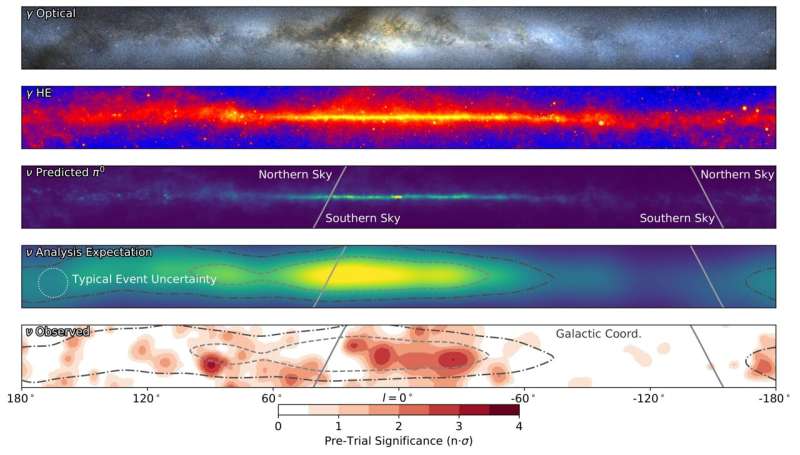
A multi-messenger view of the Milky Way galaxy, centered on the galactic center and viewed in galactic coordinates. Each panel shows the entire Galactic plane in a band of ±15◦ in galactic latitude, with each panel having a unique color scale. The panels, from top to bottom, are: 1) view in the optical range, which is partly obscured by clouds of gas and dust that absorb optical photons, 2) the integrated flux in gamma rays as seen by the Fermi-LAT 12 year survey, 3) emission template for the expected neutrino flux, taken to match the template from Fermi-LAT measurements, 4) emission template from panel 3 convolved with the IceCube detector acceptance for cascade-like neutrino events and 5) pre-trial significance of the all-sky scan for point-like sources using the cascade neutrino event sample in the same band of the Galactic plane. Credit: IceCube
"As is so often the case, significant breakthroughs in science are enabled by advances in technology," says Denise Caldwell, director of NSF's Physics Division. "The capabilities provided by the highly sensitive IceCube detector, coupled with new data analysis tools, have given us an entirely new view of our galaxy—one that had only been hinted at before. As these capabilities continue to be refined, we can look forward to watching this picture emerge with ever-increasing resolution, potentially revealing hidden features of our galaxy never before seen by humanity."
Interactions between cosmic rays–high-energy protons and heavier nuclei, also produced in our galaxy–and galactic gas and dust inevitably produce both gamma rays and neutrinos. Given the observation of gamma rays from the galactic plane, the Milky Way was expected to be a source of high-energy neutrinos.
The neutrino view (blue sky map) in front of an artist's impression of the Milky Way. Credit: IceCube Collaboration/Science Communication Lab for CRC 1491
"A neutrino counterpart has now been measured, thus confirming what we know about our galaxy and cosmic ray sources," says Steve Sclafani, a physics Ph.D. student at Drexel University, IceCube member, and co-lead analyzer.
The search focused on the southern sky, where the bulk of neutrino emission from the galactic plane is expected near the center of our galaxy. However, until now, the background of muons and neutrinos produced by cosmic-ray interactions with the Earth's atmosphere posed significant challenges.
To overcome them, IceCube collaborators at Drexel University developed analyses that select for "cascade" events, or neutrino interactions in the ice that result in roughly spherical showers of light. Because the deposited energy from cascade events starts within the instrumented volume, contamination of atmospheric muons and neutrinos is reduced. Ultimately, the higher purity of the cascade events gave a better sensitivity to astrophysical neutrinos from the southern sky.
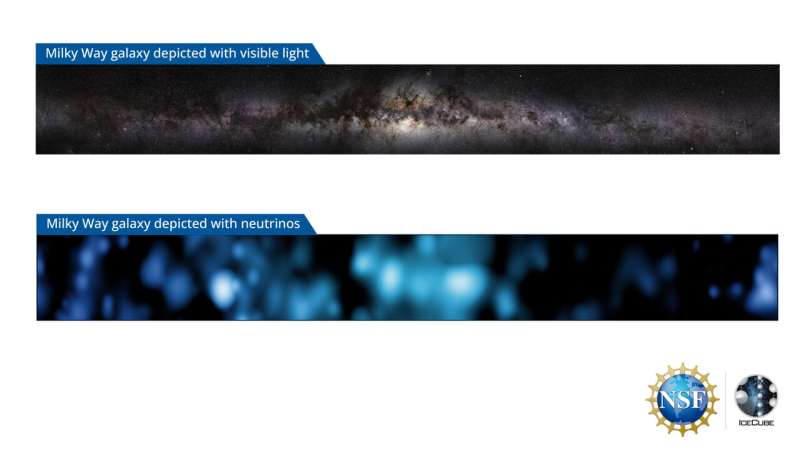
Two images of the Milky Way galaxy. The top is captured with visible light and the bottom is the first-ever captured with neutrinos. Credit: IceCube Collaboration/U.S. National Science Foundation (Lily Le & Shawn Johnson)/ESO (S. Brunier)
However, the final breakthrough came from the implementation of machine learning methods, developed by IceCube collaborators at TU Dortmund University, that improve the identification of cascades produced by neutrinos as well as their direction and energy reconstruction. The observation of neutrinos from the Milky Way is a hallmark of the emerging critical value that machine learning provides in data analysis and event reconstruction in IceCube.
"The improved methods allowed us to retain over an order of magnitude more neutrino events with better angular reconstruction, resulting in an analysis that is three times more sensitive than the previous search," says IceCube member, TU Dortmund physics Ph.D. student, and co-lead analyzer Mirco Hünnefeld.
The dataset used in the study included 60,000 neutrinos spanning 10 years of IceCube data, 30 times as many events as the selection used in a previous analysis of the galactic plane using cascade events. These neutrinos were compared to previously published prediction maps of locations in the sky where the galaxy was expected to shine in neutrinos.
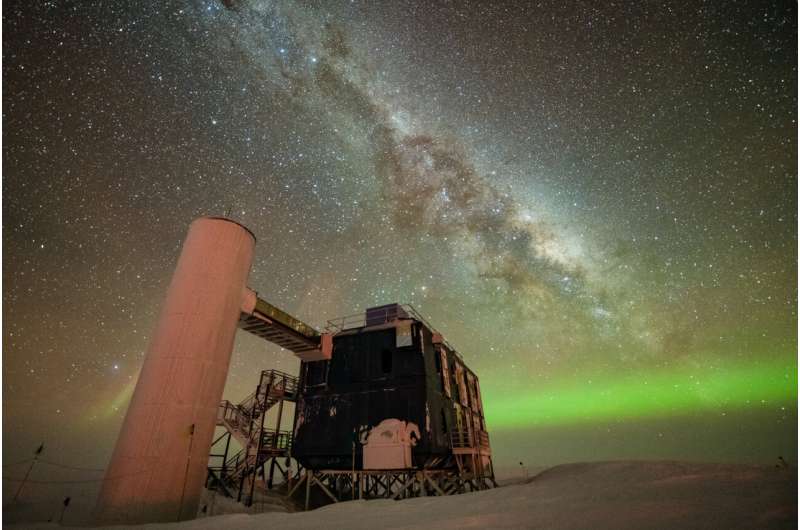
A view of the IceCube Lab with a starry night sky showing the Milky Way and green auroras. Credit: Yuya Makino, IceCube/NSF
The maps included one made from extrapolating Fermi Large Area Telescope gamma-ray observations of the Milky Way and two alternative maps identified as KRA-gamma by the group of theorists who produced them.
"This long-awaited detection of cosmic ray-interactions in the galaxy is also a wonderful example of what can be achieved when modern methods of knowledge discovery in machine learning are consistently applied," says Wolfgang Rhode, professor of physics at TU Dortmund University, IceCube member, and Hünnefeld's advisor.
The power of machine learning offers great future potential, bringing other observations closer within reach.
"The strong evidence for the Milky Way as a source of high-energy neutrinos has survived rigorous tests by the collaboration," says Ignacio Taboada, a professor of physics at the Georgia Institute of Technology and IceCube spokesperson. "Now the next step is to identify specific sources within the galaxy."
These and other questions will be addressed in planned follow-up analyses by IceCube.
"Observing our own galaxy for the first time using particles instead of light is a huge step," says Naoko Kurahashi Neilson, professor of physics at Drexel University, IceCube member, and Sclafani's advisor. "As neutrino astronomy evolves, we will get a new lens with which to observe the universe."
Citation: First 'ghost particle' image of Milky Way galaxy captured by scientists: Neutrinos detected by IceCube (2023, June 29) retrieved 2 July 2023 from https://ift.tt/bPO8hxC
This document is subject to copyright. Apart from any fair dealing for the purpose of private study or research, no part may be reproduced without the written permission. The content is provided for information purposes only.