Monday, September 5, 2022

A Re-Purposed Tactical Decision Game (TDG)

Welcome to our featured scenario of the month! We use this format to share a unique scenario that highlights an interesting problem, an emerging topic, or a new scenario format. As you read through the scenario, think carefully about how you would handle the situation – what stands out to you, what do you think is going on, and what would your priorities be if you found yourself in this situation? We suggest recording your choices and decision rationale so that you can compare your decisions with the experts at the end of the scenario. Read on to find out how you stack up against expert decision makers for this scenario.


The Situation

You are a mechanized rifle company commander operating in an arid desert environment that offers exceptional mobility for wheeled and tracked vehicles.  Each of your three rifle platoons is mounted on three armored personnel carriers (APCs) armed with .50 caliber machine guns (range 1,700m).  You also have a platoon of 81mm mortars (range 5km) on APCs.  

After intense fighting at the front for several weeks, the battalion commander has assigned your company to rear duty providing security for the Mobile Logistics Detachment (MLD).  As the ground combat forces advance north, the logistics commander plans to move in that direction and establish a forward supply point at Oasis, some 40 kilometers north but still several kilometers south of the front. Attacking forces had bypassed Oasis on the attack north.  While the front is generally to the north, there is no clear delineation between friendly and enemy territory; you long ago learned the importance of all-around security.  Irregular enemy forces mounted on small trucks and equipped with heavy machine guns are known to operate in the area.

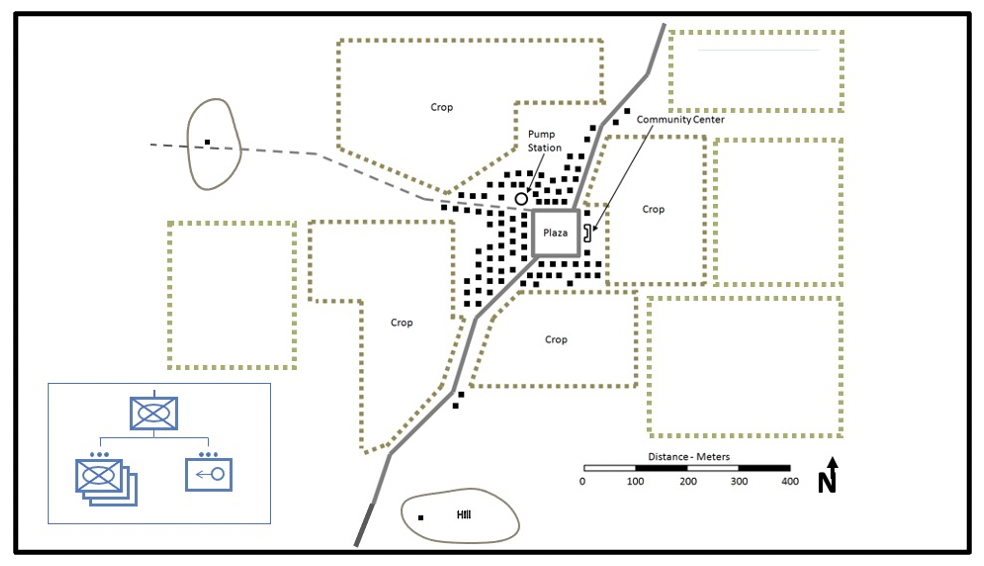
Oasis (pop. 2,500) is the only source of water in the area. The local population lives in rough dwellings that will not normally withstand anything larger than small arms. The only substantial masonry structures are the two-story community center (with a clinic and school) and the pump house, both built in the last decade with U.S. aid money.  In the center of town is a large plaza. Surrounding the buildings are irrigated fields of crops that meet local needs and are sold to outlying communities. The local population is of the same ethnic group as both the enemy and the host nation.

The time is 1800. The logistics commander tells you he wants to occupy Oasis starting at 1200 tomorrow, and he expects you to secure the settlement by that time. From experience, you know that each oasis has a small militia force consisting of the adult males of the settlement, equipped with small arms, rocket-propelled grenades (RPGs), machine guns, and possibly light mortars. The fighting skills of these outfits vary greatly but most will fight tenaciously to defend their homes and crops.  In the case of Oasis, the S-2 estimates the militia to be between 200-250 strong. He can tell you nothing more than that.

The logistics commander comes up to you and says: “One more thing; there’s an embedded cable TV news team covering us that’s looking for a little action. I’ve told them they can accompany you as you seize Oasis. Cooperate with them, but keep them out of trouble.”  You are introduced to the correspondent, whose perfect hair helmet you recognize from television.  He says:  “Let’s get something straight, Captain. The public has a right to know what’s going on over here.  I want to be right where the action is.  If you try to keep me from doing my job, it could be embarrassing for you.”

Decision Point #1

As you assess the situation and develop your plan, what are the most important considerations?

Select the three most important options from the list below.

Most Important Option
a. Secure the town (and especially the pump house) at all costs.
b. With a hostile embedded news crew, don’t do anything that could cause a scandal.
c. Minimize friendly casualties.
d. Minimize collateral damage; that will not look good on the evening news.
e. Figure out how to accomplish the mission without a fight.
f. Show the locals who is in charge right from the beginning and there won’t be any trouble.
g. Make sure the news crew is safe and out of the way at all times.

Take a moment to consider your reasons for your decision.


Decision Point #2

What actions would you be most likely to include as part of your concept of operations?

Select all that apply from the list below.

Selection Option
a. Sneak in through the crop fields on foot under cover of darkness to achieve the element of surprise.
b. Approach on the road in daylight.
c. Conduct mortar prep fires to keep militia forces suppressed as you approach.
d. Seize the pump station (the town’s lifeline) as an objective.
e. Seize the community center (“high” ground and symbolic center) as key terrain.
f. Conduct a diversion on one side of town while approaching from another.
g. Drive straight into the center of the plaza in the middle of the day and ask to speak to the community leaders.
h. Set up a base of fire with one platoon while entering the town with the other two.
i. Quickly seize the egress points (southwest, northeast, and northwest corners) to prevent hostile elements from escaping.
j. Strike quickly and decisively to overwhelm any resistance before it can get organized.
k. Occupy the hill west of town as a potential base of fire.
l. Occupy an overwatch position on the hill south of town.
m. Halt a vehicle heading into town and have them escort you.

Take a moment to consider your reasons for your decision.


from Hacker News https://ift.tt/yOChZo5

What I’ve learned from having Covid

  1. The same thing Salman Rushdie learned: either you spend your entire life in hiding, or eventually it’ll come for you. Years might pass. You might emerge from hiding once, ten times, a hundred times, be fine, and conclude (emotionally if not intellectually) that the danger must now be over, that if it were going to come at all then it already would have, that maybe you’re even magically safe. But this is just the nature of a Poisson process: 0, 0, 0, followed by 1.
  2. First comes the foreboding (in my case, on the flight back home from the wonderful CQIQC meeting in Toronto)—“could this be COVID?”—the urge to reassure yourself that it isn’t, the premature relief when the test is negative. Only then, up to a day later, comes the second vertical line on the plastic cartridge.
  3. I’m grateful for the vaccines, which have up to a 1% probability of having saved my life. My body was as ready for this virus as my brain would’ve been for someone pointing a gun at my head and demanding to know a proof of the Karp-Lipton Theorem. All the same, I wish I also could’ve taken a nasal vaccine, to neutralize the intruder at the gate. Through inaction, through delays, through safetyism that’s ironically caused millions of additional deaths, the regulatory bureaucracies of the US and other nations have a staggering amount to answer for.
  4. Likewise, Paxlovid should’ve been distributed like candy, so that everyone would have a supply and could start the instant they tested positive. By the time you’re able to book an online appointment and send a loved one to a pharmacy, a night has likely passed and the Paxlovid is less effective.
  5. By the usual standards of a cold, this is mild. But the headaches, the weakness, the tiredness … holy crap the tiredness. I now know what it’s like to be a male lion or a hundred-year-old man, to sleep for 20 hours per day and have that feel perfectly appropriate and normal. I can only hope I won’t be one of the long-haulers; if I were, this could be the end of my scientific career. Fortunately the probability seems small.
  6. You can quarantine in your bedroom, speak to your family only through the door, have meals passed to you, but your illness will still cast a penumbra on everyone around you. Your spouse will be stuck watching the kids alone. Other parents won’t let their kids play with your kids … and you can’t blame them; you’d do the same in their situation.
  7. It’s hard to generalize from a sample size of 1 (or 2 if you count my son Daniel, who recovered from a thankfully mild case half a year ago). Readers: what are your COVID stories?

This entry was posted on Sunday, September 4th, 2022 at 9:40 am and is filed under Adventures in Meatspace, Self-Referential. You can follow any responses to this entry through the RSS 2.0 feed. You can leave a response, or trackback from your own site.

You can use rich HTML in comments! You can also use basic TeX, by enclosing it within $$ $$ for displayed equations or \( \) for inline equations.


from Hacker News https://ift.tt/EJYk1FP

Johnny Mnemonic in Black-and-White

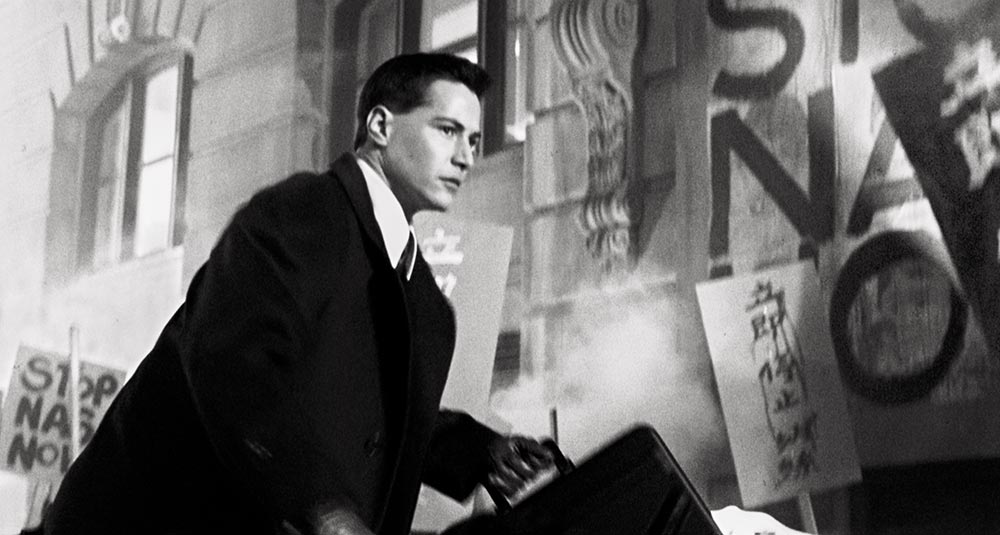
Despite 25 years of dismissal and mockery, Johnny Mnemonic remains a visionary forecast of the networked society. No pre-millennium Hollywood production captured the anxieties and exhaustion of living online so well, despite studio butchery that deprived audiences of writer William Gibson and director Robert Longo’s ambitious vision. Now Longo triumphantly returns to the film that began and ended his career in Hollywood by unveiling a black-and-white version that effectively defaces the original release’s expensive veneer. Without altering a line of dialogue or shot sequence, Longo reconfigures the tone of the film, dialing up Gibson’s cyberpunk paranoia and violating the sacred principle that every dollar spent must be lavishly displayed on screen. The Tribeca and Rockaway Film Festivals co-present the new cut’s premiere this Friday at a sold out outdoor screening. Earlier this week Screen Slate, which last year included Johnny Mnemonic in its screening series and publication 1995: The Year the Internet Broke, talked with Longo about his relationship to the much-maligned film and its ongoing “redemption.”

This conversation has been edited and condensed.

Patrick Dahl: I watched the black-and-white cut last night. It's really fantastic and I'm excited for other people to see it. What led you to consider doing this now?

Robert Longo: Well, I always had this fantasy that on the 25th anniversary I would try to get some redemption in relation to this film, because making it was really difficult. And I, at one point, thought about re-editing, but then I realized if I just turned it black-and-white that would be the best, easiest thing to do, and the most radical way of kind of imprinting how I really wanted it, because I wanted to make it in black-and-white originally. I wanted it to be like a contemporary version of Alphaville or something like that. Anyway, the movie, by dealing with Hollywood, had gotten out of control. Keanu had just blown up with Speed. Tristar wanted it to be their summer movie. It was kind of crazy. For me, for William, and for Keanu, this is a bit of redemption. They really love this new black-and-white conversion. And it looks like a shitty, million-dollar movie. It has a bit of a grunge to it and an attitude to it, which I think is really great.

Completely. The black-and-white knocks several million dollars off of the price tag.

Yes, it does, in a good way.

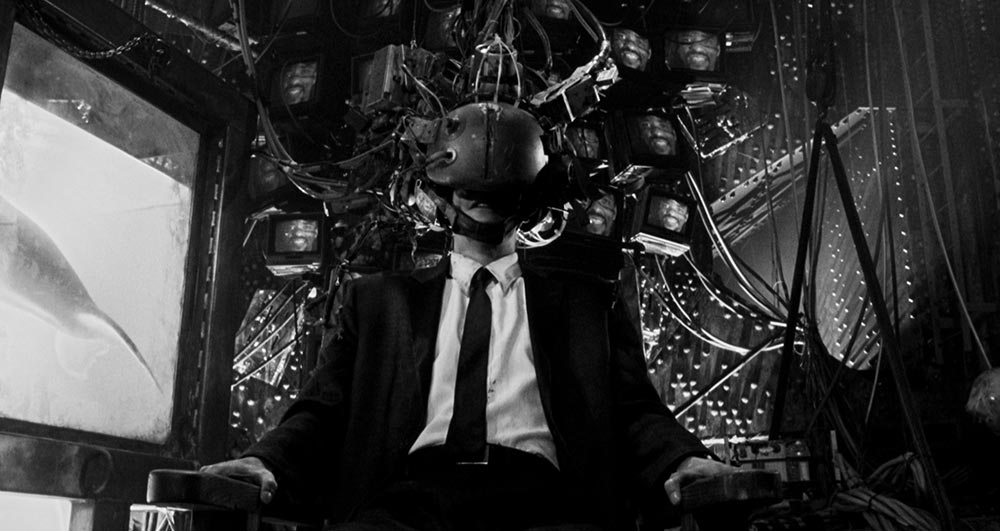
When I first heard about the black-and-white version, I thought about the color, which was one of the things that I really liked about the original. But when I saw the black-and-white version, I was like, "Oh, this feels so right." Because it has this kind of a dreamy, 16mm feel to it. It reminds me of Tetsuo and Eraserhead, and all these great, kind of dreamy, black-and-white movies.

Yeah, exactly. And I love all the video graphic stuff in black-and-white, it seems so great. In hindsight, the color graphics now look all pretty retro, but in black-and-white, it has its own quality to it for sure.

Johnny Mnemonic Black and White
Johnny Mnemonic in black-and-white, 2021, courtesy of Robert Longo Studio

Without a doubt. It's a complete other world.

I think the three computer graphic sections become quite coherent in black-and-white as well, so I am very happy with it.

Is this the end of the line for Johnny Mnemonic? You mentioned redemption... are you still interested in re-cutting—

No. I have a day job. Originally, making this movie was a torturous experience. Dealing with the Hollywood people was difficult. First of all, they couldn't say “mnemonic.” They wanted to change the title to Johnny Gets His Gun, or some shit like that. And then, when Keanu blew up with Speed, they got really excited about it. And meanwhile, their summer movie that was supposed to be released, which was called Mary Reilly, was in a disastrous state and they couldn't release it. So, they thought, "Well, let's make Johnny the summer release."

Originally, it was supposed to be a February release. Instead, Johnny Mnemonic opened the same month as Die Hard [with a Vengeance] and Batman [Forever], but it did pretty well in the beginning. It was number four for a while. And then it got trashed by the critics, and I completely understand it, because the Hollywood people just messed with it so much. They tried to pump more money into it because they were making it their summer movie, and they were complete idiots. It was a difficult time, because the guy that was editing the film with me was Ron Sanders, Cronenberg's editor. It had a very different pace to it. And then the studio brought in another editor, and he didn't get it at all. It was a difficult situation. I mean, I'd say half the movie is what I want.

The DP that wanted to shoot the movie for me was a guy named Michael Chapman, who was Scorsese's DP. But the problem was that I couldn't have him do the movie because he wasn't Canadian, because we're shooting the movie in Canada. So, all of a sudden, our DP went from Michael Chapman to some Canadian DP. And the Canadian pool of DPs was quite weak. The one guy I really wanted to do it couldn't do it, and the guy I ended up with was a French guy who at least knew who Godard was. But, I mean, his major film credit was Weekend at Bernie's, so it was really difficult.

When you were making it, did you think about potential connections to the fine art world? Or, did you see it as compartmentalized from your work there?

One of the reactions in the movie world was, "How dare an artist try to make a movie." And then, in the art world it was, "How dare an artist try to make a commercial movie." So, I got fucked either way, in that sense. There was already a prejudice against it. Originally, my art emerged from a generation that was involved in appropriation. And I always thought it'd be really great to make a movie and steal my own images. That was one of the ideas. There's a lot of “stolen” art in the film. The dolphin is a reference to Damien Hirst, the big tower of TVs is a reference to Nam June Paik. I mean, there's a lot of art shit that I stole in it, for sure.

After it came out, was the art world any kinder, or did they remain skeptical?

I basically got thrown into the garbage heap for a while. My career tanked after that, for sure. Basically, I had to redo the 90s. I kind of missed the 90s in a weird way. It was a difficult period of time for me, for sure. I don't want to blame it on the movie, but the movie set me back quite a way. My wife at the time, Barbara Sukowa, who plays Anna Kalmann, said, "Why don't you just go back to the studio and draw?" I went back to the studio. I had no more assistants. I was kind of broke. And, also, my youngest son was born the first night of shooting in Toronto. After the film, I made a drawing a day for — it was a leap year, so 366 days — a project called “Magellan,” which turned out to become my lexicon of everything I've done since then. The hardest thing as an artist, as you get older, is to figure out how to stay relevant. I think I'm doing okay with my job right now. I consider making my drawings and sculpture in my studio to be comparable to making one gigantic film.

Installation view of Longo's solo exhibition Magellan, 1997. Metro Pictures, New York.
Installation view of Longo's solo exhibition Magellan, 1997. Metro Pictures, New York. 

Oh, interesting. Would you mind elaborating?

The way I make my work is almost like a director making a film. I have different people working on different things. It’s very much like a film set in my studio. When [my friend, artist] Rashid Johnson was getting ready to make his film Native Son, he came to me asking for advice, and the best piece of advice I could give him is that you should shoot the most important part of each scene first, and get that done. And then you can get all the great visual stuff later on. I always wanted to make all these visual decisions, but I never had time. For the overhead scene in the bathroom, for example, I had to fight tooth-and-nail to get that scene done. It was tough in Hollywood. You have to remember: to them, ‘art’ is a boy's name, and they’re terrified of it. They're terrified of it, because they don't understand it at all.

You said, and I think you've said this consistently in the past, that you conceived the film in black-and-white. How long did that dream last? I imagine the studio wasn't even going to consider it.

Yeah. Well, there you go. You said it yourself. The evolution of the movie went through so many people. They had already planned in the very beginning to take me off the movie. I mean, the second unit director was promised the movie after the first week of the movie.

Oh, that's ugly.

It was a pretty fucking ugly thing. So, the second unit guy who was supposed to shoot all the action and shit, did a really shitty job. In the beginning, we were trying to raise a couple million dollars, and then I couldn't raise it. I couldn't get it together. And, in hindsight, I probably should have used my own money. I mean, that's one of the most brilliant things that Schnabel did with Basquiat. I was living in Paris at the time, and I met this guy in a bar who was an American art collector who was also a film producer, Staffan Ahrenberg. He wanted to work with me and now we’re very close. He and Peter Hoffman were executive producers. Staffan was the good guy, trying to help me make the movie I wanted to make. Peter was the bad guy, who tried to steer the movie in a completely cliché direction.

I'm assuming you try to limit contact with the studio nowadays, but do you have any sense of how they feel about the black-and-white cut?

Originally, when I decided to make this black-and-white conversion, I ripped a Blu-ray and turned it black-and-white. I contacted one of the film’s original producers who was also a good guy, Don Carmody. I said to him, "I'm doing this, and I'm going to dump it on the 25th anniversary. I'm going to dump it on YouTube,” or something like that. And he said, "Wait, let me see it." So, I sent it to him, and he got really excited. "This is really great. We should show this to Sony." I hesitated to get Sony involved at first, but the problem with the Blu-ray version is that the quality would not be good enough to project it in a theater. So, Sony gave us the footage to work from, and they may release this new version on Blu-ray There's never been a director's cut. Ironically, there is a version that some people misunderstand to be a “director's cut,” the Japanese version of it, but it's not a director's cut. It's basically got more Takeshi Kitano in it. That's basically what it is.

So, I got the hi-res footage from the studio, and we graded it into black-and-white. I worked with Cyrus Stowe, who was the colorist on this version. Basically, we went through it scene-by-scene, and he was really great. He's really a very talented guy.

Johnny Mnemonic in black-and-white, 2021, courtesy of Robert Longo Studio

Was that feeling of redemption there, throughout the process?

When I saw the first version of the black-and-white film, I was just so happy. It was so much closer to what I imagined it to be, for sure. I knew turning it black-and-white would get it closer to where I imagined it from the very beginning. In my work, I take inspiration from films like Alphaville, La Jetée, things like that. A lot of black-and-white movies are not really black-and-white. They're kind of gray. The contrast is really pumped up now [in this cut] so it’s very black-and-white.

In a lot of the interiors of the color version, there's kind of a smoke machine effect. It's a very hazy movie. And I think the black-and-white sharpens certain visual elements of it, while also giving it this dreamy vibe, which is really neat. Do you see a future in filmmaking at this scale?

Well, I've made a bunch of small arty films that I'm very happy with. I showed one in my gallery last year called Icarus Rising. Making a narrative film is really tough because you have to have a really great script. The problem with our script for Johnny Mnemonic was, the script was fucked with so much. The first couple of drafts were so great, but it was just so fucked-with. And here are these people telling Gibson how to write.

One of my greatest experiences on the film, and one of the production’s greatest outcomes was Johnny’s tirade on the mound under the bridge. William, Keanu, and I became really close friends. Keanu was basically the godfather of my youngest son because he was there when the baby was born, and we're still very close. Anyway, as I’ve explained, we were getting so frustrated with this whole movie. So I decided that the protagonist of the film should be really fucking frustrated. We're shooting in Montreal, underneath this bridge. And I said, "I got this great idea. I want to build a mound like it's the curve of the Earth. We can see the city in the background. And I want Johnny to flip out. I want him to flip out and say, “What the fuck is going on?” William wrote it that night and we gave it to Keanu, and it was my favorite scene in the whole movie, when he screams about how he wants room service. It was so great.

Yeah. That is my favorite scene as well. I have many scenes that I love dearly in the movie, but that is, by far, my favorite and —

That was never in the script.

When people talk about Johnny Mnemonic as a bad movie, they always point to that scene. And it just makes no sense to me. It’s a perfect encapsulation of that kind of frustration in a late capitalist society, and all its needs and desires, it's very post-apocalyptic, and it's so well-written... I don't know. It's a head-scratcher, but I feel the tide is turning on people's appraisal of the movie. So, I hope that continues.

Well, it's been pretty wild. William's been talking about it, too. It's kind of great that people are starting to see the movie that was in the movie. Do you know what I mean? It took a pandemic to change people's minds. It took a crazy-ass president. It was all sorts of things.

Special thanks to Alex Baye


from Hacker News https://ift.tt/1ypj8wJ

Sunday, September 4, 2022

Saving Face: Portraiture in the Age of Artificial Intelligence

THE PHOTOGRAPHER approached the trio on his bike, a bundle of gear balanced on his front fender and a wide-brimmed hat covering his head. A discussion ensued. Hubert, the first of the three to speak, took the man for a fellow enthusiast of far-left politics. Peter suspected a questionable sales pitch. Adolphe, at the head of the cluster, offered apologies for his companions’ brusqueness. No worries, the photographer countered; he was there, in fact, to propose a group photo—a slice-of-life shot that, he insisted, would be “for science’s sake only, and for the archives: a personal record of the conversation we shared today.”1

Such is the encounter of German photographer August Sander and the three young men pictured in one of his best-known images—Jungbauern (Young Farmers), 1914—as imagined in the opening pages of Richard Powers’s 1985 debut novel, Three Farmers on Their Way to a Dance. As Powers’s title suggests, Sander’s image functions as both the spark for and the through line of his novel, which begins with a viewing of the photograph decades later at the Detroit Institute of Arts and subsequently traces interwoven narratives that follow Sander’s farmers across time and space: to the country dance they were headed for on that 1914 spring day, to the cataclysmic war that began only months later, and finally—through both their lived actions and their photographic representation—to the experiences of later generations on both sides of the Atlantic.

Our Instagram feeds and work-profile pages, in short—where each newly uploaded photograph marks a potential addition to expanding training data sets—are the Texas oil wells of the Clearview AI age.

Young Farmers, most readers will know, is among the hundreds of photographs, made across decades, that Sander came to conceptualize as part of his monumental (and never realized) portrait project “People of the Twentieth Century.” Conceived around 1922 as a set of forty-five portfolios of twelve photographs each—to be arranged in a carefully assembled sequence moving from farmers to craftspeople and the educated middle class to, finally, a diverse array of social outcasts labeled simply “the last people”—Sander’s vast survey was to present a systematic, if not quite comprehensive, sociological atlas of the German people. Or, more precisely, of the German people (who had lost their kaiser only with the war’s end in 1918) on the path to democracy, advanced industrial modernity, and, ultimately, authoritarian terror.

It was just this aspect—his portraits as the index of a specific culture in the throes of a particular historical process—that Sander chose to highlight in titling his preliminary 1929 sampling of his portraits with the expression Antlitz der Zeit: roughly translated, “the face of our time.” This dimension of the work was at the root of critic Walter Benjamin’s interest in Sander’s project as well. In his seminal essay “Little History of Photography,” published two years later, Benjamin praised Sander’s photography as providing nothing less than a quasi-physiognomic “training manual” for the age—an era, the critic famously wrote, in which individuals “will have to get used to being seen according to where one comes from.”2 Sander’s photographs of bakers and accountants and washerwomen, in other words, pictured for Benjamin less isolated subjects than a distinctly modern logic of subjectivity itself—in which what we are and how we come to be seen is indivisible from the cultural environments, markers, and relations that form and connect us. To return to Powers: Those young farmers, from their dangling cigarettes and just-so stares to their pinched fingers and matching suits, invite us—as do their dozens of compatriots in Sander’s atlas—into an interconnected world of spring dances and August military campaigns and, should we accept the novelist’s wager, into the imagined afterlives of these figures and events across cultures and continents in the decades to follow. (This past August, Aperture published the most comprehensive iteration of Sander’s unfinished project to date, including 619 of his photographs in a single volume.)

THE USE OF VAST PORTRAIT COLLECTIONS as essential training manuals is, today, a much more pressing and widespread phenomenon than Benjamin could have ever imagined. To take just one notorious example from recent headlines: The facial-recognition company Clearview AI, launched with assistance from alt-right bottom-feeders including Peter Thiel and Charles Johnson, recently notified investors that it aims to amass one hundred billion facial photographs for its database by the end of the year.3 These images, culled without consent from across the internet, serve as training data sets for machine-learning systems whose goal is to be able to classify and identify any face on earth, allowing for precision-guided and near-total surveillance. The Ukrainian government, for instance, has recently used Clearview AI technology to identify Russian war dead, just as grocery magnate John Catsimatidis in 2018 used it to spy on his daughter’s date. Other Clearview AI clients include the NBA, Macy’s, and—of course—various federal, state, and local law enforcement agencies. In China, a similar project is taking shape under the guidance of the country’s Ministry of Public Security, which is integrating footage from more than half a billion surveillance cameras with an unprecedented sampling of iris scans, voice prints, and DNA samples—all, in the authorities’ own words, with the goal of successfully “controlling and managing people.”4

The billions of images collected by Clearview AI and the Chinese government (and other, hopefully more benevolent machine-vision devotees) function to construct what artificial-intelligence developers refer to as a “ground truth”—a set of verifiable data that establishes the epistemic boundaries of machine-learning processes and facilitates the construction of algorithms by which inputs (selected images) are matched with outputs (targeted classifications and identifications). These outputs range from straight identification (this picture shows that person) to predictive judgments (this picture shows somebody reliable, likely criminal, etc.). To continue to fine-tune the algorithms reaching these conclusions, of course, one needs more and more data—hence the relentless and unregulated drive to cull billions upon billions of images, from publicly available mug shots and security footage to Instagram selfies. (Indeed, everyone reading these words is likely included in Clearview AI’s data set.) Even more, this process necessitates the constant creation of data—the “(total) datafication and surveillance,” as Jathan Sadowski has written, “of people, places, processes, things, and relationships among them.”5 Our Instagram feeds and work-profile pages, in short—where each newly uploaded photograph marks a potential addition to expanding training data sets—are the Texas oil wells of the Clearview AI age.

As AI researcher Kate Crawford has noted, the metaphor of data as natural resource can be problematically bloodless, diverting our attention from the very real material and human costs of data’s extractive economy. Crawford (who with Trevor Paglen organized the 2019–20 exhibition “Training Humans,” focused on facial-recognition training data sets, at Milan’s Fondazione Prada) has detailed the extent of these costs, which reach from the geopolitical violence generated by the natural-resource mining essential for AI infrastructure to the ethical vacuum resulting from the replacement of the notion of human subjects by that of data subjects—yielding a vision of individuality, in Crawford’s words, that understands only “agglomerations of data points without subjectivity or context or clearly defined rights.”6 With such an understanding, it follows that “the meaning or care that might be given to the image of an individual person, or the context behind a scene, is presumed to be erased at the moment it becomes part of an aggregate mass that will drive a broader system.”7

This schema is the exact opposite, of course, of that encapsulated in Sander’s three farmers as conceptualized by Benjamin and narrativized by Powers—for whom, just as for the photographer himself, it was the complexities of subjectivity and context unlocked by the 1914 photograph that made it so compelling, and which, when compiled in a larger “training set” with such images as Sander’s Putzfrau (Cleaning Woman), 1928, or Ingenieur und Werbeleiter (Engineer and Advertising Manager), ca. 1935, raised fundamental questions about the economic, political, and social structures by which rights, in a country that had only fully embraced democracy with World War I’s end, might be established and maintained at all. Note the stare, garb, setting, and held implements of each of Sander’s represented subjects. They are utterly distinct and yet strikingly parallel; each individual or group both opens up a specific life-world to which they belong (one into which Sander himself entered, and which is ripe for a novelist’s gaze) and establishes dialogic correspondences with the others—creating an active portrait of the society they, and Sander, composed and inhabited together and of the commonalities and contestations this cohabitation necessarily entailed.

To face this landscape, a new program of physiognomic analysis and instruction is in order: one that examines both the countenance of AI itself and the amalgamated complexity of the individuals and communities it seeks to reduce to algorithm-building data.

As Benjamin helps us to understand, the insistent play of material specifics across Sander’s faces operates directly counter to another technologically mediated facial economy from Germany’s interwar years—that of the fascist face. And this distinction helps, in turn, to enlighten the political stakes of our own AI-driven age. Just as today’s rapacious collection of data is fueled by the need to dissolve any and all complexity of subjects, contexts, and relations within the unifying system of predictive algorithms, so the fascist economy of the face that characterized Hitler’s Germany operated through a logic of the many dissolved into the one. The individuated faces of the country’s farmers, cleaning ladies, and businessmen, that is, came to be phantasmatically reflected and sublimated in Hitler’s own visage—a symbolic structure exemplified nowhere so clearly as in the call-and-response staged between the assembled laborers and the German führer in Leni Riefenstahl’s 1935 party-rally documentary, Triumph of the Will. In the integrated essence of the Volk that Riefenstahl’s film aspires to capture, there is no room for individual detail or imaginative extension; the system it emblematizes is both anchored and sustained by a total identification of mass and leader. “Where would the Volk be,” as Bertolt Brecht imagined Hitler wondering to his mirror reflection, “without the luck of having me reflected in it, and it being able to be reflected in me?”8

This identificatory apparatus, as Benjamin among others argued, worked by taking the place of—and violently suppressing—the messy back-and-forth of politics. No wonder Sander’s studio was raided by the Gestapo and the plates for Antlitz der Zeit seized in 1936; does anything betray the fallacy of the integrated Volk more effectively than our conversant trio of businessman, washerwoman, and farmers? In today’s promises of an integrated mirroring of the world in AI’s assembled data, we see an analogous logic of absolute, and hence depoliticized, identification taking shape—one that operates through both individual subjects’ identification with AI’s claims to unfettered, all-knowing ability and, simultaneously, the ambition to identify (and in part control) these subjects via AI’s ever more expansive surveillance capacities. As Crawford astutely outlines, these dual identifications point to the double-sidedness of what she and the historian Alex Campolo have called the “enchanted determinism” of AI: the fact that AI systems, in their mix of infinite aspiration and mathematically driven systematicity, are seen to be at once “enchanted, beyond the known world, yet deterministic in that they discover patterns that can be applied with predictive certainty to everyday life.”9

A primary problem with such thinking, just as with the closed mimetic loop showcased by Riefenstahl, is that it obscures the fundamentally political decisions, priorities, and prejudices in which such enchantment is anchored and to which it gives rise. For all the benign and even beneficent uses of AI-assisted machine vision (from self-driving vehicles to medical imaging tools), to downplay the fundamental political stakes of its history, capacity, and goals is to make fatally easy the slip into totalizing surveillance as a primary function. Is it any surprise that the cast of characters filling facial-recognition technology’s brief history often reads like a rogues’ gallery of far-right ideologues, from Johnson and Thiel to Trump megabacker Robert Mercer? Or that the algorithms guiding this technology have been notoriously inaccurate, or simply incapable, when confronted with nonwhite faces? Or that the very process of training these algorithms relies on a binary logic of “this, not that” that cannot admit any porosity in the categories through which faces—and individuals—might be understood? As Florian Jaton titled his 2017 article on the design of image-processing software, “We get the algorithms of our ground truths.”10 Exactly. And these ground truths, we can be sure, are permeated by the very same prejudices, priorities, and power differentials from which, we are told, AI’s wonders promise a blissful escape.

These developments, it barely need be said, mimic—and help drive the larger logic of—neoliberal rationality’s economization of the political and (in Wendy Brown’s words) “jettisoning of the very idea of the social.”11 Rather than engaged citizens, this structure values reliable “team members” for whom the active contestation of rights, responsibilities, and values (the old business of citizenship) is superseded by an overarching concern with the economic growth of the nation-as-firm and with the securing of their roles in this process (the new business of human capital). Mirrored and emblematized in the enchanted determinism of AI—a primary new function of which is tracking the precise actions of such team members, at Amazon and elsewhere, to ensure their efficient servicing of the system to which they’re subordinated—this unifying economistic framework shunts, and works to supplant, the component differences of which a citizenry is made.

To face this landscape, a new program of physiognomic analysis and instruction is in order: one that examines both the countenance of AI itself and the amalgamated complexity of the individuals and communities it seeks to reduce to algorithm-building data. We can see attempts at the former in such recent projects as Shalini Kantayya’s 2020 film Coded Bias and Crawford and Paglen’s “Training Humans” show—both of which assiduously analyze the creation and operation of AI algorithms to, in the words of the latter’s website introduction, “look back at these systems, and understand, in a more forensic way, how they see and categorize us.”12 Beyond forensic analysis of AI’s epistemic boundaries and flaws, we need renewed epistemologies of community itself—ones that aim not to distill complex realities into simplified formulas but, like the work of Sander, to build complexities of relation and recognition from the seemingly simplest of means: the human portrait.

McQueen’s Year 3 photographs, shot in the wake of Brexit and installed right before Covid shut everything down, presented an overwhelming view of subjects and community in formation.

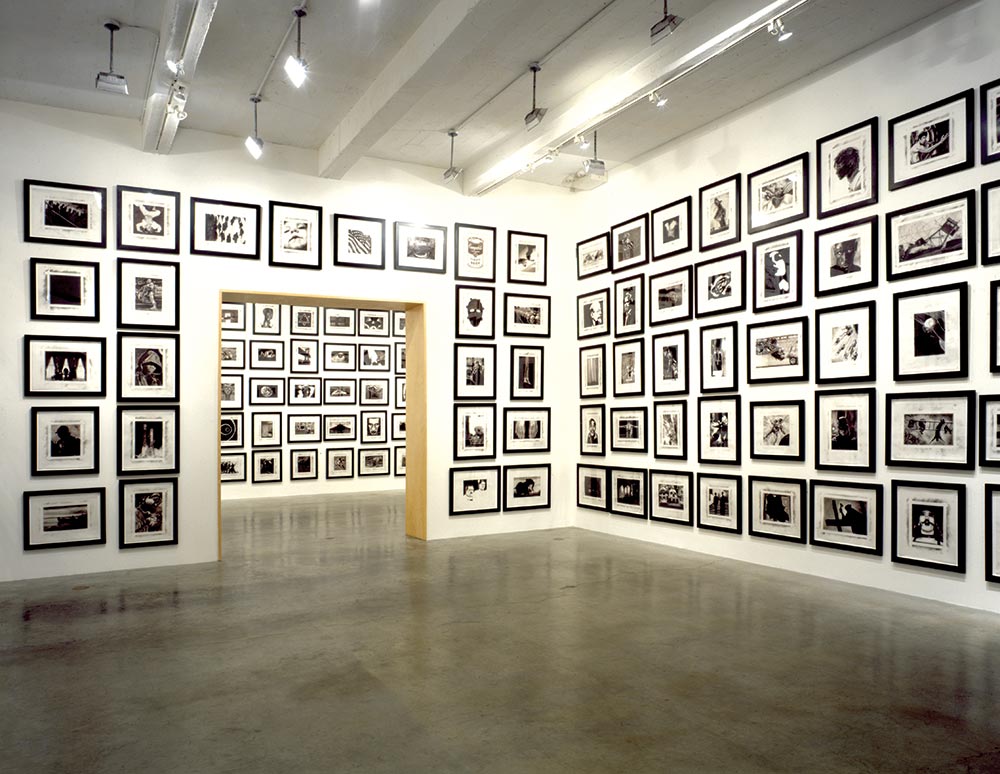
Outstanding examples of such work have, perhaps unsurprisingly, flourished in the art of the past three decades, precisely those years in which the internet—and the model of data subjectivity it promulgated and continues to fuel—has come to dominate our lives. These range from Rineke Dijkstra’s “Beach Portraits,” 1992–2002, to diverse series by Dawoud Bey, LaToya Ruby Frazier, Lyle Ashton Harris, Catherine Opie, Thomas Struth, and others, to Steve McQueen’s astounding 2019–21 project Year 3, in which the British artist filled the Tate Britain’s monumental Duveen Galleries with simple group portraits of third-grade classes—public, private, parochial—from across London. (The goal was for every such class in the city to take part; around two-thirds did.) An immense sea of postures, getups, body types, and classroom dynamics, McQueen’s assembled photographs, shot in the wake of Brexit and installed right before Covid shut everything down, presented an overwhelming view of subjects and community in formation at a time of all-consuming social stress: a profoundly moving assemblage of utterly diverse individuals, right on the cusp of adolescence, united by their shared grade and city. The essential “ground truth” his project presented was that of the impossible irreducibility, and forever coming-into-being, of human subjects and groupings. That McQueen achieved this with the most familiar of institutional formats—the class portrait, a not-too-distant cousin of the mug shot—made his project all the more effective. Across picture after picture, this rigid framework amplified its own undoing in the profusion of incident and idiosyncrasy that filled it—and in the process made clear the distinction of such historical portrait models from AI-guided machine vision, in which the foundational act of making-into-data seeks to eliminate, precisely, any disturbance from such idiosyncratic “noise.”

Of course, there’s a decent chance that many of McQueen’s Year 3 shots are now doing their part in Clearview AI’s training data set, as may the individual portraits of Bey, Dijkstra, Frazier, Harris, Opie, and others. That such “making data” may have occurred, though, doesn’t mean it inevitably must. Rather, the opposition of McQueen’s third graders as specific people and potential data-set training material clarifies the stakes: We must prioritize—and call on state power to protect—individual subjects over algorithm-driven systems, and the complexities of social difference over the unifying drive of abstract capital. We can’t, for all Powers’s novelistic imagination, ask Sander’s three farmers for their thoughts. But we can, entering their indelible image and the history of which it is a part, begin to map the terrain we ourselves are crossing and chart the course we wish to take.

Graham Bader is professor of art history at Rice University in Houston. His book Poisoned Abstraction: Kurt Schwitters Between Revolution and Exile was published by Yale University Press last fall.

NOTES

1. Richard Powers, Three Farmers on Their Way to a Dance (New York: William Morrow and Company, 1985), 27.

2. Walter Benjamin, “Kleine Geschichte der Photographie,” in Gesammelte Schriften, ed. Rolf Tiedemann and Hermann Schweppenhaüser, vol. 2, pt. 1, Aufsätze Essays Vorträge (Frankfurt: Suhrkamp, 1977), 381. Translation my own.

3. For details, see for instance Drew Harwell, “Facial Recognition Firm Clearview AI Tells Investors It’s Seeking Massive Expansion Beyond Law Enforcement,” Washington Post, February 16, 2022, washingtonpost.com/technology/2022/02/16/clearview-expansion-facial-recognition/.

4. See Isabelle Qian, Muyi Xiao, Paul Mozur, and Alexander Cardia, “Four Takeaways from a Times Investigation into China’s Expanding Surveillance State,” New York Times, June 21, 2022, nytimes.com/2022/06/21/world/asia/china-surveillance-investigation.html.

5. Jathan Sadowski, “When Data Is Capital: Datafication, Accumulation, and Extraction,” Big Data & Society, 6, no. 1 (2019): 2.

6. Kate Crawford, Atlas of AI: Power, Politics, and the Planetary Costs of Artificial Intelligence (New Haven: Yale University Press, 2021), 115.

7. Ibid., 93.

8. Bertolt Brecht, “Notizen zu Heinrich Manns ‘Mut,’” as cited in Gerhard Richter, “Face-off,” in Monatshefte, 90, no. 4 (Winter 1998): 418. Translation my own. Richter’s essay is a highly intelligent discussion of the logic of the face in German culture and criticism of the Weimar and Nazi eras.

9. Crawford, Atlas of AI, 213.

10. See Florian Jaton, “We Get the Algorithms of Our Ground Truths: Designing Referential Databases in Digital Image Processing,” in Social Studies of Science,<span class=“Apple-converted-space”>  </span>47, no. 6 (December 2017), 811–840.

11. Wendy Brown, Undoing the Demos: Neoliberalism’s Stealth Revolution (New York: Zone, 2015), 210.

12. On Crawford and Paglen’s show, “Kate Crawford | Trevor Paglen: Training Humans,” Fondazione Prada, fondazioneprada.org/project/training-humans/?lang=en.

from Hacker News https://ift.tt/a8wBLmb

Portrait of the Artist as a Grown Man

Eliot After “The Waste Land” by Robert Crawford. Farrar, Straus and Giroux, 624 pages.

In a June 1922 journal entry, Virginia Woolf described a memorable evening spent with her friend, T. S. Eliot:

Eliot dined last Sunday & read his poem. He sang it & chanted it rhythmed it. It has great beauty & force of phrase: symmetry; & tensity. What connects it together, I’m not so sure . . . One was left, however, with some strong emotion. The Waste Land it is called; & Mary Hutch[inson], who has heard it more quietly, interprets it to be Tom’s autobiography — a melancholy one.

It is remarkable that Woolf could respond so intelligently to her first encounter with a poem that, one hundred years after its publication, remains synonymous with inscrutability. (A year before this recitation, Eliot claimed “that it appears likely that poets in our civilization . . . must be difficult.” He certainly was.) On the spot, Woolf identified the particular brilliance of The Waste Land: its balancing of, or oscillation between, symmetry and fracturing; its impersonal form and deeply personal feeling; its vibrating “tensity.” It’s easy for a reader now, schooled in the history of modernism, to sense the poem’s architecture and preoccupations. Far harder to recognize these in the moment, over cocktails.

By another light, though, Woolf’s introduction to The Waste Land—listening to it rather than poring over it—was ideal. Eliot later described the poem as “just a piece of rhythmical grumbling.” We can argue over the source of Eliot’s grousing. There was his unhappy, even dehumanizing marriage to Vivien Haigh-Wood, which he summed up in 1925: “In the last ten years—gradually, but deliberately—I have made myself into a machine. I have done it deliberately—in order to endure, in order not to feel—but it has killed V.” There were his infirmities both physical (regular bouts of influenza and a congenital double hernia) and psychological (he composed much of the poem while at a Swiss sanitarium). Finally, there was postwar Europe. From 1917 to 1925, Eliot worked on foreign accounts at Lloyds Bank in London. He knew just how prone to breakage the world was.

What can’t be argued is the power of The Waste Land’s rhythms—its feel in the ear, the way this tissue of quotations booms, echoes, and resonates. Despite his image as a prematurely-aged fuddy-duddy, Eliot loved to dance—in 1927, he offered to teach Woolf the Grizzly Bear and the Chicken Strut—and his language jitterbugs all over the place. His impressive mastery of cadences ranges from the Biblical (“I will show you fear in a handful of dust”) to the demotic (“And if you don’t give it him, there’s others will, I said. / Oh is there, she said. Something o’ that, I said”) to the surrealistic (“And bats with baby faces in the violet light / Whistled, and beat their wings / And crawled head downward down a blackened wall”). At the suggestion of Ezra Pound, the original nineteen-page manuscript of The Waste Land was cut almost in half. What remained was language pressurized into music.

All of which is to say, Woolf’s first, purely acoustic encounter was in many ways perfect. In the poem’s third section, “The Fire Sermon,” we read, “But at my back in a cold blast I hear / The rattle of the bones, and chuckle spread from ear to ear.” In “What the Thunder Said,” a speaker intones, “I have heard the key / Turn in the door once and turn once only.” To read The Waste Land well is, in the end, to hear it well—to listen to its voices and to recognize the music they jointly create.


For generations, critics have located The Waste Land, that great poem of the center not holding, at the very center of both modernist history and Eliot’s life. Robert Crawford’s Eliot After “The Waste Land,” the second volume in a two-part biography of the poet, follows suit. 

In the first volume, Young Eliot: From St. Louis to “The Waste Land,” Crawford, an excellent poet and seasoned biographer, meticulously followed Eliot’s years of apprenticeship: his descent from a Boston Brahmin family; his childhood in St. Louis (Eliot’s grandfather founded Washington University); his time as a Harvard undergrad, where he drank, sailed, and wrote racist doggerel about a figure named King Bolo until, in 1908, he discovered his own voice by discovering the voice of the Uruguay-born French poet Jules Laforgue; his experience as a philosophy grad student, also at Harvard; his decision to leave academia and conquer the London literary market; his rash marriage to Vivien in 1915 (her mother had warned a previous suitor off due to Vivien’s “moral insanity”);  the many breakdowns of Vivien (she suffered from migraines, digestive issues, and paranoia), of Eliot (respiratory problems and bad teeth), and of their relationship (shortly after the wedding, Vivien began an affair with the British philosopher Bertrand Russell). In Crawford’s telling, all of this—the “soundscape of St. Louis,” the reading, the marital discord—led to The Waste Land in 1922. The final words in Young Eliot read, “It was as if he had never been young.”

This notion—that Eliot led a belated, almost posthumous existence—is a critical truism, and part of Young Eliot’s success lay in its sharing of a different, livelier Eliot. This “Tom,” as Crawford refers to him throughout, was not just a dancer but a rascally prankster: Crawford opens with Eliot and his nephew, in the 1960s, setting off a stink bomb in the Bedford Hotel and then fleeing the scene. What to do with a second volume, though, one that seems to announce a dwindling away in its very title: Eliot After “The Waste Land”?

The poet had a lot of life to live after 1922. In those forty-three years he converted to Anglo-Catholicism; engaged in a seventeen-year-long epistolary extramarital romance with the American drama teacher Emily Hale; separated from Vivien; became an editor at Faber and Faber; saw Vivien committed to a mental hospital (where she died almost a decade later); published one of the century’s great religious lyrics (“Ash-Wednesday”) and one of its great poetic sequences (Four Quartets); won the Nobel Prize in Literature; and, in 1957, got married again, this time to his much-younger secretary, Esmé “Valerie” Fletcher. Still, if you see The Waste Land as the pinnacle of modernism and of Eliot’s achievement, then there’s an inevitable sense of anticlimax to the post-Waste Land life.

There are different ways a literary biographer might deal with this issue: rush through the last decades at a breakneck pace, say, or dilate upon the later, less celebrated work. Crawford employs neither strategy. Clocking in at over six hundred pages, Eliot After “The Waste Land” is a maximalist biography of a minimalist poet. (Eliot declared in 1919 that “there are only two ways in which a writer can become important—to write a great deal, and have his writings appear everywhere, or to write very little . . . I write very little, and I should not become more powerful by increasing my output.”) Crawford’s seeming command of every letter Eliot wrote—and he wrote many—is admirable, and he doesn’t skimp on the great anecdotes. For example: one day, W. H. Auden visited Eliot at his flat, where the older poet was playing Patience. Asked why he enjoyed the card game, Eliot campily responded, “Well, I suppose it’s because it’s the nearest thing to being dead.” Still, one occasionally longs for a Pound-like editor to excise and condense. At times, the book’s second half devolves into a desultory lecture tour. Now Eliot is at Harvard, now he’s at Oxford, now he’s speaking in Minnesota, where, in 1956, 13,523 people showed up to listen to “The Frontiers of Criticism.”

If you see The Waste Land as the pinnacle of Eliot’s achievement, then there’s an inevitable sense of anticlimax to the post-Waste Land life.

In Young Eliot, Crawford said that he wanted to spend less time on Eliot as “a thinker,” and more on him as “a poet.” In that volume he succeeded, attending to pitch and irony in the early poems. There’s some of that sensitivity in Eliot After “The Waste Land,” too. Crawford provides a lovely reading of Eliot’s 1930 poem “Marina,” focusing on its distinctive “soundscape.” In “Reflections on Vers Libre,” Eliot claimed that “liberation from rhyme might be as well a liberation of rhyme. Freed from its exacting task of supporting lame verse, it could be applied with greater effect where it is most needed.” His use of internal rhyme in “Marina” is exquisite, and Crawford beautifully observes how the poem’s sounds are “islanded yet joined, scattered but netted.”

Yet this kind of sustained attention, one critic responding to the music of another, is largely absent from this second volume. Partly this is because, after Four Quartets was published in 1943, Eliot was essentially done as a poet. He still wrote some very good verse drama and occasional verse but no serious lyrics. Still, Crawford dispatches with the new, more abstracted sounds of “Burnt Norton” (“Time present and time past / Are both perhaps present in time future, / And time future contained in time past”) in a few pages. He notes biographical echoes in “The Dry Salvages”: the title refers to Cape Ann, Massachusetts, where the young Eliot sailed during summers. But he doesn’t spend much time with that poem’s claim that all our epiphanic experiences—“the moment in and out of time,” when “music [is] heard so deeply / That it is not heard at all, but you are the music / While the music lasts”—are but echoes of and pointers towards “the Incarnation.”

Throughout Four Quartets, Eliot considers, often obliquely but always seriously, the Incarnation—God taking on human flesh in the form of Jesus Christ—and how this event might change our understanding of time, embodiment, beauty, language. Yet the word “Incarnation” appears not once in Crawford’s reading of the sequence. He notes that we can hear World War II in Eliot’s description of language as “a raid on the inarticulate / With shabby equipment always deteriorating / In the general mess of imprecision of feeling.” But he doesn’t spell out how these lines are also about apophatic theology: the inability of language to capture the real, which for a believing Christian like Eliot means God and grace. Eliot often used words like “order” and “structure” when talking about Christianity. Just as crucial for him, though, were the disordering and de-structuring effects of religious faith: belief in God troubled one’s self and one’s language. The sentences in Four Quartets are longer because they needed to make room for the poet to unsay what he’s just said: “That was a way of putting it—not very satisfactory: / A periphrastic study in a worn-out poetical fashion, / Leaving one still with the intolerable wrestle / With words and meanings.”

Language fails; that’s what it does. Eliot believed that in The Waste Land, and he believed that in Four Quartets. But the reason for this belief had changed in the intervening years. Part of the task of Four Quartets was to find a new style—less expressionist and more philosophical—for this new theological poetics. To go back to Crawford’s distinction, Eliot the thinker can’t be separated from Eliot the poet. Four Quartets gives us a new pitch of mind by giving us a new pitch of voice.


Ultimately, though, neither Eliot the poet nor Eliot the thinker are the star of Eliot After “The Waste Land.” That distinction belongs to Eliot the letter writer—or, more specifically, Eliot the correspondent of Emily Hale. The two met in Boston in 1912. They could have married but didn’t, first in 1914 because she rejected his declaration of love (if it was a declaration of love and if she did reject it: it’s all a bit unclear since, as Crawford writes, Hale was “schooled in Bostonian restraint,” and Eliot was, too); then in the 1930s because, due to religious convictions, Eliot wouldn’t divorce Vivien; finally in 1947 because, after Vivien’s death, he just didn’t want to.

Starting in 1930, Eliot and Hale corresponded regularly, and in loving terms, for seventeen years. It was intimacy at a distance, with Eliot in London and Hale in America, though they did see one another occasionally, including at Burnt Norton in 1935. For decades, the record of this relationship remained unavailable: Eliot destroyed most of his letters from Hale; Hale donated her letters from Eliot to Princeton with the condition that they not be opened until fifty years after both parties were dead. On January 2, 2020, after the allotted time had passed, Princeton threw open the archival doors.

Crawford reminds us how remarkably stable the reputation of this unsettling poet has been.

Though there have been several excellent accounts of the letters, Eliot After “The Waste Land” does something different, folding the missives into a synoptic vision of Eliot’s life and the many roles he played in it. There’s Eliot the besotted lover, referring to Hale as “Raspberrymouth” and imploring her to “imagine [him] kissing [her] dear dear feet.” There’s Eliot the Anglo-Catholic, reminding Hale that “in canon (Church) law there is no divorce.” And there’s Eliot the antisemite, writing that he’s “distressed for the fate of the Jews in Vienna” while crossing his fingers “that all the university professors will not come and settle here: there are enough Jews in the English universities as it is.” The original title for The Waste Land was He Do the Police in Different Voices, a phrase that comes from Dickens’s Our Mutual Friend, and Eliot’s letters—cajoling and imploring, romantically playful, and theologically serious—reveal a personal voice as varied as his poetic voice.

At one point, Crawford describes Eliot, who regularly appeared on BBC broadcasts, as “good at radio work.” As a poet, he could tune into different stations. Classical, ragtime: you name it and he could find it. We shouldn’t be surprised that he tuned into more hateful frequencies, too. Crawford doesn’t look away from Eliot’s ugliness. But he doesn’t allow it to color everything about the work either, and he clearly shows how questions of authorial ethics were alive in Eliot’s own time. His contemporaries wouldn’t have known that he wrote privately in 1941, “To suggest that the Jewish problem may be simplified because so many will have been killed off is trifling: a few generations of security and they will be as numerous as ever.” But they would have read this from “Gerontion”: “My house is a decayed house, / And the Jew squats on the window sill, the owner, / Spawned in some estaminet of Antwerp.” And they would have known that, first in a 1933 lecture given at the University of Virginia and then in 1934’s After Strange Gods, Eliot claimed that, in the West, “reasons of race and religion combine to make any large number of free-thinking Jews undesirable.” Accusations of antisemitism dogged him for years; in 1951, he issued a statement through his secretary denying these prejudices.

Crawford doesn’t offer a “revisionist” account of Eliot’s career; there’s no need to revise when his tendencies toward nastiness have long been known. Rather, Crawford reminds us how remarkably stable the reputation of this unsettling poet has been, continues to be, and most likely will be. As Eliot knew, time present and time past are both perhaps present in time future. 


In this year that marks the centennial of The Waste Land, what is to be gained by looking at all the years that came after? For one thing, these years remind us how much of the life of a great poet is lived outside the poetry: in romances imagined and achieved, in letters written and received, in friendships made and sustained.

Take Eliot’s friendship with Virginia Woolf. They had a professional relationship: Woolf published Eliot’s work at the Hogarth Press, and Woolf contributed to the Criterion. But the two bonded less over their august writing than over gossip and snobbery. They enjoyed one another’s company deeply, even if they complained about one another in private—what true friends don’t! Woolf often wrote about Eliot in her journals and letters, and these furnish Crawford with all manner of delightful quotes. Here she is on Eliot’s reserve: “There’s something hole & cornerish, biting in the back, suspicious, elaborate, uneasy, about him.” And on his marriage: “But suppose a little boy was beaten every day, and had his fingers shut in doors, and dead rats tied to his tail coat—that is Tom’s predicament I maintain.” And on his conversion: “A corpse would seem to me more credible than he is. I mean, there’s something obscene in a living person sitting by the fire and believing in God.” And on the Eliots moving from flat to flat, seeking something peaceful for the sickly pair and convenient for Eliot’s commute: “the 5th move in 6 months; which means I suppose that the worm in Vivien turns and turns, and not a nice worm at that.” And on Eliot’s changed comportment after separating from Vivien: “tight & shiny as a wood louse,” with “well water in him, cold & pure.”

When Woolf died, Eliot confessed that he “did not know her work very well”; James Joyce and detective novels were more his style. But, in a lovely tribute, he described her as “like a kind of member of my own family”: “Virginia Woolf was the centre, not merely of an esoteric group, but of the literary life of London.” In Young Eliot, Crawford says that “Eliot had perfect pitch when it came to the music of words.” He did, and so did Woolf. Of the many rewards of Crawford’s biographical project, this is not the least of them: listening to the sometimes strained, often beautiful music of this strange friendship.


from Hacker News https://ift.tt/ZOfk41s

Self-hosted email is the hardest it's ever been, but also the easiest

tl;dr - This post was inspired by Carlos Fenollosa’s post (and the resulting discussion on HN). Self hosting email is th easiest it’s ever been – don’t let the oligopoly win.

The discussion up until now

The top page on HN had an interesting post on it titled “After self-hosting my email for twenty-three years I have thrown in the towel. The oligopoly has won.”.

Carlos makes excellent points, and they’re all about the centralization of email services. Big, concentrated email services are elbowing out people who run their own servers in the name of “spam protection”. While the attacks may not be targeted to one individual or another, kafka-esque systems that often just don’t work are being employed to make it harder to land in user’s inbox.

Before you write off the post as just another self-hoster complaining, read it. Carlos has been at it a LONG time, and he’s tried everything.

Deliverability may be troubled, but it’s never been easier to self-host your email

One thing I didn’t want to get lost in the discussion is the fact that it’s also never been easier to start hosting your own email. There’s awesome softare out there that makes it possible these days to run your own email with very little effort.

You don’t have to postfix + dovecot in 2022. Don’t let the oligopoly win. Keep hosting your own email.

At the very least, use alternative email providers like ProtonMail (I personally use proton mail as well for a couple addresses, so I’m safe from myself breaking my mail setup :).

This page is probably going to serve as a reference I point to all the time since I seem to talk about this far too much.


from Hacker News https://ift.tt/3XQUM9O

The WFH Folks

The WFH Folks
1 point by syed_h5 3 minutes ago | hide | past | favorite | discuss
Have you all noticed a lack of social connection ever since work from home took off? Don't get me wrong, I love working from home. But when starting at a new company, it is hard to get to know your co-workers and fit into the company.

There are tons of studies showing how social connection was a driver for better morale and performance (since new people settled in faster).

Would the ideal situation be where we can be WFH and still create the meaningful social connections with our co-workers?

We are working on something like that. But wanted to see if others felt the same issue.


Applications are open for YC Winter 2023

Guidelines | FAQ | Lists | API | Security | Legal | Apply to YC | Contact


from Hacker News https://ift.tt/pinLIq1