Tuesday, October 1, 2019

The psychology and biology of gifted children and highly intelligent people

Much has been written about gifted and high IQ people and to a large extent, the focus has been on their cognition, for obvious reasons. I have a gifted son and as many parents of gifted children can attest, these kids can be quite challenging for any parent: from daily chores, such as buckling up the kiddo in a car seat to the point when he or she fails in conventional schools.

While cognitive psychology has been a passion of mine since my early years at university, there comes a point when you can’t explain giftedness in cognitive terms anymore. For example, when your kid prefers to cry for an hour over some simple piece of homework he could easily do in a matter of a few minutes and threatens you to run away from home. Such behaviour would leave any parent just puzzled and perplexed. What is the biological foundation of such seemingly irrational behaviour? 

Here are some traits gifted kids typically display, that have little to do with cognition: 

  • look younger than their age/have neotenous traits
  • look more “unisex”, i.e. they don’t accentuate their gender
  • start sex later than their peers
  • have a highly developed sense of justice
  • might be clumsy and/or ADHD sufferers
  • tend to be socially awkward and at least a bit autistic;
  • tend to suffer from social anxiety
  • are likely into “alternative reality” stuff like fantasy, sci-fi, comics, etc.
  • are playful and many of them really heavily into computer gaming
  • might be quite lazy and reluctant to do work when they don’t see any point
  • as a consequence might show signs of ODD (oppositional defiant disorder)
  • picky eaters
  • highly sensitive (HSPs)
  • external motivation (like grades at school or money) is much less important than internal motivation (their passions) 

In order to make sense of these diverse behaviors and traits, I delved into personality psychology. The one personality trait that correlates with high IQ is “Openness to experience”, which in turn correlates with the (controversial) trait N (iNtuitive) in Myers-Briggs, first described by the Swiss psychologist Carl Gustav Jung.

Giftedness and trait N are highly correlated, as you can see from the following statistics:
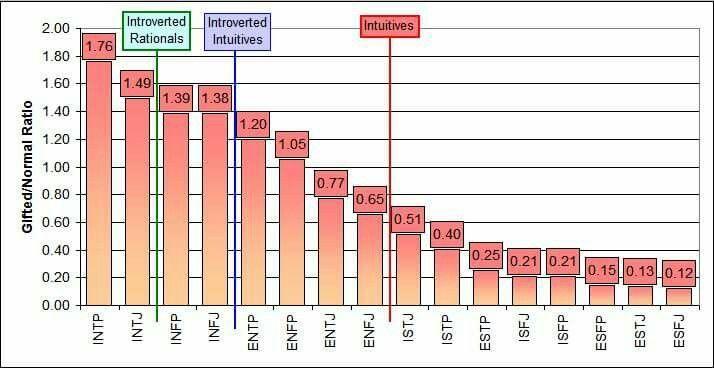
Image result for mbti and gifted

From Myers-Briggs studies some of the above traits can be accounted for:  Ns tend to be very creative (cognitive fluidity) and idealistic. It is also known that the introverted intuitives often suffer from mental problems such as social anxiety and ASD.

However, I still couldn’t account for half of the traits on the above list, so I turned to evolutionary biology.

r/K selection seems to explain a lot: highly intelligent people have faster brain growth in infancy but grow more slowly in general. My two boys (both IN types) are both quite short for their age and their skeleton is almost two years behind the average.

What in our biology could make people grow more slowly? The answer is probably buried deep in our past: hunter-gatherers grew up more slowly than later farmers and herders who had more caloric intake at their disposal. They were highly egalitarian as they couldn’t accumulate wealth and that also made them highly defiant when facing hierarchical power structures (European colonialists never really could “domesticate” hunter-gatherers).

One by one those giftedness traits began to make sense: picking eating and being highly sensitive were probably more advantageous out in the wilderness than in a farming village. Hunter-gatherers (Ns in Myers-Briggs) are also more monogamous than herders (SP in Myers-Briggs), who have the earliest onset of puberty and the shortest life span among the different early modes of subsistence (the third being farmers or SJ in Myers-Briggs). It is, therefore, no big surprise that highly intelligent people do not accentuate their gender, whereas people who inherited their personality from herders or pastoralists do so to a high degree, i.e. sexual dimorphism is diminished in hunter-gatherers as well as gifted people. Hunter-gatherers are also quite playful into adulthood, as play is used to reduce conflict among them. Farmer personalities are more serious and business-like in contrast to hunter-gatherer personalities. 

The final piece of the puzzle is trying to explain why hunter-gatherer personalities should be more intelligent than their farmer and herder counter-parts:


One explanation is that hunter-gatherers needed more cognitive fluidity and vigilance (hence the ADHD) to survive in the Savannah than farmers who had to rely far more on conscientiousness, routine and hard work. This explanation still doesn’t account for why hunter-gatherers (Ns) tend to be more intelligent on average than herders (SPs). Here the answer lies probably in natural selection. Hunter-gatherers have an out-group sociality and sharing and caring attitude. In mixed hunter-gatherer, farmer and herder societies hunter-gatherer minds who were of average intelligence probably lost out (nice guys came last) in the genetic race and there were high selective pressures on hunter-gatherer genotypes to become more intelligent. 


So, higher IQ might at the end of the day be nothing more than a protective mechanism! Just like social anxiety: if you are very open, you better have a defense shield in place! Introverted intuitives are already socially anxious by the time they go to kindergarten because they are aware they are different. By the time they are in their teens, they might be complete outcasts because they don't play power/alpha games and as they tend not to be violent they can become easy targets for bullying. The extraverted intuitives also are in danger of becoming outsiders and social phobics during their teens, unless they already have an established network with other hunter-gatherer minds. 

In modern slang, we could say that gifted kids/high IQ people with a hunter-gatherer personality run on the updated operating system “Hunter-gatherer v2.0”.


from Hacker News https://ift.tt/2nFzhyx

South Korean telcos and police to develop digital driver licences

2.jpg
Image: SK Telecom

South Korean telcos and the Korean National Police Agency have partnered up to develop a digital driver's licence service.

SK Telecom, KT, and LG Uplus will use the identification app, dubbed PASS, which is currently used for authentication in mobile financial transactions to create the new driver's licence service.

Subscribers of PASS will eventually be able to register their driver's licence on the app and receive a QR code or barcode for verification purposes.

The digital driver's licence will be accepted by police as a suitable form of identity verification, the telcos said.

The telcos are currently working with police to link their PASS database to the latter's driver's licence register. PASS currently has 25 million users and is used by subscribers from all three telcos.

The Ministry of Science and ICT has also given permission for the project to be trialled under a regulatory sandbox program.

The digital driver's licence service is expected to become available during the first quarter of 2020.

The telcos said users will keep their own private information on their smartphones and that they would only manage a  limited amount of data by applying blockchain technology.

They also have plans to expand the usability of digital licence to shared-car services as well. 

SK Telecom is currently working with Deutsche Telekom to develop a borderless blockchain ID that could be used like a passport to ease authentication processes.

Related Coverage

Personal info on nearly 5 million DoorDash users, drivers, and merchants exposed

Driver's licence numbers of approximately 100,000 'Dashers' were also accessed.

Demand for digital driving licenses soars in Brazil

The smartphone-based version of the document is available to 60 million Brazilian drivers.

Digital driver licence rollout to follow NSW election

Digital driver licences will be made available statewide following the March 2019 state election, Minister for Finance, Services and Property Victor Dominello has revealed.

Future Android versions to support Electronic IDs

Electronic IDs not expected to land in Android Q.

Why digital devices aren't responsible for employee distraction (TechRepublic)

While many people blame their distractions on digital devices, the problem is actually within the company culture.


from Latest Topic for ZDNet in... https://ift.tt/2pbUKzI

Elizabeth Warren bites back at Zuckerberg’s leaked threat to K.O. the government


Presidential candidate Senator Elizabeth Warren has responded publicly to a leaked attack on her by Facebook CEO Mark Zuckerberg, saying she won’t be bullied out of taking big tech to task for anticompetitive practices.

Warren’s subtweeting of the Facebook founder follows a leak in which the Verge obtained two hours of audio from an internal Q&A session with Zuckerberg — publishing a series of snippets today.

In one snippet the Facebook leader can be heard opining on how Warren’s plan to break up big tech would “suck”.

“You have someone like Elizabeth Warren who thinks that the right answer is to break up the companies … if she gets elected president, then I would bet that we will have a legal challenge, and I would bet that we will win the legal challenge,” he can be heard saying. “Does that still suck for us? Yeah. I mean, I don’t want to have a major lawsuit against our own government. … But look, at the end of the day, if someone’s going to try to threaten something that existential, you go to the mat and you fight.”

Warren responded soon after publication with a pithy zinger, writing on Twitter: “What would really ‘suck’ is if we don’t fix a corrupt system that lets giant companies like Facebook engage in illegal anticompetitive practices, stomp on consumer privacy rights, and repeatedly fumble their responsibility to protect our democracy.”

In a follow up tweet she added that she would not be afraid to “hold Big Tech companies like Facebook, Google and Amazon accountable”.

The Verge claims it did not obtain the leaked audio from Facebook’s PR machine. But in a public Facebook post following its publication of the audio snippets Zuckerberg links to their article — and doesn’t exactly sound mad to have what he calls his “unfiltered” views put right out there…

Whether the audio was leaked intentionally or not, as many commentators have been quick to point out — Warren principal among them — the fact that a company has gotten so vastly powerful it feels able to threaten to fight and defeat its own government should give pause for civilized thought.

Someone high up in Facebook’s PR department might want to pull Zuckerberg aside and make a major wincing gesture right in his face.

In another of the audio snippets Zuckerberg extends the threat — arguing that breaking up tech giants would threaten the integrity of elections.

“It’s just that breaking up these companies, whether it’s Facebook or Google or Amazon, is not actually going to solve the issues,” he is heard saying. “And, you know, it doesn’t make election interference less likely. It makes it more likely because now the companies can’t coordinate and work together.”

Elections such as the one Warren hopes to be running in as a US presidential candidate… so er… again this argument is a very strange one to be making when the critics you’re railing against are calling you an overbearing, oversized democracy-denting beast.

Zuckerberg’s remarks also contain the implied threat that a failure to properly police elections, by Facebook, could result in someone like Warren not actually getting elected in the first place.

Given, y’know, the vast power Facebook wields with its content-shaping algorithms which amplify narratives and shape public opinion at cheap, factory farm scale.

Reading between the lines, then, presidential hopefuls should be really careful what they say about important technology companies — or, er, else!

How times change.

Just a few short years ago Zuckerberg was the guy telling everyone that election interference via algorithmically amplified social media fakes was “a pretty crazy idea”.

Now he’s saying only tech behemoths like Facebook can save democracy from, uh, tech behemoths like Facebook…

For more on where Zuckerberg’s self-servingly circular logic leads, let’s refer to another of his public talking points: That only Facebook’s continued use of powerful, privacy-hostile AI technologies such as facial recognition can save Western society from a Chinese-style state dystopia in which the presence of your face broadcasts a social credit score for others to determine what you get to access.

This equally uncompelling piece of ‘Zuckerlogic’ sums to: ‘Don’t regulate our privacy hostile shit — or China will get to do worse shit before we can!’

So um… yeah but no.


from Hacker News https://ift.tt/2oXI6nE

Working all night is not 'a badge of pride'

Ina Kjaer and Maggie BreretonImage copyright Eos Deal Advisory
Image caption Ina Kjaer and Maggie Brereton

After years of early starts and late nights, two of KPMG's former top bosses have shunned what they call a "culture of fear" at the "big four" accountancy firms to start a rival that prides itself on keeping more sociable hours.

Maggie Brereton and Ina Kjaer each spent more than 20 years on the team that advises businesses on deals at KPMG, where it was seen as a "badge of pride" to work all night, Ms Brereton told the BBC.

"There's a traditional macho culture that pervades," she says.

"I remember doing my first 'all-nighter'," she says. "I came back into the office the next day with a swagger."

'Crazy hours'

But now, she believes those long hours aren't necessary, saying people are pulling all nighters "almost for the sake of it".

And she thinks the prospect of working those anti-social hours puts off potential employees, especially women and those with caring duties or young children.

Instead, the new firm - Eos Deal Advisory - aims to bring together a diverse team that Ms Brereton says will be better equipped to "get to the heart" of what needs to be done to get a deal over the line.

And she says that appeals to clients: "They don't necessarily want to be doing these crazy hours either."

Image copyright Getty Images

But Tamzen Isacsson, the boss of the Management Consultancies Association, which counts the big four firms among its members, says established firms are working to promote sociable hours and an inclusive culture.

"There are significant strides being made in creating a more gender balanced culture and a more inclusive culture.

"There isn't a need to create companies to deliver that - our companies are delivering that already."

Ms Isacsson says there is now a greater awareness of what is considered acceptable within companies, adding that "macho culture has been eradicated".

"What was acceptable 20 years ago is no longer acceptable and there are huge efforts - I cannot underline how heavily firms are working - to ensure that there is a much more inclusive culture where everybody can belong."

She adds that there is a "very strong and well-intentioned" drive to rebalance diversity among the leadership at firms, adding that it is "impossible" to think of an example where a company had promoted someone who behaved in a macho way.

"These firms are incredibly attractive to employees, they're hugely over-subscribed," she says. However, she notes that in order to retain and attract talent they need to offer a good salary, sociable working hours and training.

Nevertheless, Eos co-founder Ms Brereton thinks her firm will be able to attract people from the big four who are looking for a change.

"We are interviewing every day," she told the BBC, adding that they already had a list of potential clients who want to work with the new firm, which began trading this week.

Ms Brereton and Ms Kjaer resigned from KPMG in February over the firm's response to allegations of bullying.

In a statement, KPMG said: "KPMG has a strong, inclusive culture, evidenced by consistently high employee engagement scores, good retention rates and numerous awards for our role as a top employer.

"We are proud of the contribution our people make to the UK."


Do you work long hours? Do you think it's necessary to do so? Share your experiences by emailing haveyoursay@bbc.co.uk.

Please include a contact number if you are willing to speak to a BBC journalist. You can also contact us in the following ways:


from Hacker News https://ift.tt/2pc2aTy

Predictive CPU isolation of containers at Netflix using a MIP solver


Predictive CPU isolation of containers at Netflix

By Benoit Rostykus, Gabriel Hartmann

Noisy Neighbors

We’ve all had noisy neighbors at one point in our life. Whether it’s at a cafe or through a wall of an apartment, it is always disruptive. The need for good manners in shared spaces turns out to be important not just for people, but for your Docker containers too.

When you’re running in the cloud your containers are in a shared space; in particular they share the CPU’s memory hierarchy of the host instance.

Because microprocessors are so fast, computer architecture design has evolved towards adding various levels of caching between compute units and the main memory, in order to hide the latency of bringing the bits to the brains. However, the key insight here is that these caches are partially shared among the CPUs, which means that perfect performance isolation of co-hosted containers is not possible. If the container running on the core next to your container suddenly decides to fetch a lot of data from the RAM, it will inevitably result in more cache misses for you (and hence a potential performance degradation).

Linux to the rescue?

Traditionally it has been the responsibility of the operating system’s task scheduler to mitigate this performance isolation problem. In Linux, the current mainstream solution is CFS (Completely Fair Scheduler). Its goal is to assign running processes to time slices of the CPU in a “fair” way.

CFS is widely used and therefore well tested and Linux machines around the world run with reasonable performance. So why mess with it? As it turns out, for the large majority of Netflix use cases, its performance is far from optimal. Titus is Netflix’s container platform. Every month, we run millions of containers on thousands of machines on Titus, serving hundreds of internal applications and customers. These applications range from critical low-latency services powering our customer-facing video streaming service, to batch jobs for encoding or machine learning. Maintaining performance isolation between these different applications is critical to ensuring a good experience for internal and external customers.

We were able to meaningfully improve both the predictability and performance of these containers by taking some of the CPU isolation responsibility away from the operating system and moving towards a data driven solution involving combinatorial optimization and machine learning.

The idea

CFS operates by very frequently (every few microseconds) applying a set of heuristics which encapsulate a general concept of best practices around CPU hardware use.

Instead, what if we reduced the frequency of interventions (to every few seconds) but made better data-driven decisions regarding the allocation of processes to compute resources in order to minimize collocation noise?

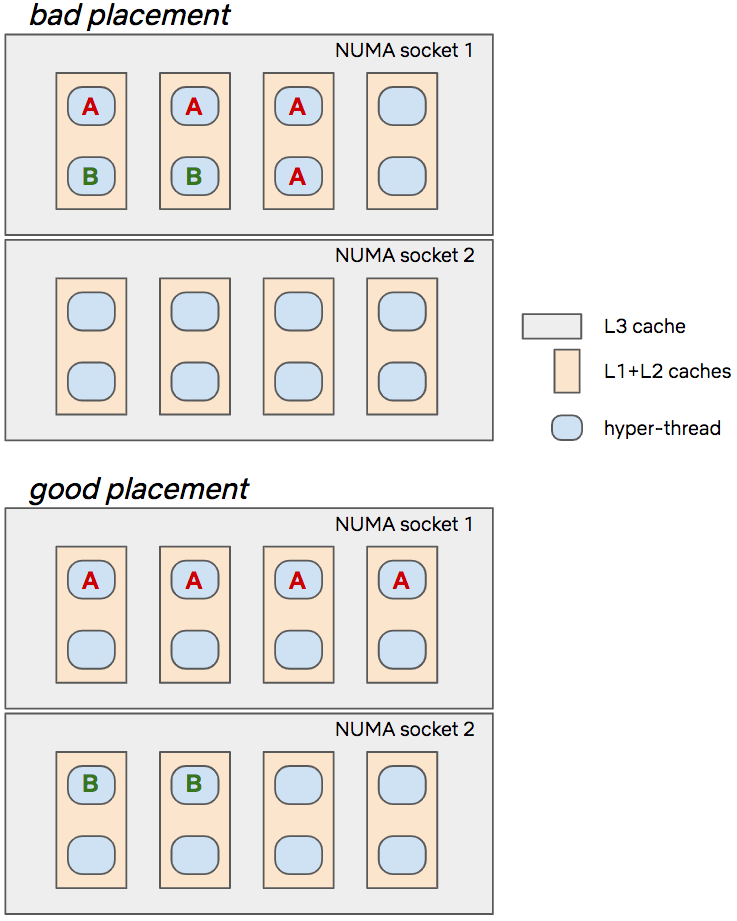
One traditional way of mitigating CFS performance issues is for application owners to manually cooperate through the use of core pinning or nice values. However, we can automatically make better global decisions by detecting collocation opportunities based on actual usage information. For example if we predict that container A is going to become very CPU intensive soon, then maybe we should run it on a different NUMA socket than container B which is very latency-sensitive. This avoids thrashing caches too much for B and evens out the pressure on the L3 caches of the machine.

Optimizing placements through combinatorial optimization

What the OS task scheduler is doing is essentially solving a resource allocation problem: I have X threads to run but only Y CPUs available, how do I allocate the threads to the CPUs to give the illusion of concurrency?

As an illustrative example, let’s consider a toy instance of 16 hyperthreads. It has 8 physical hyperthreaded cores, split on 2 NUMA sockets. Each hyperthread shares its L1 and L2 caches with its neighbor, and shares its L3 cache with the 7 other hyperthreads on the socket:

If we want to run container A on 4 threads and container B on 2 threads on this instance, we can look at what “bad” and “good” placement decisions look like:

The first placement is intuitively bad because we potentially create collocation noise between A and B on the first 2 cores through their L1/L2 caches, and on the socket through the L3 cache while leaving a whole socket empty. The second placement looks better as each CPU is given its own L1/L2 caches, and we make better use of the two L3 caches available.

Resource allocation problems can be efficiently solved through a branch of mathematics called combinatorial optimization, used for example for airline scheduling or logistics problems.

We formulate the problem as a Mixed Integer Program (MIP). Given a set of K containers each requesting a specific number of CPUs on an instance possessing d threads, the goal is to find a binary assignment matrix M of size (d, K) such that each container gets the number of CPUs it requested. The loss function and constraints contain various terms expressing a priori good placement decisions such as:

  • avoid spreading a container across multiple NUMA sockets (to avoid potentially slow cross-sockets memory accesses or page migrations)
  • don’t use hyper-threads unless you need to (to reduce L1/L2 thrashing)
  • try to even out pressure on the L3 caches (based on potential measurements of the container’s hardware usage)
  • don’t shuffle things too much between placement decisions

Given the low-latency and low-compute requirements of the system (we certainly don’t want to spend too many CPU cycles figuring out how containers should use CPU cycles!), can we actually make this work in practice?

Implementation

We decided to implement the strategy through Linux cgroups since they are fully supported by CFS, by modifying each container’s cpuset cgroup based on the desired mapping of containers to hyper-threads. In this way a user-space process defines a “fence” within which CFS operates for each container. In effect we remove the impact of CFS heuristics on performance isolation while retaining its core scheduling capabilities.

This user-space process is a Titus subsystem called titus-isolate which works as follows. On each instance, we define three events that trigger a placement optimization:

  • add: A new container was allocated by the Titus scheduler to this instance and needs to be run
  • remove: A running container just finished
  • rebalance: CPU usage may have changed in the containers so we should reevaluate our placement decisions

We periodically enqueue rebalance events when no other event has recently triggered a placement decision.

Every time a placement event is triggered, titus-isolate queries a remote optimization service (running as a Titus service, hence also isolating itself… turtles all the way down) which solves the container-to-threads placement problem.

This service then queries a local GBRT model (retrained every couple of hours on weeks of data collected from the whole Titus platform) predicting the P95 CPU usage of each container in the coming 10 minutes (conditional quantile regression). The model contains both contextual features (metadata associated with the container: who launched it, image, memory and network configuration, app name…) as well as time-series features extracted from the last hour of historical CPU usage of the container collected regularly by the host from the kernel CPU accounting controller.

The predictions are then fed into a MIP which is solved on the fly. We’re using cvxpy as a nice generic symbolic front-end to represent the problem which can then be fed into various open-source or proprietary MIP solver backends. Since MIPs are NP-hard, some care needs to be taken. We impose a hard time budget to the solver to drive the branch-and-cut strategy into a low-latency regime, with guardrails around the MIP gap to control overall quality of the solution found.

The service then returns the placement decision to the host, which executes it by modifying the cpusets of the containers.

For example, at any moment in time, an r4.16xlarge with 64 logical CPUs might look like this (the color scale represents CPU usage):

Results

The first version of the system led to surprisingly good results. We reduced overall runtime of batch jobs by multiple percent on average while most importantly reducing job runtime variance (a reasonable proxy for isolation), as illustrated below. Here we see a real-world batch job runtime distribution with and without improved isolation:

Notice how we mostly made the problem of long-running outliers disappear. The right-tail of unlucky noisy-neighbors runs is now gone.

For services, the gains were even more impressive. One specific Titus middleware service serving the Netflix streaming service saw a capacity reduction of 13% (a decrease of more than 1000 containers) needed at peak traffic to serve the same load with the required P99 latency SLA! We also noticed a sharp reduction of the CPU usage on the machines, since far less time was spent by the kernel in cache invalidation logic. Our containers are now more predictable, faster and the machine is less used! It’s not often that you can have your cake and eat it too.

Next Steps

We are excited with the strides made so far in this area. We are working on multiple fronts to extend the solution presented here.

We want to extend the system to support CPU oversubscription. Most of our users have challenges knowing how to properly size the numbers of CPUs their app needs. And in fact, this number varies during the lifetime of their containers. Since we already predict future CPU usage of the containers, we want to automatically detect and reclaim unused resources. For example, one could decide to auto-assign a specific container to a shared cgroup of underutilized CPUs, to better improve overall isolation and machine utilization, if we can detect the sensitivity threshold of our users along the various axes of the following graph.

We also want to leverage kernel PMC events to more directly optimize for minimal cache noise. One possible avenue is to use the Intel based bare metal instances recently introduced by Amazon that allow deep access to performance analysis tools. We could then feed this information directly into the optimization engine to move towards a more supervised learning approach. This would require a proper continuous randomization of the placements to collect unbiased counterfactuals, so we could build some sort of interference model (“what would be the performance of container A in the next minute, if I were to colocate one of its threads on the same core as container B, knowing that there’s also C running on the same socket right now?”).

Conclusion

If any of this piques your interest, reach out to us! We’re looking for ML engineers to help us push the boundary of containers performance and “machine learning for systems” and systems engineers for our core infrastructure and compute platform.


from Hacker News https://ift.tt/2K27KhX

You're Solving the Wrong Problem

Bilden va ofera keyword5 pentru keyword10 si keyword12, keyword16 keyword18, keyword21, keyword24, keyword27, keyword30, keyword34, keyword37, keyword40, keyword41, cupru, teava si fitinguri pp, fitinguri ppr, protectie si sudura, haine de protectie, incaltaminte de protectie, manusi, mascade protectie, sudura, accesorii scule, betoniere, bormasini, ferastraie electrice, palane si scripeti, pistoale cu aer cald, polizoare, abrazive, aschietoare, banda si role adezive, chei, ciocane, clesti, constructii si zidarie, diverse unelte, elemente de prindere, gradina, uz gradinaresc, instrumente de masurat, menghine, perii si pile, pistoale, pompe, sfoara, surubelnite, tamplarie, truse scule, unelte auto, unelte pentru taiat, unelte pentru vopsit, materiale de constructii si amenajari, materiale constructie, de constructie, depozitare materiale, mapei hidroizolatii, mapei, hidroizolati mapei, rigips, gips-carton, pvc, bca, electrice, unelte, cimente, lemn, hidroizolant, izolatii termice, panouri din policarbonat, plasa sudata, fier beton, sape, teava metalica, corniere, tabla zincata, sarma, plasa bordurata, tencuieli decorative, vopsele, grunduri, aparataj, cabluri, conductori, conectica, corpuri, iluminat, senzori de miscare, sonerii, surse de lumina, tablouri electrice, amortizoare, usa intrare, balamale, broaste, butucuri, yale, carlige, console, cutii postale, cutii pentru scule, diverse feronerie, lacat, lant, litere, cifre, maner, roti, zavor, hidrofoare, pompe, accesorii, closete, accesorii, diverse instalatii sanitare, fitinguri, fitinguri fonta, radiatoare, hidroizolatii, mapei, hidroizolati mapei, rigips, gips-carton, pvc, bca, electrice, unelte, cimente, lemn


from Hacker News https://ift.tt/mI3hiI

Radio Tecnico: How the Zetas Cartel Took over Mexico with Walkie-Talkies


Project Reckoning, authorities proclaimed, had dealt La Compañia’s business a “substantial blow.” The DEA’s Pike likened it to taking out 64 cartel-owned Walmarts. And once all the doors had been kicked in, the haul was indeed staggering: $90 million in cash, 61 tons of narcotics, and enough weapons to equip an insurgency. Among the 900 people rounded up across the U.S. and Mexico, the Justice Department indicted dealers, transporters, money counters, teen gangsters, and even the owner of a Quiznos franchise. One of those swept up in the net was a 37-year-old resident of McAllen, Texas, named Jose Luis Del Toro Estrada. He seemed, at first, not particularly significant—a luckless guppy caught swimming with sharks. His arrest barely warranted mention in the local paper. His house, a well-maintained white-brick rancher with an arbor of pink flowers over the front door, contained no cocaine or caches of AK-47s. He lacked an extensive rap sheet and in fact seemed to have no criminal record at all. On the outskirts of McAllen, he ran a small, nondescript shop that installed car alarms and sold two-way radios.


from Hacker News https://ift.tt/2mJecTE